

Synchrotron Motion
255
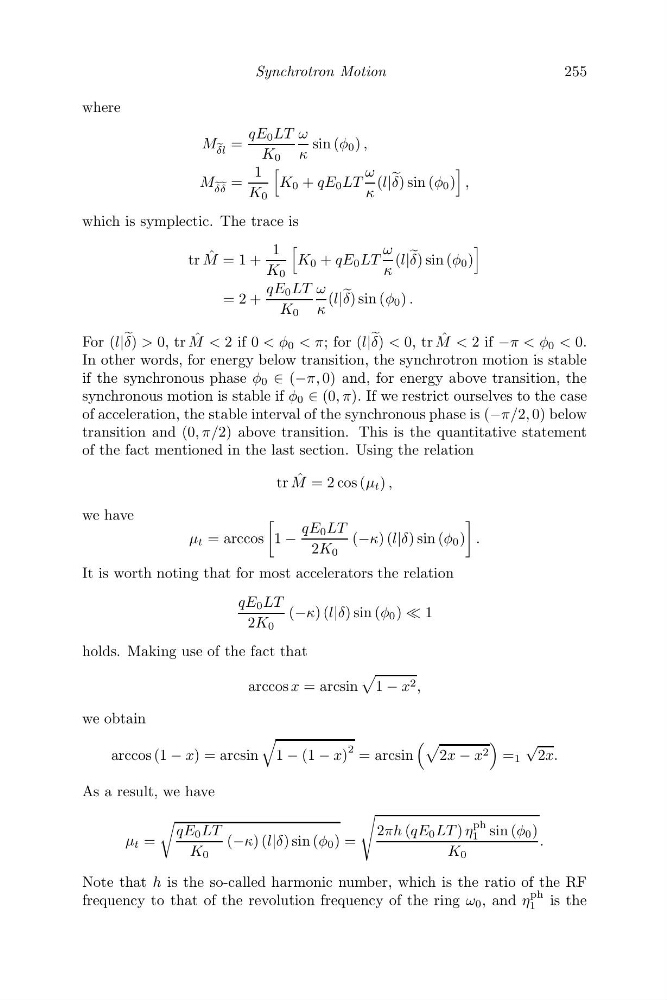
where
M
δl =
qE 0 LT
K 0
ω
κ
sin (φ 0 ) ,
M
δ δ =
1
K 0
K 0 + qE 0 LT
ω
κ
(l|
δ) sin (φ 0 )
,
which is symplectic. The trace is
tr ˆ
M = 1 +
1
K 0
K 0 + qE 0 LT
ω
κ
(l|
δ) sin (φ 0 )
= 2 +
qE 0 LT
K 0
ω
κ
(l|
δ) sin (φ 0 ) .
For (l|
δ) > 0, tr ˆ
M < 2 if 0 < φ 0 < π; for (l|
δ) < 0, tr ˆ
M < 2 if −π < φ 0 < 0.
In other words, for energy below transition, the synchrotron motion is stable
if the synchronous phase φ 0 ∈ (−π, 0) and, for energy above transition, the
synchronous motion is stable if φ 0 ∈ (0, π). If we restrict ourselves to the case
of acceleration, the stable interval of the synchronous phase is (−π/2, 0) below
transition and (0, π/2) above transition. This is the quantitative statement
of the fact mentioned in the last section. Using the relation
tr ˆ
M = 2 cos (μ t ) ,
we have
μ t = arccos
1 −
qE 0 LT
2K 0
(−κ) (l|δ) sin (φ 0 )
.
It is worth noting that for most accelerators the relation
qE 0 LT
2K 0
(−κ) (l|δ) sin (φ 0 ) 1
holds. Making use of the fact that
arccos x = arcsin
1 − x 2 ,
we obtain
arccos (1 − x) = arcsin
1 − (1 − x)
2 = arcsin
2x − x 2
= 1
√
2x.
As a result, we have
μ t =
qE 0 LT
K 0
(−κ) (l|δ) sin (φ 0 ) =
2πh (qE 0 LT ) η
ph
1 sin (φ 0 )
K 0
.
Note that h is the so-called harmonic number, which is the ratio of the RF
frequency to that of the revolution frequency of the ring ω 0 , and η
ph
1 is the
255
where
M
δl =
qE 0 LT
K 0
ω
κ
sin (φ 0 ) ,
M
δ δ =
1
K 0
K 0 + qE 0 LT
ω
κ
(l|
δ) sin (φ 0 )
,
which is symplectic. The trace is
tr ˆ
M = 1 +
1
K 0
K 0 + qE 0 LT
ω
κ
(l|
δ) sin (φ 0 )
= 2 +
qE 0 LT
K 0
ω
κ
(l|
δ) sin (φ 0 ) .
For (l|
δ) > 0, tr ˆ
M < 2 if 0 < φ 0 < π; for (l|
δ) < 0, tr ˆ
M < 2 if −π < φ 0 < 0.
In other words, for energy below transition, the synchrotron motion is stable
if the synchronous phase φ 0 ∈ (−π, 0) and, for energy above transition, the
synchronous motion is stable if φ 0 ∈ (0, π). If we restrict ourselves to the case
of acceleration, the stable interval of the synchronous phase is (−π/2, 0) below
transition and (0, π/2) above transition. This is the quantitative statement
of the fact mentioned in the last section. Using the relation
tr ˆ
M = 2 cos (μ t ) ,
we have
μ t = arccos
1 −
qE 0 LT
2K 0
(−κ) (l|δ) sin (φ 0 )
.
It is worth noting that for most accelerators the relation
qE 0 LT
2K 0
(−κ) (l|δ) sin (φ 0 ) 1
holds. Making use of the fact that
arccos x = arcsin
1 − x 2 ,
we obtain
arccos (1 − x) = arcsin
1 − (1 − x)
2 = arcsin
2x − x 2
= 1
√
2x.
As a result, we have
μ t =
qE 0 LT
K 0
(−κ) (l|δ) sin (φ 0 ) =
2πh (qE 0 LT ) η
ph
1 sin (φ 0 )
K 0
.
Note that h is the so-called harmonic number, which is the ratio of the RF
frequency to that of the revolution frequency of the ring ω 0 , and η
ph
1 is the