

Synchrotron Motion
253
As shown in Section 10.1, the transverse focusing is negligible. Together with
the fact that the change of velocity is insignificant, the cavity is simply a drift
space for the variable x, a, y, b and l. As a result, we can treat the cavity as
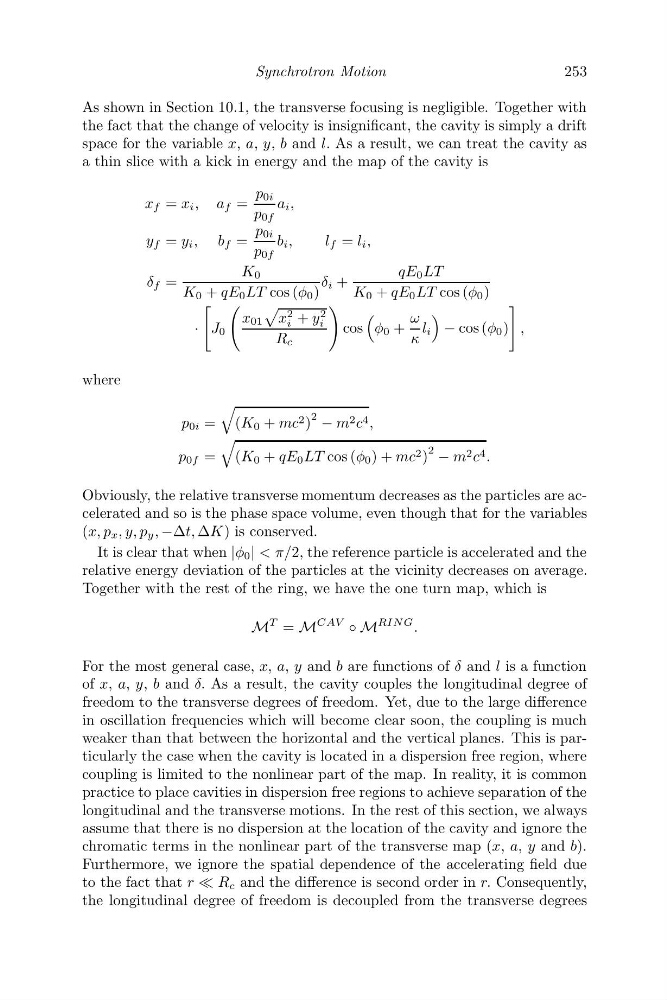
a thin slice with a kick in energy and the map of the cavity is
x f = x i , a f =
p 0i
p 0f
a i ,
y f = y i , b f =
p 0i
p 0f
b i ,
l f = l i ,
δ f =
K 0
K 0 + qE 0 LT cos (φ 0 )
δ i +
qE 0 LT
K 0 + qE 0 LT cos (φ 0 )
·
J 0
x 01
x 2
i + y 2
i
R c
cos
φ 0 +
ω
κ
l i
− cos (φ 0 )
,
where
p 0i =
(K 0 + mc 2 )
2 − m 2 c 4 ,
p 0f =
(K 0 + qE 0 LT cos (φ 0 ) + mc 2 )
2 − m 2 c 4 .
Obviously, the relative transverse momentum decreases as the particles are accelerated and so is the phase space volume, even though that for the variables
(x, p x , y, p y , −Δt, ΔK) is conserved.
It is clear that when |φ 0 | < π/2, the reference particle is accelerated and the
relative energy deviation of the particles at the vicinity decreases on average.
Together with the rest of the ring, we have the one turn map, which is
M
T = M
CAV
◦ M
RIN G .
For the most general case, x, a, y and b are functions of δ and l is a function
of x, a, y, b and δ. As a result, the cavity couples the longitudinal degree of
freedom to the transverse degrees of freedom. Yet, due to the large difference
in oscillation frequencies which will become clear soon, the coupling is much
weaker than that between the horizontal and the vertical planes. This is particularly the case when the cavity is located in a dispersion free region, where
coupling is limited to the nonlinear part of the map. In reality, it is common
practice to place cavities in dispersion free regions to achieve separation of the
longitudinal and the transverse motions. In the rest of this section, we always
assume that there is no dispersion at the location of the cavity and ignore the
chromatic terms in the nonlinear part of the transverse map (x, a, y and b).
Furthermore, we ignore the spatial dependence of the accelerating field due
to the fact that r R c and the difference is second order in r. Consequently,
the longitudinal degree of freedom is decoupled from the transverse degrees
253
As shown in Section 10.1, the transverse focusing is negligible. Together with
the fact that the change of velocity is insignificant, the cavity is simply a drift
space for the variable x, a, y, b and l. As a result, we can treat the cavity as
a thin slice with a kick in energy and the map of the cavity is
x f = x i , a f =
p 0i
p 0f
a i ,
y f = y i , b f =
p 0i
p 0f
b i ,
l f = l i ,
δ f =
K 0
K 0 + qE 0 LT cos (φ 0 )
δ i +
qE 0 LT
K 0 + qE 0 LT cos (φ 0 )
·
J 0
x 01
x 2
i + y 2
i
R c
cos
φ 0 +
ω
κ
l i
− cos (φ 0 )
,
where
p 0i =
(K 0 + mc 2 )
2 − m 2 c 4 ,
p 0f =
(K 0 + qE 0 LT cos (φ 0 ) + mc 2 )
2 − m 2 c 4 .
Obviously, the relative transverse momentum decreases as the particles are accelerated and so is the phase space volume, even though that for the variables
(x, p x , y, p y , −Δt, ΔK) is conserved.
It is clear that when |φ 0 | < π/2, the reference particle is accelerated and the
relative energy deviation of the particles at the vicinity decreases on average.
Together with the rest of the ring, we have the one turn map, which is
M
T = M
CAV
◦ M
RIN G .
For the most general case, x, a, y and b are functions of δ and l is a function
of x, a, y, b and δ. As a result, the cavity couples the longitudinal degree of
freedom to the transverse degrees of freedom. Yet, due to the large difference
in oscillation frequencies which will become clear soon, the coupling is much
weaker than that between the horizontal and the vertical planes. This is particularly the case when the cavity is located in a dispersion free region, where
coupling is limited to the nonlinear part of the map. In reality, it is common
practice to place cavities in dispersion free regions to achieve separation of the
longitudinal and the transverse motions. In the rest of this section, we always
assume that there is no dispersion at the location of the cavity and ignore the
chromatic terms in the nonlinear part of the transverse map (x, a, y and b).
Furthermore, we ignore the spatial dependence of the accelerating field due
to the fact that r R c and the difference is second order in r. Consequently,
the longitudinal degree of freedom is decoupled from the transverse degrees