

244
An Introduction to Beam Physics
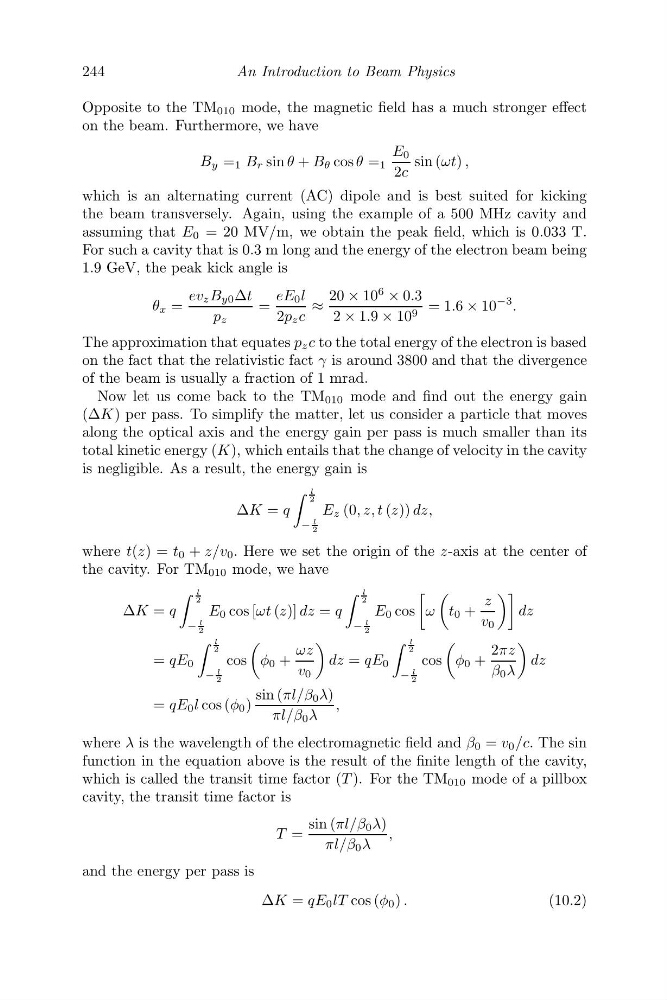
Opposite to the TM 010 mode, the magnetic field has a much stronger effect
on the beam. Furthermore, we have
B y = 1 B r sin θ + B θ cos θ = 1
E 0
2c
sin (ωt) ,
which is an alternating current (AC) dipole and is best suited for kicking
the beam transversely. Again, using the example of a 500 MHz cavity and
assuming that E 0 = 20 MV/m, we obtain the peak field, which is 0.033 T.
For such a cavity that is 0.3 m long and the energy of the electron beam being
1.9 GeV, the peak kick angle is
θ x =
ev z B y0 Δt
p z
=
eE 0 l
2p z c
≈
20 × 10
6
× 0.3
2 × 1.9 × 10 9 = 1.6 × 10
−3 .
The approximation that equates p z c to the total energy of the electron is based
on the fact that the relativistic fact γ is around 3800 and that the divergence
of the beam is usually a fraction of 1 mrad.
Now let us come back to the TM 010 mode and find out the energy gain
(ΔK) per pass. To simplify the matter, let us consider a particle that moves
along the optical axis and the energy gain per pass is much smaller than its
total kinetic energy (K), which entails that the change of velocity in the cavity
is negligible. As a result, the energy gain is
ΔK = q
l
2
−
l
2
E z (0, z, t (z)) dz,
where t(z) = t 0 + z/v 0 . Here we set the origin of the z-axis at the center of
the cavity. For TM 010 mode, we have
ΔK = q
l
2
−
l
2
E 0 cos [ωt (z)] dz = q
l
2
−
l
2
E 0 cos
ω
t 0 +
z
v 0
dz
= qE 0
l
2
−
l
2
cos
φ 0 +
ωz
v 0
dz = qE 0
l
2
−
l
2
cos
φ 0 +
2πz
β 0 λ
dz
= qE 0 l cos (φ 0 )
sin (πl/β 0 λ)
πl/β 0 λ
,
where λ is the wavelength of the electromagnetic field and β 0 = v 0 /c. The sin
function in the equation above is the result of the finite length of the cavity,
which is called the transit time factor (T ). For the TM 010 mode of a pillbox
cavity, the transit time factor is
T =
sin (πl/β 0 λ)
πl/β 0 λ
,
and the energy per pass is
ΔK = qE 0 lT cos (φ 0 ) .
(10.2)
An Introduction to Beam Physics
Opposite to the TM 010 mode, the magnetic field has a much stronger effect
on the beam. Furthermore, we have
B y = 1 B r sin θ + B θ cos θ = 1
E 0
2c
sin (ωt) ,
which is an alternating current (AC) dipole and is best suited for kicking
the beam transversely. Again, using the example of a 500 MHz cavity and
assuming that E 0 = 20 MV/m, we obtain the peak field, which is 0.033 T.
For such a cavity that is 0.3 m long and the energy of the electron beam being
1.9 GeV, the peak kick angle is
θ x =
ev z B y0 Δt
p z
=
eE 0 l
2p z c
≈
20 × 10
6
× 0.3
2 × 1.9 × 10 9 = 1.6 × 10
−3 .
The approximation that equates p z c to the total energy of the electron is based
on the fact that the relativistic fact γ is around 3800 and that the divergence
of the beam is usually a fraction of 1 mrad.
Now let us come back to the TM 010 mode and find out the energy gain
(ΔK) per pass. To simplify the matter, let us consider a particle that moves
along the optical axis and the energy gain per pass is much smaller than its
total kinetic energy (K), which entails that the change of velocity in the cavity
is negligible. As a result, the energy gain is
ΔK = q
l
2
−
l
2
E z (0, z, t (z)) dz,
where t(z) = t 0 + z/v 0 . Here we set the origin of the z-axis at the center of
the cavity. For TM 010 mode, we have
ΔK = q
l
2
−
l
2
E 0 cos [ωt (z)] dz = q
l
2
−
l
2
E 0 cos
ω
t 0 +
z
v 0
dz
= qE 0
l
2
−
l
2
cos
φ 0 +
ωz
v 0
dz = qE 0
l
2
−
l
2
cos
φ 0 +
2πz
β 0 λ
dz
= qE 0 l cos (φ 0 )
sin (πl/β 0 λ)
πl/β 0 λ
,
where λ is the wavelength of the electromagnetic field and β 0 = v 0 /c. The sin
function in the equation above is the result of the finite length of the cavity,
which is called the transit time factor (T ). For the TM 010 mode of a pillbox
cavity, the transit time factor is
T =
sin (πl/β 0 λ)
πl/β 0 λ
,
and the energy per pass is
ΔK = qE 0 lT cos (φ 0 ) .
(10.2)