

242
An Introduction to Beam Physics
0.5
1
1.5
2.0
x 01
0
0.5
1.0
0.5
1
1.5
2.0
x 01
0
0.2
0.4
0.6
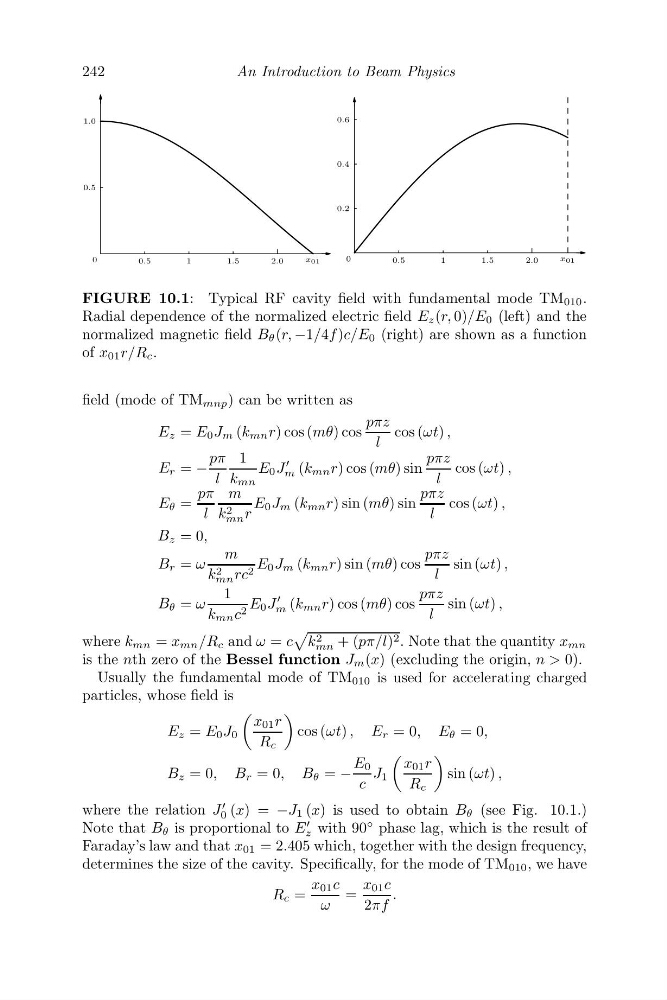
FIGURE 10.1: Typical RF cavity field with fundamental mode TM 010 .
Radial dependence of the normalized electric field E z (r, 0)/E 0 (left) and the
normalized magnetic field B θ (r, −1/4f )c/E 0 (right) are shown as a function
of x 01 r/R c .
field (mode of TM mnp ) can be written as
E z = E 0 J m (k mn r) cos (mθ) cos
pπz
l
cos (ωt) ,
E r = −
pπ
l
1
k mn
E 0 J
m (k mn r) cos (mθ) sin
pπz
l
cos (ωt) ,
E θ =
pπ
l
m
k 2
mn r
E 0 J m (k mn r) sin (mθ) sin
pπz
l
cos (ωt) ,
B z = 0,
B r = ω
m
k 2
mn rc 2 E 0 J m (k mn r) sin (mθ) cos
pπz
l
sin (ωt) ,
B θ = ω
1
k mn c 2 E 0 J
m (k mn r) cos (mθ) cos
pπz
l
sin (ωt) ,
where k mn = x mn /R c and ω = c
k 2
mn + (pπ/l) 2 . Note that the quantity x mn
is the nth zero of the Bessel function J m (x) (excluding the origin, n > 0).
Usually the fundamental mode of TM 010 is used for accelerating charged
particles, whose field is
E z = E 0 J 0
x 01 r
R c
cos (ωt) , E r = 0, E θ = 0,
B z = 0, B r = 0, B θ = −
E 0
c
J 1
x 01 r
R c
sin (ωt) ,
where the relation J
0 (x) = −J 1 (x) is used to obtain B θ (see Fig. 10.1.)
Note that B θ is proportional to E
z with 90
◦ phase lag, which is the result of
Faraday’s law and that x 01 = 2.405 which, together with the design frequency,
determines the size of the cavity. Specifically, for the mode of TM 010 , we have
R c =
x 01 c
ω
=
x 01 c
2πf
.
An Introduction to Beam Physics
0.5
1
1.5
2.0
x 01
0
0.5
1.0
0.5
1
1.5
2.0
x 01
0
0.2
0.4
0.6
FIGURE 10.1: Typical RF cavity field with fundamental mode TM 010 .
Radial dependence of the normalized electric field E z (r, 0)/E 0 (left) and the
normalized magnetic field B θ (r, −1/4f )c/E 0 (right) are shown as a function
of x 01 r/R c .
field (mode of TM mnp ) can be written as
E z = E 0 J m (k mn r) cos (mθ) cos
pπz
l
cos (ωt) ,
E r = −
pπ
l
1
k mn
E 0 J
m (k mn r) cos (mθ) sin
pπz
l
cos (ωt) ,
E θ =
pπ
l
m
k 2
mn r
E 0 J m (k mn r) sin (mθ) sin
pπz
l
cos (ωt) ,
B z = 0,
B r = ω
m
k 2
mn rc 2 E 0 J m (k mn r) sin (mθ) cos
pπz
l
sin (ωt) ,
B θ = ω
1
k mn c 2 E 0 J
m (k mn r) cos (mθ) cos
pπz
l
sin (ωt) ,
where k mn = x mn /R c and ω = c
k 2
mn + (pπ/l) 2 . Note that the quantity x mn
is the nth zero of the Bessel function J m (x) (excluding the origin, n > 0).
Usually the fundamental mode of TM 010 is used for accelerating charged
particles, whose field is
E z = E 0 J 0
x 01 r
R c
cos (ωt) , E r = 0, E θ = 0,
B z = 0, B r = 0, B θ = −
E 0
c
J 1
x 01 r
R c
sin (ωt) ,
where the relation J
0 (x) = −J 1 (x) is used to obtain B θ (see Fig. 10.1.)
Note that B θ is proportional to E
z with 90
◦ phase lag, which is the result of
Faraday’s law and that x 01 = 2.405 which, together with the design frequency,
determines the size of the cavity. Specifically, for the mode of TM 010 , we have
R c =
x 01 c
ω
=
x 01 c
2πf
.