

234
An Introduction to Beam Physics
= (D 1 , D
1 )
γ 1 α 1
α 1 β 1
D 1
D
1
+ (D 1 , D
1 )
(x|x) 12 (a|x) 12
(x|a) 12 (a|a) 12
γ 2 α 2
α 2 β 2
(x|δ) 12
(a|δ) 12
+ ((x|δ) 12 , (a|δ) 12 )
γ 2 α 2
α 2 β 2
(x|x) 12 (x|a) 12
(a|x) 12 (a|a) 12
D 1
D
1
+ ((x|δ) 12 , (a|δ) 12 )
γ 2 α 2
α 2 β 2
(x|δ) 12
(a|δ) 12
.
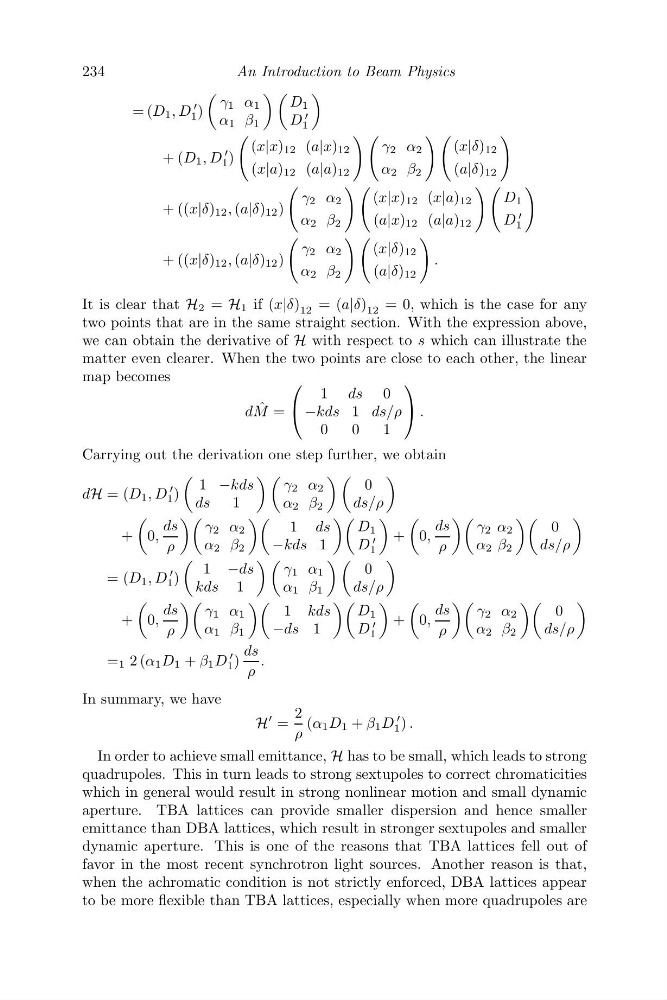
It is clear that H 2 = H 1 if (x|δ) 12 = (a|δ) 12 = 0, which is the case for any
two points that are in the same straight section. With the expression above,
we can obtain the derivative of H with respect to s which can illustrate the
matter even clearer. When the two points are close to each other, the linear
map becomes
d ˆ
M =
⎛
⎝
1 ds 0
−kds 1 ds/ρ
0
0
1
⎞
⎠ .
Carrying out the derivation one step further, we obtain
dH = (D 1 , D
1 )
1 −kds
ds 1
γ 2 α 2
α 2 β 2
0
ds/ρ
+
0,
ds
ρ
γ 2 α 2
α 2 β 2
1 ds
−kds 1
D 1
D
1
+
0,
ds
ρ
γ 2 α 2
α 2 β 2
0
ds/ρ
= (D 1 , D
1 )
1 −ds
kds 1
γ 1 α 1
α 1 β 1
0
ds/ρ
+
0,
ds
ρ
γ 1 α 1
α 1 β 1
1 kds
−ds 1
D 1
D
1
+
0,
ds
ρ
γ 2 α 2
α 2 β 2
0
ds/ρ
= 1 2 (α 1 D 1 + β 1 D
1 )
ds
ρ
.
In summary, we have
H
=
2
ρ
(α 1 D 1 + β 1 D
1 ) .
In order to achieve small emittance, H has to be small, which leads to strong
quadrupoles. This in turn leads to strong sextupoles to correct chromaticities
which in general would result in strong nonlinear motion and small dynamic
aperture. TBA lattices can provide smaller dispersion and hence smaller
emittance than DBA lattices, which result in stronger sextupoles and smaller
dynamic aperture. This is one of the reasons that TBA lattices fell out of
favor in the most recent synchrotron light sources. Another reason is that,
when the achromatic condition is not strictly enforced, DBA lattices appear
to be more flexible than TBA lattices, especially when more quadrupoles are
An Introduction to Beam Physics
= (D 1 , D
1 )
γ 1 α 1
α 1 β 1
D 1
D
1
+ (D 1 , D
1 )
(x|x) 12 (a|x) 12
(x|a) 12 (a|a) 12
γ 2 α 2
α 2 β 2
(x|δ) 12
(a|δ) 12
+ ((x|δ) 12 , (a|δ) 12 )
γ 2 α 2
α 2 β 2
(x|x) 12 (x|a) 12
(a|x) 12 (a|a) 12
D 1
D
1
+ ((x|δ) 12 , (a|δ) 12 )
γ 2 α 2
α 2 β 2
(x|δ) 12
(a|δ) 12
.
It is clear that H 2 = H 1 if (x|δ) 12 = (a|δ) 12 = 0, which is the case for any
two points that are in the same straight section. With the expression above,
we can obtain the derivative of H with respect to s which can illustrate the
matter even clearer. When the two points are close to each other, the linear
map becomes
d ˆ
M =
⎛
⎝
1 ds 0
−kds 1 ds/ρ
0
0
1
⎞
⎠ .
Carrying out the derivation one step further, we obtain
dH = (D 1 , D
1 )
1 −kds
ds 1
γ 2 α 2
α 2 β 2
0
ds/ρ
+
0,
ds
ρ
γ 2 α 2
α 2 β 2
1 ds
−kds 1
D 1
D
1
+
0,
ds
ρ
γ 2 α 2
α 2 β 2
0
ds/ρ
= (D 1 , D
1 )
1 −ds
kds 1
γ 1 α 1
α 1 β 1
0
ds/ρ
+
0,
ds
ρ
γ 1 α 1
α 1 β 1
1 kds
−ds 1
D 1
D
1
+
0,
ds
ρ
γ 2 α 2
α 2 β 2
0
ds/ρ
= 1 2 (α 1 D 1 + β 1 D
1 )
ds
ρ
.
In summary, we have
H
=
2
ρ
(α 1 D 1 + β 1 D
1 ) .
In order to achieve small emittance, H has to be small, which leads to strong
quadrupoles. This in turn leads to strong sextupoles to correct chromaticities
which in general would result in strong nonlinear motion and small dynamic
aperture. TBA lattices can provide smaller dispersion and hence smaller
emittance than DBA lattices, which result in stronger sextupoles and smaller
dynamic aperture. This is one of the reasons that TBA lattices fell out of
favor in the most recent synchrotron light sources. Another reason is that,
when the achromatic condition is not strictly enforced, DBA lattices appear
to be more flexible than TBA lattices, especially when more quadrupoles are