

Lattice Modules
227
than five), a synchrotron light source usually supports tens and sometimes
more than a hundred experiments with the circumference of the ring only
a fraction of the high energy counterpart. Furthermore, insertion devices
(wigglers and undulators) have become the main source of light, as opposed
to bend magnets. These requirements result in a ring divided into many
sections (usually identical ones) with long straight sections in between where
dispersion is either zero or small. Apparently FODO cells plus dispersion
suppressors are not well suited for this kind of ring. The solution has been
mirror symmetric achromatic sections with relatively long straight sections at
the ends.
Before going into the details of the lattice modules, let us first look into
the general properties of a mirror symmetric cell. Mirror symmetry here is
referred to as the symmetry between the cell and its mirror image of the x-y
plane. In other words, a mirror symmetric cell means that the optical elements
of the cell are symmetric about the center, both in terms of geometry and the
excitation of the fields. For example, a quadrupole is mirror symmetric and
a sector bend is mirror symmetric, too. When a cell is mirror symmetric, the
map of the cell is the same as that of its mirror image. To obtain the map of
the mirror image cell, we observe that a particle that enters the mirror image
cell with (x f , −a f , y f , −b f ) exits it with (x i , −a i , y i , −b i ), where (x i , a i , y i , b i )
and (x f , a f , y f , b f ) are the entrance and exit coordinates of the transverse
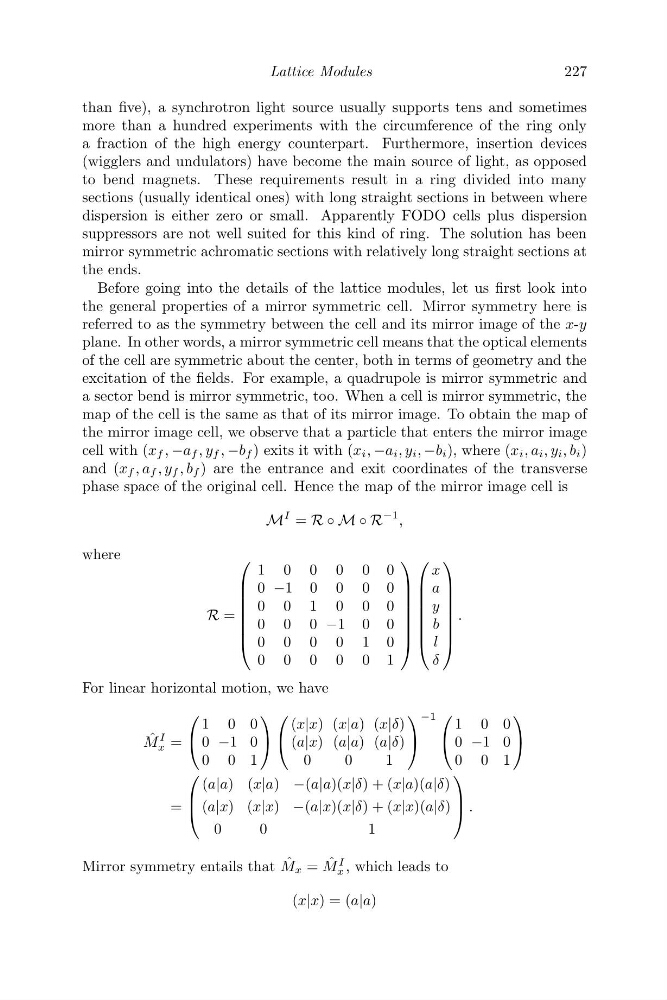
phase space of the original cell. Hence the map of the mirror image cell is
M
I = R ◦ M ◦ R
−1 ,
where
R =
⎛
⎜
⎜
⎜
⎜
⎜
⎜
⎝
1 0 0 0 0 0
0 −1 0 0 0 0
0 0 1 0 0 0
0 0 0 −1 0 0
0 0 0 0 1 0
0 0 0 0 0 1
⎞
⎟
⎟
⎟
⎟
⎟
⎟
⎠
⎛
⎜
⎜
⎜
⎜
⎜
⎜
⎝
x
a
y
b
l
δ
⎞
⎟
⎟
⎟
⎟
⎟
⎟
⎠
.
For linear horizontal motion, we have
ˆ
M
I
x =
⎛
⎝
1 0 0
0 −1 0
0 0 1
⎞
⎠
⎛
⎝
(x|x) (x|a) (x|δ)
(a|x) (a|a) (a|δ)
0
0
1
⎞
⎠
−1 ⎛
⎝
1 0 0
0 −1 0
0 0 1
⎞
⎠
=
⎛
⎜
⎝
(a|a) (x|a) −(a|a)(x|δ) + (x|a)(a|δ)
(a|x) (x|x) −(a|x)(x|δ) + (x|x)(a|δ)
0
0
1
⎞
⎟
⎠ .
Mirror symmetry entails that ˆ
M x = ˆ
M
I
x , which leads to
(x|x) = (a|a)
227
than five), a synchrotron light source usually supports tens and sometimes
more than a hundred experiments with the circumference of the ring only
a fraction of the high energy counterpart. Furthermore, insertion devices
(wigglers and undulators) have become the main source of light, as opposed
to bend magnets. These requirements result in a ring divided into many
sections (usually identical ones) with long straight sections in between where
dispersion is either zero or small. Apparently FODO cells plus dispersion
suppressors are not well suited for this kind of ring. The solution has been
mirror symmetric achromatic sections with relatively long straight sections at
the ends.
Before going into the details of the lattice modules, let us first look into
the general properties of a mirror symmetric cell. Mirror symmetry here is
referred to as the symmetry between the cell and its mirror image of the x-y
plane. In other words, a mirror symmetric cell means that the optical elements
of the cell are symmetric about the center, both in terms of geometry and the
excitation of the fields. For example, a quadrupole is mirror symmetric and
a sector bend is mirror symmetric, too. When a cell is mirror symmetric, the
map of the cell is the same as that of its mirror image. To obtain the map of
the mirror image cell, we observe that a particle that enters the mirror image
cell with (x f , −a f , y f , −b f ) exits it with (x i , −a i , y i , −b i ), where (x i , a i , y i , b i )
and (x f , a f , y f , b f ) are the entrance and exit coordinates of the transverse
phase space of the original cell. Hence the map of the mirror image cell is
M
I = R ◦ M ◦ R
−1 ,
where
R =
⎛
⎜
⎜
⎜
⎜
⎜
⎜
⎝
1 0 0 0 0 0
0 −1 0 0 0 0
0 0 1 0 0 0
0 0 0 −1 0 0
0 0 0 0 1 0
0 0 0 0 0 1
⎞
⎟
⎟
⎟
⎟
⎟
⎟
⎠
⎛
⎜
⎜
⎜
⎜
⎜
⎜
⎝
x
a
y
b
l
δ
⎞
⎟
⎟
⎟
⎟
⎟
⎟
⎠
.
For linear horizontal motion, we have
ˆ
M
I
x =
⎛
⎝
1 0 0
0 −1 0
0 0 1
⎞
⎠
⎛
⎝
(x|x) (x|a) (x|δ)
(a|x) (a|a) (a|δ)
0
0
1
⎞
⎠
−1 ⎛
⎝
1 0 0
0 −1 0
0 0 1
⎞
⎠
=
⎛
⎜
⎝
(a|a) (x|a) −(a|a)(x|δ) + (x|a)(a|δ)
(a|x) (x|x) −(a|x)(x|δ) + (x|x)(a|δ)
0
0
1
⎞
⎟
⎠ .
Mirror symmetry entails that ˆ
M x = ˆ
M
I
x , which leads to
(x|x) = (a|a)