

224
An Introduction to Beam Physics
and
ξ y =
T y,bδ .
The simplest of such a second order achromat consists of four FODO cells
with μ x = μ y = π/2 and two families of sextupoles correcting the chromaticities.
9.1.2 The Dispersion Suppressor
As it become clear shortly, an achromat of n identical cells is not optimal
in terms of minimizing D max . Let us consider half of an achromat,
ˆ
M =
− ˆ
I
d
0 1
.
For an n cell achromat, D, D
at the center are
⎛
⎝
D
D
1
⎞
⎠ =
⎛
⎝
−1 0 d
0 −1 d
0 0 1
⎞
⎠
⎛
⎝
0
0
1
⎞
⎠ =
⎛
⎝
d
d
1
⎞
⎠ ,
whereas the periodic solution is
⎛
⎝
D
D
1
⎞
⎠ =
⎛
⎝
−1 0 d
0 −1 d
0 0 1
⎞
⎠
⎛
⎝
D
D
1
⎞
⎠ .
=⇒ D =
d
2
, D
=
d
2
.
Obviously the dispersion at the center of the achromat is twice that of the
periodic solution of a cell. There is a module called dispersion suppressor
which makes the whole section an achromat while maintaining the periodic
solution in the regular cells. It takes advantage of the fact that dipoles, especially when θ is small, affect only the dispersion, not focusing. A dispersion
suppressor consists of two FODO cells which are the same as the standard
cells except for the bending angle. Two free parameters, or “knobs,” such
as the the bending angles can fulfill the two conditions needed to obtain an
achromat.
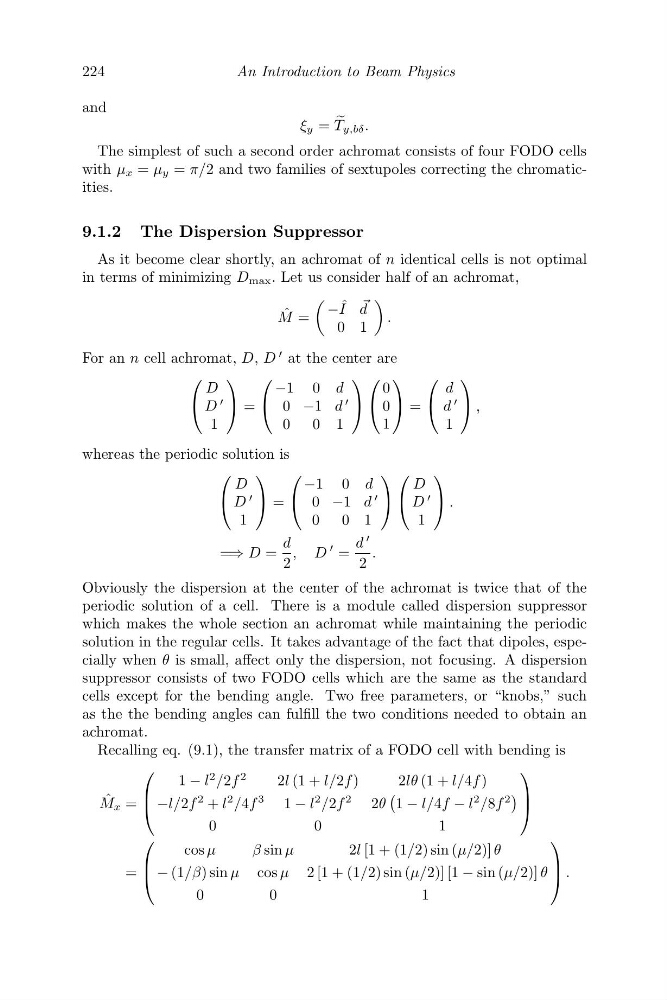
Recalling eq. (9.1), the transfer matrix of a FODO cell with bending is
ˆ
M x =
⎛
⎜
⎝
1 − l
2 /2f
2
2l (1 + l/2f )
2lθ (1 + l/4f )
−l/2f
2 + l
2 /4f
3
1 − l
2 /2f
2
2θ
1 − l/4f − l
2 /8f
2
0
0
1
⎞
⎟
⎠
=
⎛
⎜
⎝
cos μ
βsin μ
2l [1 + (1/2) sin (μ/2)] θ
− (1/β) sin μ cos μ 2 [1 + (1/2) sin (μ/2)] [1 − sin (μ/2)] θ
0
0
1
⎞
⎟
⎠ .
An Introduction to Beam Physics
and
ξ y =
T y,bδ .
The simplest of such a second order achromat consists of four FODO cells
with μ x = μ y = π/2 and two families of sextupoles correcting the chromaticities.
9.1.2 The Dispersion Suppressor
As it become clear shortly, an achromat of n identical cells is not optimal
in terms of minimizing D max . Let us consider half of an achromat,
ˆ
M =
− ˆ
I
d
0 1
.
For an n cell achromat, D, D
at the center are
⎛
⎝
D
D
1
⎞
⎠ =
⎛
⎝
−1 0 d
0 −1 d
0 0 1
⎞
⎠
⎛
⎝
0
0
1
⎞
⎠ =
⎛
⎝
d
d
1
⎞
⎠ ,
whereas the periodic solution is
⎛
⎝
D
D
1
⎞
⎠ =
⎛
⎝
−1 0 d
0 −1 d
0 0 1
⎞
⎠
⎛
⎝
D
D
1
⎞
⎠ .
=⇒ D =
d
2
, D
=
d
2
.
Obviously the dispersion at the center of the achromat is twice that of the
periodic solution of a cell. There is a module called dispersion suppressor
which makes the whole section an achromat while maintaining the periodic
solution in the regular cells. It takes advantage of the fact that dipoles, especially when θ is small, affect only the dispersion, not focusing. A dispersion
suppressor consists of two FODO cells which are the same as the standard
cells except for the bending angle. Two free parameters, or “knobs,” such
as the the bending angles can fulfill the two conditions needed to obtain an
achromat.
Recalling eq. (9.1), the transfer matrix of a FODO cell with bending is
ˆ
M x =
⎛
⎜
⎝
1 − l
2 /2f
2
2l (1 + l/2f )
2lθ (1 + l/4f )
−l/2f
2 + l
2 /4f
3
1 − l
2 /2f
2
2θ
1 − l/4f − l
2 /8f
2
0
0
1
⎞
⎟
⎠
=
⎛
⎜
⎝
cos μ
βsin μ
2l [1 + (1/2) sin (μ/2)] θ
− (1/β) sin μ cos μ 2 [1 + (1/2) sin (μ/2)] [1 − sin (μ/2)] θ
0
0
1
⎞
⎟
⎠ .