

218
An Introduction to Beam Physics
when n = 1, 3. In conclusion, for a system that consists of n identical cells
(n > 1, n = 3) and μ x = μ y = 2π/n, all second order geometrical aberrations
vanish. Note that this is true even for systems without midplane symmetry.
When coupling is present, the second order kicks for x and y will become more
complicated but remain a polynomial of the second order. The transformation
to the normalized coordinates ˆ
A will be coupled as well, yet the general form
of the kicks in the normalized space remains unchanged. Therefore the same
proof holds.
Another result of such a system is that some chromatic aberrations are
canceled. Of all the remaining chromatic terms, only two are independent.
With two families of sextupoles, all second order chromatic aberrations can
be corrected. Thus we obtain a system that is free of all aberrations up to the
second order, which is called a second order achromat. From the symplectic
condition, we know that, up to the second order, the path length depends on
δ only.
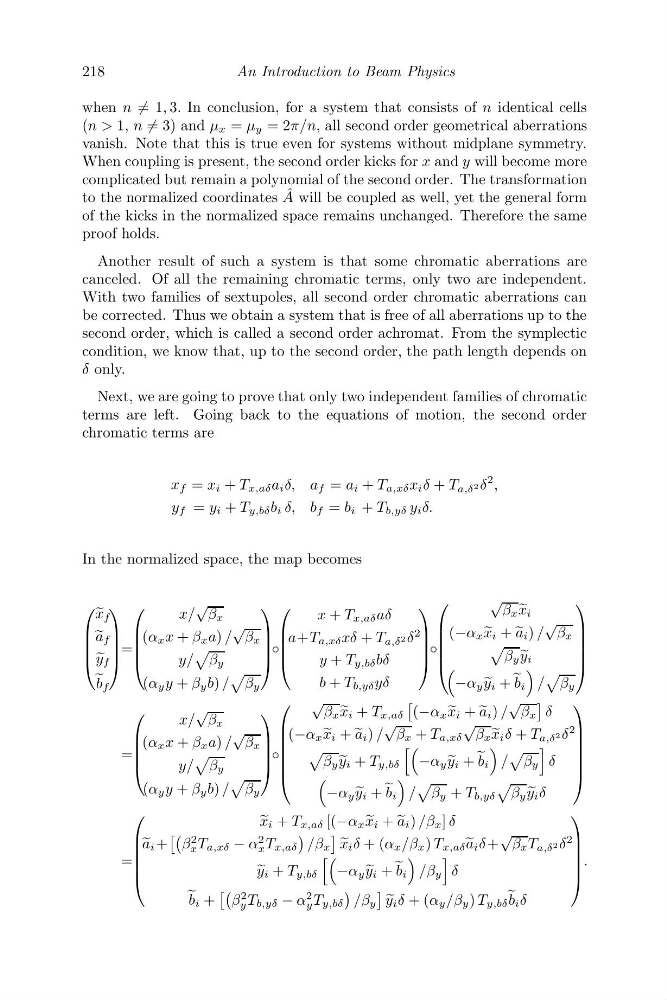
Next, we are going to prove that only two independent families of chromatic
terms are left. Going back to the equations of motion, the second order
chromatic terms are
x f = x i + T x,aδ a i δ, a f = a i + T a,xδ x i δ + T a,δ 2 δ
2 ,
y f = y i + T y,bδ b i δ, b f = b i + T b,yδ y i δ.
In the normalized space, the map becomes
⎛
⎜
⎜
⎜
⎝
x f
a f
y f
b f
⎞
⎟
⎟
⎟
⎠
=
⎛
⎜
⎜
⎜
⎝
x/
√
β x
(α x x + β x a) /
√
β x
y/
β y
(α y y + β y b) /
β y
⎞
⎟
⎟
⎟
⎠
◦
⎛
⎜
⎜
⎜
⎝
x + T x,aδ aδ
a+T a,xδ xδ + T a,δ 2 δ
2
y + T y,bδ bδ
b + T b,yδ yδ
⎞
⎟
⎟
⎟
⎠
◦
⎛
⎜
⎜
⎜
⎜
⎝
√
β x
x i
(−α x
x i + a i ) /
√
β x
β y
y i
−α y
y i + b i
/
β y
⎞
⎟
⎟
⎟
⎟
⎠
=
⎛
⎜
⎜
⎜
⎝
x/
√
β x
(α x x + β x a) /
√
β x
y/
β y
(α y y + β y b) /
β y
⎞
⎟
⎟
⎟
⎠
◦
⎛
⎜
⎜
⎜
⎜
⎜
⎝
√
β x
x i + T x,aδ
(−α x
x i + a i ) /
√
β x
δ
(−α x
x i + a i ) /
√
β x + T a,xδ
√
β x
x i δ + T a,δ 2 δ
2
β y
y i + T y,bδ
−α y
y i + b i
/
β y
δ
−α y
y i + b i
/
β y + T b,yδ
β y
y i δ
⎞
⎟
⎟
⎟
⎟
⎟
⎠
=
⎛
⎜
⎜
⎜
⎜
⎝
x i + T x,aδ [(−α x
x i + a i ) /β x ] δ
a i +
β
2
x T a,xδ − α
2
x T x,aδ
/β x
x i δ + (α x /β x ) T x,aδ a i δ+
√
β x T a,δ 2 δ
2
y i + T y,bδ
−α y
y i + b i
/β y
δ
b i +
β
2
y T b,yδ − α
2
y T y,bδ
/β y
y i δ + (α y /β y ) T y,bδ b i δ
⎞
⎟
⎟
⎟
⎟
⎠
.
An Introduction to Beam Physics
when n = 1, 3. In conclusion, for a system that consists of n identical cells
(n > 1, n = 3) and μ x = μ y = 2π/n, all second order geometrical aberrations
vanish. Note that this is true even for systems without midplane symmetry.
When coupling is present, the second order kicks for x and y will become more
complicated but remain a polynomial of the second order. The transformation
to the normalized coordinates ˆ
A will be coupled as well, yet the general form
of the kicks in the normalized space remains unchanged. Therefore the same
proof holds.
Another result of such a system is that some chromatic aberrations are
canceled. Of all the remaining chromatic terms, only two are independent.
With two families of sextupoles, all second order chromatic aberrations can
be corrected. Thus we obtain a system that is free of all aberrations up to the
second order, which is called a second order achromat. From the symplectic
condition, we know that, up to the second order, the path length depends on
δ only.
Next, we are going to prove that only two independent families of chromatic
terms are left. Going back to the equations of motion, the second order
chromatic terms are
x f = x i + T x,aδ a i δ, a f = a i + T a,xδ x i δ + T a,δ 2 δ
2 ,
y f = y i + T y,bδ b i δ, b f = b i + T b,yδ y i δ.
In the normalized space, the map becomes
⎛
⎜
⎜
⎜
⎝
x f
a f
y f
b f
⎞
⎟
⎟
⎟
⎠
=
⎛
⎜
⎜
⎜
⎝
x/
√
β x
(α x x + β x a) /
√
β x
y/
β y
(α y y + β y b) /
β y
⎞
⎟
⎟
⎟
⎠
◦
⎛
⎜
⎜
⎜
⎝
x + T x,aδ aδ
a+T a,xδ xδ + T a,δ 2 δ
2
y + T y,bδ bδ
b + T b,yδ yδ
⎞
⎟
⎟
⎟
⎠
◦
⎛
⎜
⎜
⎜
⎜
⎝
√
β x
x i
(−α x
x i + a i ) /
√
β x
β y
y i
−α y
y i + b i
/
β y
⎞
⎟
⎟
⎟
⎟
⎠
=
⎛
⎜
⎜
⎜
⎝
x/
√
β x
(α x x + β x a) /
√
β x
y/
β y
(α y y + β y b) /
β y
⎞
⎟
⎟
⎟
⎠
◦
⎛
⎜
⎜
⎜
⎜
⎜
⎝
√
β x
x i + T x,aδ
(−α x
x i + a i ) /
√
β x
δ
(−α x
x i + a i ) /
√
β x + T a,xδ
√
β x
x i δ + T a,δ 2 δ
2
β y
y i + T y,bδ
−α y
y i + b i
/
β y
δ
−α y
y i + b i
/
β y + T b,yδ
β y
y i δ
⎞
⎟
⎟
⎟
⎟
⎟
⎠
=
⎛
⎜
⎜
⎜
⎜
⎝
x i + T x,aδ [(−α x
x i + a i ) /β x ] δ
a i +
β
2
x T a,xδ − α
2
x T x,aδ
/β x
x i δ + (α x /β x ) T x,aδ a i δ+
√
β x T a,δ 2 δ
2
y i + T y,bδ
−α y
y i + b i
/β y
δ
b i +
β
2
y T b,yδ − α
2
y T y,bδ
/β y
y i δ + (α y /β y ) T y,bδ b i δ
⎞
⎟
⎟
⎟
⎟
⎠
.