

6
An Introduction to Beam Physics
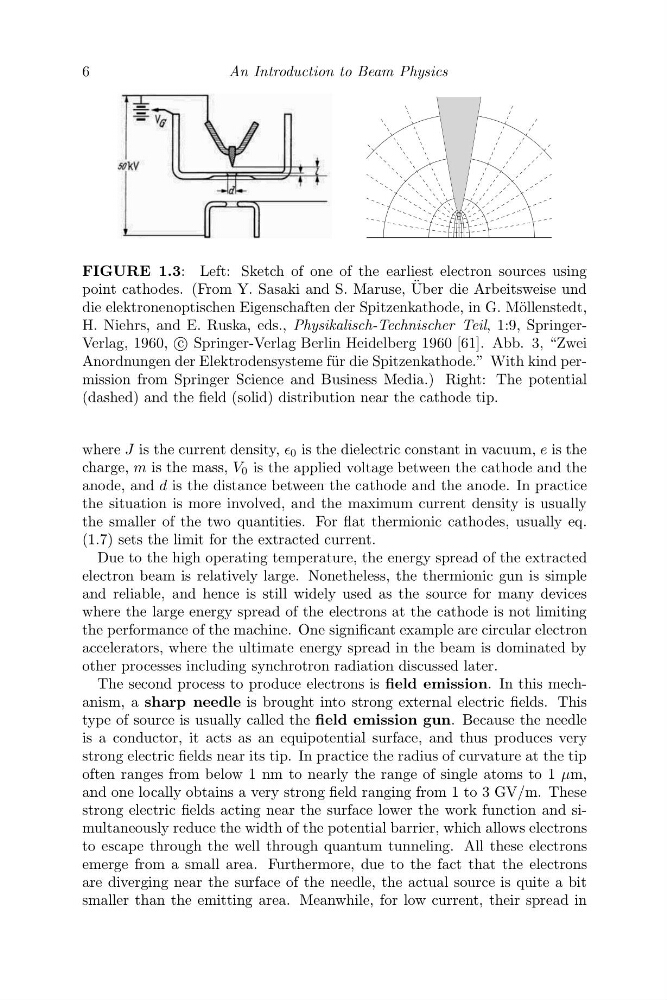
FIGURE 1.3: Left: Sketch of one of the earliest electron sources using
point cathodes. (From Y. Sasaki and S. Maruse, ¨
Uber die Arbeitsweise und
die elektronenoptischen Eigenschaften der Spitzenkathode, in G. M¨ ollenstedt,
H. Niehrs, and E. Ruska, eds., Physikalisch-Technischer Teil, 1:9, SpringerVerlag, 1960, c
Springer-Verlag Berlin Heidelberg 1960 [61]. Abb. 3, “Zwei
Anordnungen der Elektrodensysteme f¨ ur die Spitzenkathode.” With kind permission from Springer Science and Business Media.) Right: The potential
(dashed) and the field (solid) distribution near the cathode tip.
where J is the current density, 0 is the dielectric constant in vacuum, e is the
charge, m is the mass, V 0 is the applied voltage between the cathode and the
anode, and d is the distance between the cathode and the anode. In practice
the situation is more involved, and the maximum current density is usually
the smaller of the two quantities. For flat thermionic cathodes, usually eq.
(1.7) sets the limit for the extracted current.
Due to the high operating temperature, the energy spread of the extracted
electron beam is relatively large. Nonetheless, the thermionic gun is simple
and reliable, and hence is still widely used as the source for many devices
where the large energy spread of the electrons at the cathode is not limiting
the performance of the machine. One significant example are circular electron
accelerators, where the ultimate energy spread in the beam is dominated by
other processes including synchrotron radiation discussed later.
The second process to produce electrons is field emission. In this mechanism, a sharp needle is brought into strong external electric fields. This
type of source is usually called the field emission gun. Because the needle
is a conductor, it acts as an equipotential surface, and thus produces very
strong electric fields near its tip. In practice the radius of curvature at the tip
often ranges from below 1 nm to nearly the range of single atoms to 1 μm,
and one locally obtains a very strong field ranging from 1 to 3 GV/m. These
strong electric fields acting near the surface lower the work function and simultaneously reduce the width of the potential barrier, which allows electrons
to escape through the well through quantum tunneling. All these electrons
emerge from a small area. Furthermore, due to the fact that the electrons
are diverging near the surface of the needle, the actual source is quite a bit
smaller than the emitting area. Meanwhile, for low current, their spread in
An Introduction to Beam Physics
FIGURE 1.3: Left: Sketch of one of the earliest electron sources using
point cathodes. (From Y. Sasaki and S. Maruse, ¨
Uber die Arbeitsweise und
die elektronenoptischen Eigenschaften der Spitzenkathode, in G. M¨ ollenstedt,
H. Niehrs, and E. Ruska, eds., Physikalisch-Technischer Teil, 1:9, SpringerVerlag, 1960, c
Springer-Verlag Berlin Heidelberg 1960 [61]. Abb. 3, “Zwei
Anordnungen der Elektrodensysteme f¨ ur die Spitzenkathode.” With kind permission from Springer Science and Business Media.) Right: The potential
(dashed) and the field (solid) distribution near the cathode tip.
where J is the current density, 0 is the dielectric constant in vacuum, e is the
charge, m is the mass, V 0 is the applied voltage between the cathode and the
anode, and d is the distance between the cathode and the anode. In practice
the situation is more involved, and the maximum current density is usually
the smaller of the two quantities. For flat thermionic cathodes, usually eq.
(1.7) sets the limit for the extracted current.
Due to the high operating temperature, the energy spread of the extracted
electron beam is relatively large. Nonetheless, the thermionic gun is simple
and reliable, and hence is still widely used as the source for many devices
where the large energy spread of the electrons at the cathode is not limiting
the performance of the machine. One significant example are circular electron
accelerators, where the ultimate energy spread in the beam is dominated by
other processes including synchrotron radiation discussed later.
The second process to produce electrons is field emission. In this mechanism, a sharp needle is brought into strong external electric fields. This
type of source is usually called the field emission gun. Because the needle
is a conductor, it acts as an equipotential surface, and thus produces very
strong electric fields near its tip. In practice the radius of curvature at the tip
often ranges from below 1 nm to nearly the range of single atoms to 1 μm,
and one locally obtains a very strong field ranging from 1 to 3 GV/m. These
strong electric fields acting near the surface lower the work function and simultaneously reduce the width of the potential barrier, which allows electrons
to escape through the well through quantum tunneling. All these electrons
emerge from a small area. Furthermore, due to the fact that the electrons
are diverging near the surface of the needle, the actual source is quite a bit
smaller than the emitting area. Meanwhile, for low current, their spread in