

The Periodic Transport
191
a
x
x
a
x
α
β
v 1
v 2
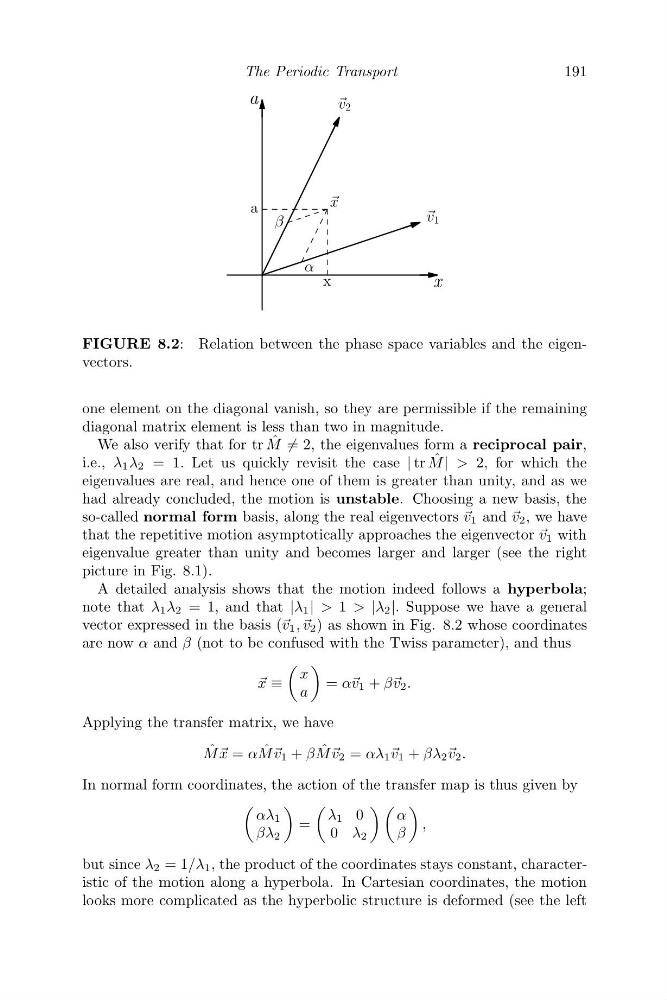
FIGURE 8.2: Relation between the phase space variables and the eigenvectors.
one element on the diagonal vanish, so they are permissible if the remaining
diagonal matrix element is less than two in magnitude.
We also verify that for tr ˆ
M = 2, the eigenvalues form a reciprocal pair,
i.e., λ 1 λ 2 = 1. Let us quickly revisit the case | tr ˆ
M | > 2, for which the
eigenvalues are real, and hence one of them is greater than unity, and as we
had already concluded, the motion is unstable. Choosing a new basis, the
so-called normal form basis, along the real eigenvectors v 1 and v 2 , we have
that the repetitive motion asymptotically approaches the eigenvector v 1 with
eigenvalue greater than unity and becomes larger and larger (see the right
picture in Fig. 8.1).
A detailed analysis shows that the motion indeed follows a hyperbola;
note that λ 1 λ 2 = 1, and that |λ 1 | > 1 > |λ 2 |. Suppose we have a general
vector expressed in the basis ( v 1 , , v 2 ) as shown in Fig. 8.2 whose coordinates
are now α and β (not to be confused with the Twiss parameter), and thus
x ≡
x
a
= αα v 1 + ββ v 2 .
Applying the transfer matrix, we have
ˆ
MM x = α ˆ
MM v 1 + β ˆ
MM v 2 = αλ 1 v 1 + βλ 2 v 2 .
In normal form coordinates, the action of the transfer map is thus given by
αλ 1
βλ 2
=
λ 1 0
0 λ 2
α
β
,
but since λ 2 = 1/λ 1 , the product of the coordinates stays constant, characteristic of the motion along a hyperbola. In Cartesian coordinates, the motion
looks more complicated as the hyperbolic structure is deformed (see the left
191
a
x
x
a
x
α
β
v 1
v 2
FIGURE 8.2: Relation between the phase space variables and the eigenvectors.
one element on the diagonal vanish, so they are permissible if the remaining
diagonal matrix element is less than two in magnitude.
We also verify that for tr ˆ
M = 2, the eigenvalues form a reciprocal pair,
i.e., λ 1 λ 2 = 1. Let us quickly revisit the case | tr ˆ
M | > 2, for which the
eigenvalues are real, and hence one of them is greater than unity, and as we
had already concluded, the motion is unstable. Choosing a new basis, the
so-called normal form basis, along the real eigenvectors v 1 and v 2 , we have
that the repetitive motion asymptotically approaches the eigenvector v 1 with
eigenvalue greater than unity and becomes larger and larger (see the right
picture in Fig. 8.1).
A detailed analysis shows that the motion indeed follows a hyperbola;
note that λ 1 λ 2 = 1, and that |λ 1 | > 1 > |λ 2 |. Suppose we have a general
vector expressed in the basis ( v 1 , , v 2 ) as shown in Fig. 8.2 whose coordinates
are now α and β (not to be confused with the Twiss parameter), and thus
x ≡
x
a
= αα v 1 + ββ v 2 .
Applying the transfer matrix, we have
ˆ
MM x = α ˆ
MM v 1 + β ˆ
MM v 2 = αλ 1 v 1 + βλ 2 v 2 .
In normal form coordinates, the action of the transfer map is thus given by
αλ 1
βλ 2
=
λ 1 0
0 λ 2
α
β
,
but since λ 2 = 1/λ 1 , the product of the coordinates stays constant, characteristic of the motion along a hyperbola. In Cartesian coordinates, the motion
looks more complicated as the hyperbolic structure is deformed (see the left