

Imaging Devices
177
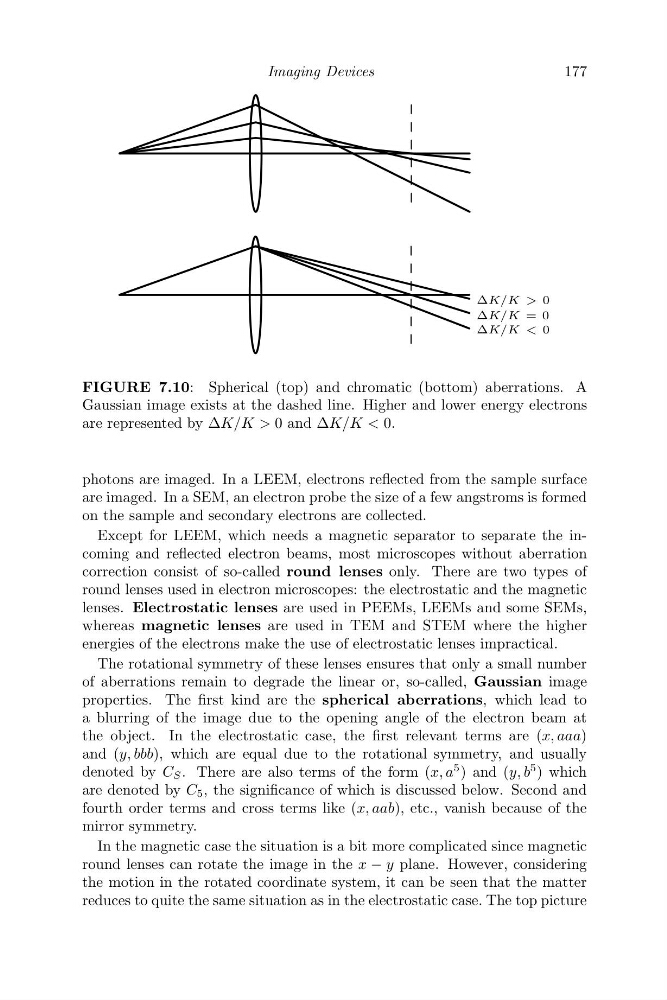
ΔK/K = 0
ΔK/K > 0
ΔK/K < 0
FIGURE 7.10: Spherical (top) and chromatic (bottom) aberrations. A
Gaussian image exists at the dashed line. Higher and lower energy electrons
are represented by ΔK/K > 0 and ΔK/K < 0.
photons are imaged. In a LEEM, electrons reflected from the sample surface
are imaged. In a SEM, an electron probe the size of a few angstroms is formed
on the sample and secondary electrons are collected.
Except for LEEM, which needs a magnetic separator to separate the incoming and reflected electron beams, most microscopes without aberration
correction consist of so-called round lenses only. There are two types of
round lenses used in electron microscopes: the electrostatic and the magnetic
lenses. Electrostatic lenses are used in PEEMs, LEEMs and some SEMs,
whereas magnetic lenses are used in TEM and STEM where the higher
energies of the electrons make the use of electrostatic lenses impractical.
The rotational symmetry of these lenses ensures that only a small number
of aberrations remain to degrade the linear or, so-called, Gaussian image
properties. The first kind are the spherical aberrations, which lead to
a blurring of the image due to the opening angle of the electron beam at
the object. In the electrostatic case, the first relevant terms are (x, aaa)
and (y, bbb), which are equal due to the rotational symmetry, and usually
denoted by C S . There are also terms of the form (x, a
5 ) and (y, b
5 ) which
are denoted by C 5 , the significance of which is discussed below. Second and
fourth order terms and cross terms like (x, aab), etc., vanish because of the
mirror symmetry.
In the magnetic case the situation is a bit more complicated since magnetic
round lenses can rotate the image in the x − y plane. However, considering
the motion in the rotated coordinate system, it can be seen that the matter
reduces to quite the same situation as in the electrostatic case. The top picture
177
ΔK/K = 0
ΔK/K > 0
ΔK/K < 0
FIGURE 7.10: Spherical (top) and chromatic (bottom) aberrations. A
Gaussian image exists at the dashed line. Higher and lower energy electrons
are represented by ΔK/K > 0 and ΔK/K < 0.
photons are imaged. In a LEEM, electrons reflected from the sample surface
are imaged. In a SEM, an electron probe the size of a few angstroms is formed
on the sample and secondary electrons are collected.
Except for LEEM, which needs a magnetic separator to separate the incoming and reflected electron beams, most microscopes without aberration
correction consist of so-called round lenses only. There are two types of
round lenses used in electron microscopes: the electrostatic and the magnetic
lenses. Electrostatic lenses are used in PEEMs, LEEMs and some SEMs,
whereas magnetic lenses are used in TEM and STEM where the higher
energies of the electrons make the use of electrostatic lenses impractical.
The rotational symmetry of these lenses ensures that only a small number
of aberrations remain to degrade the linear or, so-called, Gaussian image
properties. The first kind are the spherical aberrations, which lead to
a blurring of the image due to the opening angle of the electron beam at
the object. In the electrostatic case, the first relevant terms are (x, aaa)
and (y, bbb), which are equal due to the rotational symmetry, and usually
denoted by C S . There are also terms of the form (x, a
5 ) and (y, b
5 ) which
are denoted by C 5 , the significance of which is discussed below. Second and
fourth order terms and cross terms like (x, aab), etc., vanish because of the
mirror symmetry.
In the magnetic case the situation is a bit more complicated since magnetic
round lenses can rotate the image in the x − y plane. However, considering
the motion in the rotated coordinate system, it can be seen that the matter
reduces to quite the same situation as in the electrostatic case. The top picture