

Imaging Devices
163
z
x
(x, x
2
a)
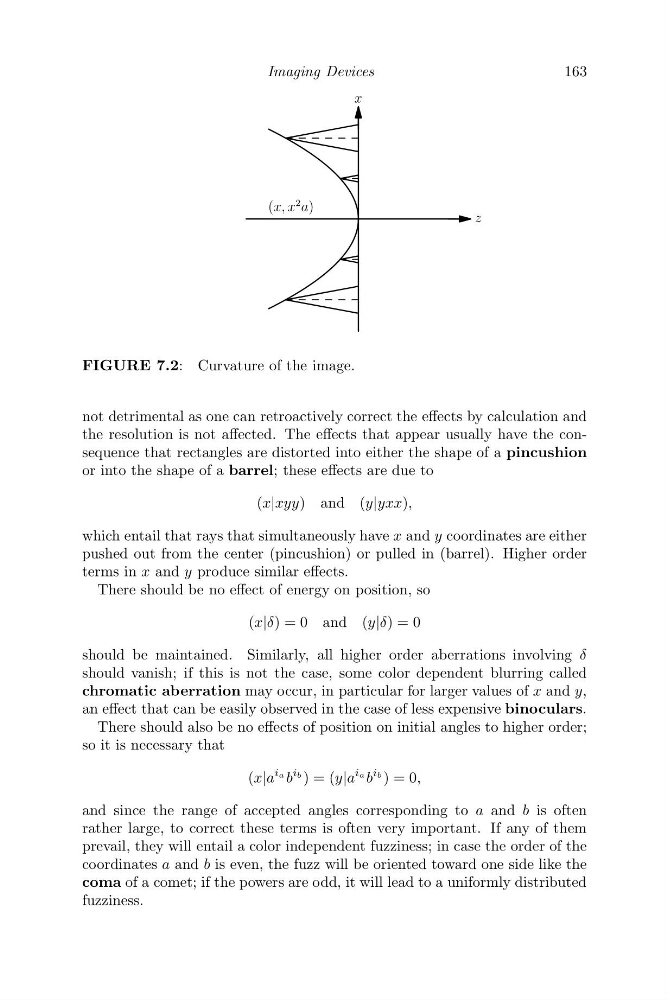
FIGURE 7.2: Curvature of the image.
not detrimental as one can retroactively correct the effects by calculation and
the resolution is not affected. The effects that appear usually have the consequence that rectangles are distorted into either the shape of a pincushion
or into the shape of a barrel; these effects are due to
(x|xyy) and (y|yxx),
which entail that rays that simultaneously have x and y coordinates are either
pushed out from the center (pincushion) or pulled in (barrel). Higher order
terms in x and y produce similar effects.
There should be no effect of energy on position, so
(x|δ) = 0 and (y|δ) = 0
should be maintained. Similarly, all higher order aberrations involving δ
should vanish; if this is not the case, some color dependent blurring called
chromatic aberration may occur, in particular for larger values of x and y,
an effect that can be easily observed in the case of less expensive binoculars.
There should also be no effects of position on initial angles to higher order;
so it is necessary that
(x|a
ia b
i b ) = (y|a
ia b
i b ) = 0,
and since the range of accepted angles corresponding to a and b is often
rather large, to correct these terms is often very important. If any of them
prevail, they will entail a color independent fuzziness; in case the order of the
coordinates a and b is even, the fuzz will be oriented toward one side like the
coma of a comet; if the powers are odd, it will lead to a uniformly distributed
fuzziness.
163
z
x
(x, x
2
a)
FIGURE 7.2: Curvature of the image.
not detrimental as one can retroactively correct the effects by calculation and
the resolution is not affected. The effects that appear usually have the consequence that rectangles are distorted into either the shape of a pincushion
or into the shape of a barrel; these effects are due to
(x|xyy) and (y|yxx),
which entail that rays that simultaneously have x and y coordinates are either
pushed out from the center (pincushion) or pulled in (barrel). Higher order
terms in x and y produce similar effects.
There should be no effect of energy on position, so
(x|δ) = 0 and (y|δ) = 0
should be maintained. Similarly, all higher order aberrations involving δ
should vanish; if this is not the case, some color dependent blurring called
chromatic aberration may occur, in particular for larger values of x and y,
an effect that can be easily observed in the case of less expensive binoculars.
There should also be no effects of position on initial angles to higher order;
so it is necessary that
(x|a
ia b
i b ) = (y|a
ia b
i b ) = 0,
and since the range of accepted angles corresponding to a and b is often
rather large, to correct these terms is often very important. If any of them
prevail, they will entail a color independent fuzziness; in case the order of the
coordinates a and b is even, the fuzz will be oriented toward one side like the
coma of a comet; if the powers are odd, it will lead to a uniformly distributed
fuzziness.