

Linear Phase Space Motion
159
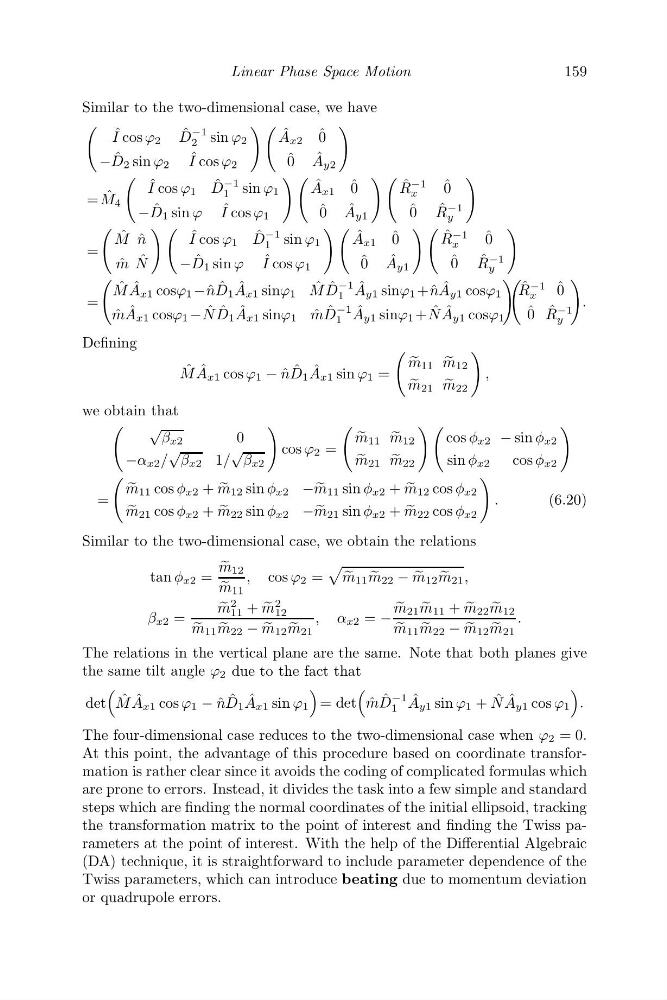
Similar to the two-dimensional case, we have
ˆ
I cos ϕ 2 ˆ
D
−1
2 sin ϕ 2
− ˆ
D 2 sin ϕ 2 ˆ
I cos ϕ 2
ˆ
A x2 ˆ 0
ˆ 0 ˆ
A y2
= ˆ
M 4
ˆ
I cos ϕ 1 ˆ
D
−1
1 sin ϕ 1
− ˆ
D 1 sin ϕ ˆ
I cos ϕ 1
ˆ
A x1 ˆ 0
ˆ 0 ˆ
A y1
ˆ
R
−1
x
ˆ 0
ˆ 0 ˆ
R
−1
y
=
ˆ
M ˆ
n
ˆ
m ˆ
N
ˆ
I cos ϕ 1 ˆ
D
−1
1 sin ϕ 1
− ˆ
D 1 sin ϕ ˆ
I cos ϕ 1
ˆ
A x1 ˆ 0
ˆ 0 ˆ
A y1
ˆ
R
−1
x
ˆ 0
ˆ 0 ˆ
R
−1
y
=
ˆ
M ˆ
A x1 cosϕ 1 − ˆ
n ˆ
D 1 ˆ
A x1 sinϕ 1 ˆ
M ˆ
D
−1
1
ˆ
A y1 sinϕ 1 + ˆ
n ˆ
A y1 cosϕ 1
ˆ
m ˆ
A x1 cosϕ 1 − ˆ
N ˆ
D 1 ˆ
A x1 sinϕ 1 ˆ
m ˆ
D
−1
1
ˆ
A y1 sinϕ 1 + ˆ
N ˆ
A y1 cosϕ 1
ˆ
R
−1
x
ˆ 0
ˆ 0 ˆ
R
−1
y
.
Defining
ˆ
M ˆ
A x1 cos ϕ 1 − ˆ
n ˆ
D 1 ˆ
A x1 sin ϕ 1 =
m 11
m 12
m 21
m 22
,
we obtain that
√
β x2
0
−α x2 /
√
β x2 1/
√
β x2
cos ϕ 2 =
m 11
m 12
m 21
m 22
cos φ x2 − sin φ x2
sin φ x2
cos φ x2
=
m 11 cos φ x2 +
m 12 sin φ x2 −
m 11 sin φ x2 +
m 12 cos φ x2
m 21 cos φ x2 +
m 22 sin φ x2 −
m 21 sin φ x2 +
m 22 cos φ x2
.
(6.20)
Similar to the two-dimensional case, we obtain the relations
tan φ x2 =
m 12
m 11
, cos ϕ 2 =
m 11
m 22 −
m 12
m 21 ,
β x2 =
m
2
11 +
m
2
12
m 11
m 22 −
m 12
m 21
, α x2 = −
m 21
m 11 +
m 22
m 12
m 11
m 22 −
m 12
m 21
.
The relations in the vertical plane are the same. Note that both planes give
the same tilt angle ϕ 2 due to the fact that
det
ˆ
M ˆ
A x1 cos ϕ 1 − ˆ
n ˆ
D 1 ˆ
A x1 sin ϕ 1
= det
ˆ
m ˆ
D
−1
1
ˆ
A y1 sin ϕ 1 + ˆ
N ˆ
A y1 cos ϕ 1
.
The four-dimensional case reduces to the two-dimensional case when ϕ 2 = 0.
At this point, the advantage of this procedure based on coordinate transformation is rather clear since it avoids the coding of complicated formulas which
are prone to errors. Instead, it divides the task into a few simple and standard
steps which are finding the normal coordinates of the initial ellipsoid, tracking
the transformation matrix to the point of interest and finding the Twiss parameters at the point of interest. With the help of the Differential Algebraic
(DA) technique, it is straightforward to include parameter dependence of the
Twiss parameters, which can introduce beating due to momentum deviation
or quadrupole errors.
159
Similar to the two-dimensional case, we have
ˆ
I cos ϕ 2 ˆ
D
−1
2 sin ϕ 2
− ˆ
D 2 sin ϕ 2 ˆ
I cos ϕ 2
ˆ
A x2 ˆ 0
ˆ 0 ˆ
A y2
= ˆ
M 4
ˆ
I cos ϕ 1 ˆ
D
−1
1 sin ϕ 1
− ˆ
D 1 sin ϕ ˆ
I cos ϕ 1
ˆ
A x1 ˆ 0
ˆ 0 ˆ
A y1
ˆ
R
−1
x
ˆ 0
ˆ 0 ˆ
R
−1
y
=
ˆ
M ˆ
n
ˆ
m ˆ
N
ˆ
I cos ϕ 1 ˆ
D
−1
1 sin ϕ 1
− ˆ
D 1 sin ϕ ˆ
I cos ϕ 1
ˆ
A x1 ˆ 0
ˆ 0 ˆ
A y1
ˆ
R
−1
x
ˆ 0
ˆ 0 ˆ
R
−1
y
=
ˆ
M ˆ
A x1 cosϕ 1 − ˆ
n ˆ
D 1 ˆ
A x1 sinϕ 1 ˆ
M ˆ
D
−1
1
ˆ
A y1 sinϕ 1 + ˆ
n ˆ
A y1 cosϕ 1
ˆ
m ˆ
A x1 cosϕ 1 − ˆ
N ˆ
D 1 ˆ
A x1 sinϕ 1 ˆ
m ˆ
D
−1
1
ˆ
A y1 sinϕ 1 + ˆ
N ˆ
A y1 cosϕ 1
ˆ
R
−1
x
ˆ 0
ˆ 0 ˆ
R
−1
y
.
Defining
ˆ
M ˆ
A x1 cos ϕ 1 − ˆ
n ˆ
D 1 ˆ
A x1 sin ϕ 1 =
m 11
m 12
m 21
m 22
,
we obtain that
√
β x2
0
−α x2 /
√
β x2 1/
√
β x2
cos ϕ 2 =
m 11
m 12
m 21
m 22
cos φ x2 − sin φ x2
sin φ x2
cos φ x2
=
m 11 cos φ x2 +
m 12 sin φ x2 −
m 11 sin φ x2 +
m 12 cos φ x2
m 21 cos φ x2 +
m 22 sin φ x2 −
m 21 sin φ x2 +
m 22 cos φ x2
.
(6.20)
Similar to the two-dimensional case, we obtain the relations
tan φ x2 =
m 12
m 11
, cos ϕ 2 =
m 11
m 22 −
m 12
m 21 ,
β x2 =
m
2
11 +
m
2
12
m 11
m 22 −
m 12
m 21
, α x2 = −
m 21
m 11 +
m 22
m 12
m 11
m 22 −
m 12
m 21
.
The relations in the vertical plane are the same. Note that both planes give
the same tilt angle ϕ 2 due to the fact that
det
ˆ
M ˆ
A x1 cos ϕ 1 − ˆ
n ˆ
D 1 ˆ
A x1 sin ϕ 1
= det
ˆ
m ˆ
D
−1
1
ˆ
A y1 sin ϕ 1 + ˆ
N ˆ
A y1 cos ϕ 1
.
The four-dimensional case reduces to the two-dimensional case when ϕ 2 = 0.
At this point, the advantage of this procedure based on coordinate transformation is rather clear since it avoids the coding of complicated formulas which
are prone to errors. Instead, it divides the task into a few simple and standard
steps which are finding the normal coordinates of the initial ellipsoid, tracking
the transformation matrix to the point of interest and finding the Twiss parameters at the point of interest. With the help of the Differential Algebraic
(DA) technique, it is straightforward to include parameter dependence of the
Twiss parameters, which can introduce beating due to momentum deviation
or quadrupole errors.