

Linear Phase Space Motion
157
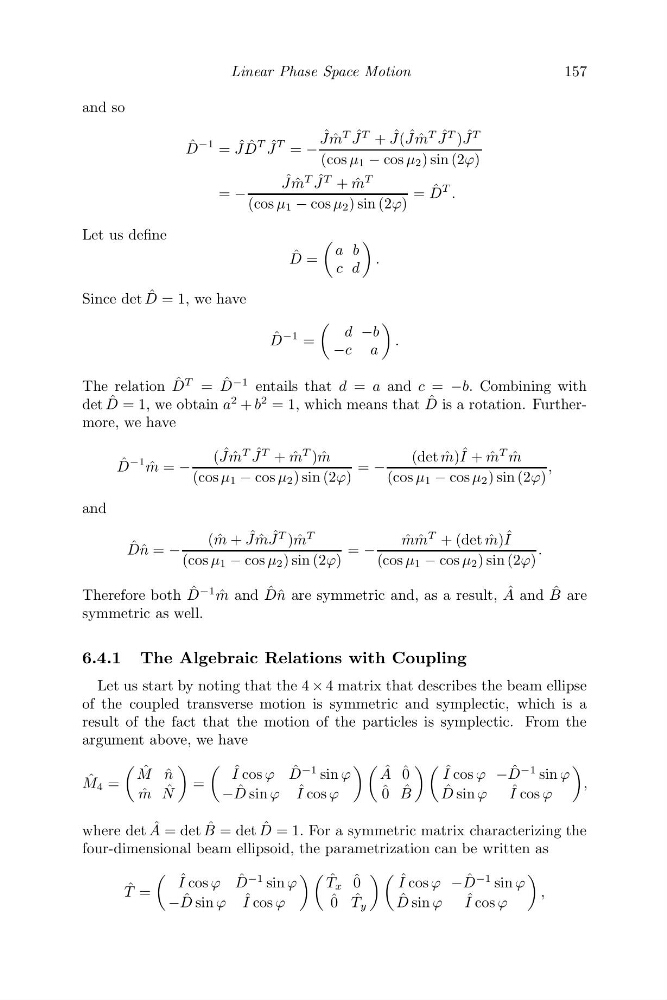
and so
ˆ
D
−1 = ˆ
J ˆ
D
T ˆ
J
T = −
ˆ
J ˆ
m
T ˆ
J
T + ˆ
J( ˆ
J ˆ
m
T ˆ
J
T ) ˆ
J
T
(cos μ 1 − cos μ 2 ) sin (2ϕ)
= −
ˆ
J ˆ
m
T ˆ
J
T + ˆ
m
T
(cos μ 1 − cos μ 2 ) sin (2ϕ)
= ˆ
D
T .
Let us define
ˆ
D =
a b
c d
.
Since det ˆ
D = 1, we have
ˆ
D
−1 =
d −b
−c a
.
The relation ˆ
D
T = ˆ
D
−1 entails that d = a and c = −b. Combining with
det ˆ
D = 1, we obtain a
2 + b
2 = 1, which means that ˆ
D is a rotation. Furthermore, we have
ˆ
D
−1 ˆ
m = −
( ˆ
J ˆ
m
T ˆ
J
T + ˆ
m
T ) ˆ
m
(cos μ 1 − cos μ 2 ) sin (2ϕ)
= −
(det ˆ
m) ˆ
I + ˆ
m
T ˆ
m
(cos μ 1 − cos μ 2 ) sin (2ϕ)
,
and
ˆ
Dˆ n = −
( ˆ
m + ˆ
J ˆ
m ˆ
J
T ) ˆ
m
T
(cos μ 1 − cos μ 2 ) sin (2ϕ)
= −
ˆ
m ˆ
m
T + (det ˆ
m) ˆ
I
(cos μ 1 − cos μ 2 ) sin (2ϕ)
.
Therefore both ˆ
D
−1 ˆ
m and ˆ
Dˆ n are symmetric and, as a result, ˆ
A and ˆ
B are
symmetric as well.
6.4.1 The Algebraic Relations with Coupling
Let us start by noting that the 4 × 4 matrix that describes the beam ellipse
of the coupled transverse motion is symmetric and symplectic, which is a
result of the fact that the motion of the particles is symplectic. From the
argument above, we have
ˆ
M 4 =
ˆ
M ˆ
n
ˆ
m ˆ
N
=
ˆ
I cos ϕ ˆ
D
−1 sin ϕ
− ˆ
D sin ϕ ˆ
I cos ϕ
ˆ
A ˆ 0
ˆ 0 ˆ
B
ˆ
I cos ϕ − ˆ
D
−1 sin ϕ
ˆ
D sin ϕ
ˆ
I cos ϕ
,
where det ˆ
A = det ˆ
B = det ˆ
D = 1. For a symmetric matrix characterizing the
four-dimensional beam ellipsoid, the parametrization can be written as
ˆ
T =
ˆ
I cos ϕ ˆ
D
−1 sin ϕ
− ˆ
D sin ϕ ˆ
I cos ϕ
ˆ
T x ˆ 0
ˆ 0 ˆ
T y
ˆ
I cos ϕ − ˆ
D
−1 sin ϕ
ˆ
D sin ϕ
ˆ
I cos ϕ
,
157
and so
ˆ
D
−1 = ˆ
J ˆ
D
T ˆ
J
T = −
ˆ
J ˆ
m
T ˆ
J
T + ˆ
J( ˆ
J ˆ
m
T ˆ
J
T ) ˆ
J
T
(cos μ 1 − cos μ 2 ) sin (2ϕ)
= −
ˆ
J ˆ
m
T ˆ
J
T + ˆ
m
T
(cos μ 1 − cos μ 2 ) sin (2ϕ)
= ˆ
D
T .
Let us define
ˆ
D =
a b
c d
.
Since det ˆ
D = 1, we have
ˆ
D
−1 =
d −b
−c a
.
The relation ˆ
D
T = ˆ
D
−1 entails that d = a and c = −b. Combining with
det ˆ
D = 1, we obtain a
2 + b
2 = 1, which means that ˆ
D is a rotation. Furthermore, we have
ˆ
D
−1 ˆ
m = −
( ˆ
J ˆ
m
T ˆ
J
T + ˆ
m
T ) ˆ
m
(cos μ 1 − cos μ 2 ) sin (2ϕ)
= −
(det ˆ
m) ˆ
I + ˆ
m
T ˆ
m
(cos μ 1 − cos μ 2 ) sin (2ϕ)
,
and
ˆ
Dˆ n = −
( ˆ
m + ˆ
J ˆ
m ˆ
J
T ) ˆ
m
T
(cos μ 1 − cos μ 2 ) sin (2ϕ)
= −
ˆ
m ˆ
m
T + (det ˆ
m) ˆ
I
(cos μ 1 − cos μ 2 ) sin (2ϕ)
.
Therefore both ˆ
D
−1 ˆ
m and ˆ
Dˆ n are symmetric and, as a result, ˆ
A and ˆ
B are
symmetric as well.
6.4.1 The Algebraic Relations with Coupling
Let us start by noting that the 4 × 4 matrix that describes the beam ellipse
of the coupled transverse motion is symmetric and symplectic, which is a
result of the fact that the motion of the particles is symplectic. From the
argument above, we have
ˆ
M 4 =
ˆ
M ˆ
n
ˆ
m ˆ
N
=
ˆ
I cos ϕ ˆ
D
−1 sin ϕ
− ˆ
D sin ϕ ˆ
I cos ϕ
ˆ
A ˆ 0
ˆ 0 ˆ
B
ˆ
I cos ϕ − ˆ
D
−1 sin ϕ
ˆ
D sin ϕ
ˆ
I cos ϕ
,
where det ˆ
A = det ˆ
B = det ˆ
D = 1. For a symmetric matrix characterizing the
four-dimensional beam ellipsoid, the parametrization can be written as
ˆ
T =
ˆ
I cos ϕ ˆ
D
−1 sin ϕ
− ˆ
D sin ϕ ˆ
I cos ϕ
ˆ
T x ˆ 0
ˆ 0 ˆ
T y
ˆ
I cos ϕ − ˆ
D
−1 sin ϕ
ˆ
D sin ϕ
ˆ
I cos ϕ
,