

Linear Phase Space Motion
155
The behavior of φ, α, β and γ are determined by the above set of differential
equations.
6.4 *Edwards-Teng Parametrization
Here we have shown an alternative way of propagating the Twiss parameters
through a beamline or a ring. The advantage is that only matrix multiplication
and inner products of vectors (rows of a matrix) are used. In the following
we will show that this way of tracking the Twiss parameters can be readily
extended to coupled x and y motions.
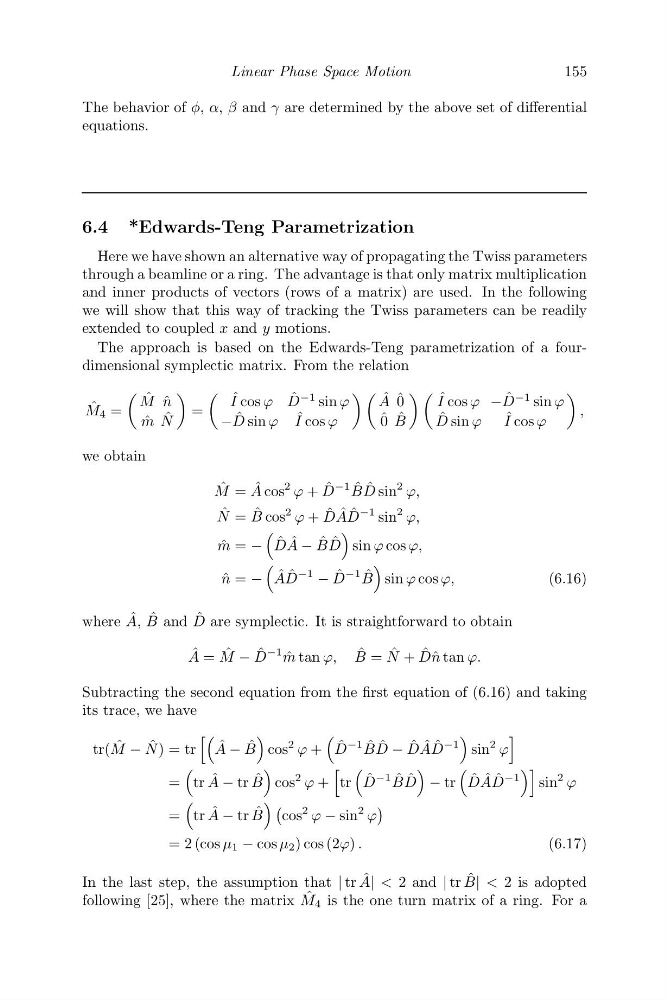
The approach is based on the Edwards-Teng parametrization of a fourdimensional symplectic matrix. From the relation
ˆ
M 4 =
ˆ
M ˆ
n
ˆ
m ˆ
N
=
ˆ
I cos ϕ ˆ
D
−1 sin ϕ
− ˆ
D sin ϕ ˆ
I cos ϕ
ˆ
A ˆ 0
ˆ 0 ˆ
B
ˆ
I cos ϕ − ˆ
D
−1 sin ϕ
ˆ
D sin ϕ
ˆ
I cos ϕ
,
we obtain
ˆ
M = ˆ
A cos
2 ϕ + ˆ
D
−1 ˆ
B ˆ
D sin
2 ϕ,
ˆ
N = ˆ
B cos
2 ϕ + ˆ
D ˆ
A ˆ
D
−1 sin
2 ϕ,
ˆ
m = −
ˆ
D ˆ
A − ˆ
B ˆ
D
sin ϕ cos ϕ,
ˆ
n = −
ˆ
A ˆ
D
−1
− ˆ
D
−1 ˆ
B
sin ϕ cos ϕ,
(6.16)
where ˆ
A, ˆ
B and ˆ
D are symplectic. It is straightforward to obtain
ˆ
A = ˆ
M − ˆ
D
−1 ˆ
m tan ϕ, ˆ
B = ˆ
N + ˆ
Dˆ n tan ϕ.
Subtracting the second equation from the first equation of (6.16) and taking
its trace, we have
tr( ˆ
M − ˆ
N ) = tr
ˆ
A − ˆ
B
cos
2 ϕ +
ˆ
D
−1 ˆ
B ˆ
D − ˆ
D ˆ
A ˆ
D
−1
sin
2 ϕ
=
tr ˆ
A − tr ˆ
B
cos
2 ϕ +
tr
ˆ
D
−1 ˆ
B ˆ
D
− tr
ˆ
D ˆ
A ˆ
D
−1
sin
2 ϕ
=
tr ˆ
A − tr ˆ
B
cos
2 ϕ − sin
2 ϕ
= 2 (cos μ 1 − cos μ 2 ) cos (2ϕ) .
(6.17)
In the last step, the assumption that | tr ˆ
A| < 2 and | tr ˆ
B| < 2 is adopted
following [25], where the matrix ˆ
M 4 is the one turn matrix of a ring. For a
155
The behavior of φ, α, β and γ are determined by the above set of differential
equations.
6.4 *Edwards-Teng Parametrization
Here we have shown an alternative way of propagating the Twiss parameters
through a beamline or a ring. The advantage is that only matrix multiplication
and inner products of vectors (rows of a matrix) are used. In the following
we will show that this way of tracking the Twiss parameters can be readily
extended to coupled x and y motions.
The approach is based on the Edwards-Teng parametrization of a fourdimensional symplectic matrix. From the relation
ˆ
M 4 =
ˆ
M ˆ
n
ˆ
m ˆ
N
=
ˆ
I cos ϕ ˆ
D
−1 sin ϕ
− ˆ
D sin ϕ ˆ
I cos ϕ
ˆ
A ˆ 0
ˆ 0 ˆ
B
ˆ
I cos ϕ − ˆ
D
−1 sin ϕ
ˆ
D sin ϕ
ˆ
I cos ϕ
,
we obtain
ˆ
M = ˆ
A cos
2 ϕ + ˆ
D
−1 ˆ
B ˆ
D sin
2 ϕ,
ˆ
N = ˆ
B cos
2 ϕ + ˆ
D ˆ
A ˆ
D
−1 sin
2 ϕ,
ˆ
m = −
ˆ
D ˆ
A − ˆ
B ˆ
D
sin ϕ cos ϕ,
ˆ
n = −
ˆ
A ˆ
D
−1
− ˆ
D
−1 ˆ
B
sin ϕ cos ϕ,
(6.16)
where ˆ
A, ˆ
B and ˆ
D are symplectic. It is straightforward to obtain
ˆ
A = ˆ
M − ˆ
D
−1 ˆ
m tan ϕ, ˆ
B = ˆ
N + ˆ
Dˆ n tan ϕ.
Subtracting the second equation from the first equation of (6.16) and taking
its trace, we have
tr( ˆ
M − ˆ
N ) = tr
ˆ
A − ˆ
B
cos
2 ϕ +
ˆ
D
−1 ˆ
B ˆ
D − ˆ
D ˆ
A ˆ
D
−1
sin
2 ϕ
=
tr ˆ
A − tr ˆ
B
cos
2 ϕ +
tr
ˆ
D
−1 ˆ
B ˆ
D
− tr
ˆ
D ˆ
A ˆ
D
−1
sin
2 ϕ
=
tr ˆ
A − tr ˆ
B
cos
2 ϕ − sin
2 ϕ
= 2 (cos μ 1 − cos μ 2 ) cos (2ϕ) .
(6.17)
In the last step, the assumption that | tr ˆ
A| < 2 and | tr ˆ
B| < 2 is adopted
following [25], where the matrix ˆ
M 4 is the one turn matrix of a ring. For a