

Linear Phase Space Motion
149
thus
x m =
εβ.
Because of the symmetry of the equations with respect to interchange of x
and a, we see that also
a m =
√
εγ.
So the maximal width in x direction is determined by the area of phase
space ε as well as the function β. Thus, β plays an eminent role, as it immediately tells the width of a beam at a given point; and plots of its value
for different positions around the accelerator are very commonly studied. An
example of such a plot showing the β functions for horizontal (x) and vertical
(y) motion of a beamline at the Advanced Light Source (ALS) at Lawrence
Berkeley National Laboratory (LBNL, LBL), California, USA, is shown in
Fig. 6.9 [54, 21].
6.3.2 The Algebraic Relations among the Twiss Parameters
In this section, we attempt to introduce concept of the phase advance,
which is the difference in phase between two points on the s-axis, and obtain
the relations among the Twiss parameters. Let ˆ
M (s) be the transfer matrix
of a beamline, which may or may not be part of a periodic transport system,
from s 1 = 0 to s 2 = s. Let α, β and γ be the Twiss parameters at s 1 = 0 and
α(s), β(s) and γ(s) be the ones at s 2 = s. From eq. (6.4), we obtain that
γ(s) α(s)
α(s) β(s)
=
ˆ
M (s)
−1
T
γ α
α β
ˆ
M (s)
−1
,
or in another form
ˆ
M (s)
T
γ(s) α(s)
α(s) β(s)
ˆ
M (s) =
γ α
α β
.
(6.5)
On the other hand, it is straightforward to show that
√
β −α/
√
β
0 1/
√
β
γ α
α β
√
β
0
−α/
√
β 1/
√
β
= ˆ
I,
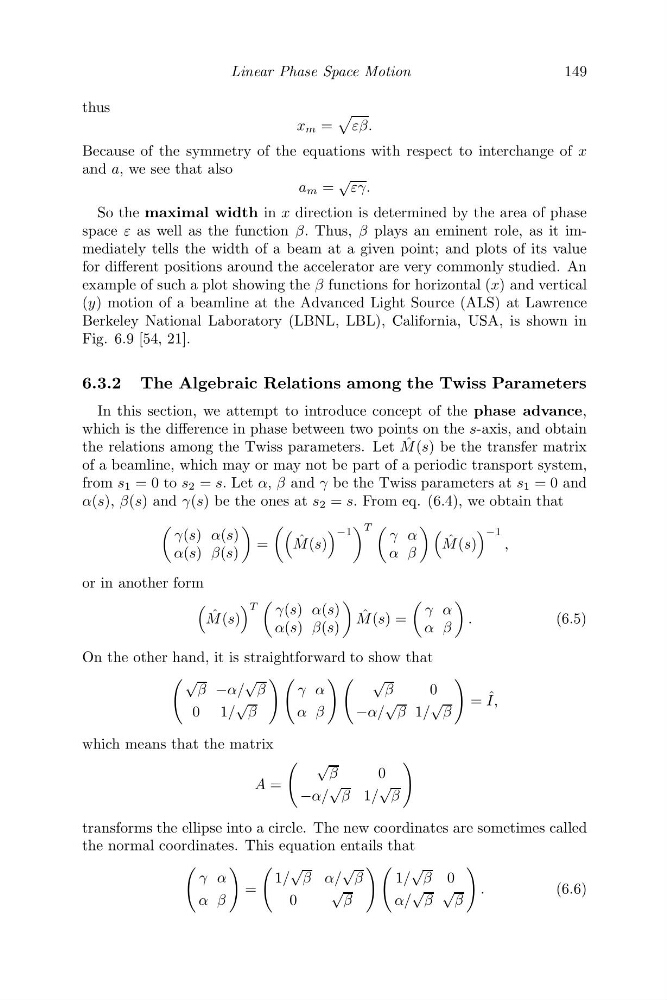
which means that the matrix
A =
√
β
0
−α/
√
β 1/
√
β
transforms the ellipse into a circle. The new coordinates are sometimes called
the normal coordinates. This equation entails that
γ α
α β
=
1/
√
β α/
√
β
0
√
β
1/
√
β 0
α/
√
β
√
β
.
(6.6)
149
thus
x m =
εβ.
Because of the symmetry of the equations with respect to interchange of x
and a, we see that also
a m =
√
εγ.
So the maximal width in x direction is determined by the area of phase
space ε as well as the function β. Thus, β plays an eminent role, as it immediately tells the width of a beam at a given point; and plots of its value
for different positions around the accelerator are very commonly studied. An
example of such a plot showing the β functions for horizontal (x) and vertical
(y) motion of a beamline at the Advanced Light Source (ALS) at Lawrence
Berkeley National Laboratory (LBNL, LBL), California, USA, is shown in
Fig. 6.9 [54, 21].
6.3.2 The Algebraic Relations among the Twiss Parameters
In this section, we attempt to introduce concept of the phase advance,
which is the difference in phase between two points on the s-axis, and obtain
the relations among the Twiss parameters. Let ˆ
M (s) be the transfer matrix
of a beamline, which may or may not be part of a periodic transport system,
from s 1 = 0 to s 2 = s. Let α, β and γ be the Twiss parameters at s 1 = 0 and
α(s), β(s) and γ(s) be the ones at s 2 = s. From eq. (6.4), we obtain that
γ(s) α(s)
α(s) β(s)
=
ˆ
M (s)
−1
T
γ α
α β
ˆ
M (s)
−1
,
or in another form
ˆ
M (s)
T
γ(s) α(s)
α(s) β(s)
ˆ
M (s) =
γ α
α β
.
(6.5)
On the other hand, it is straightforward to show that
√
β −α/
√
β
0 1/
√
β
γ α
α β
√
β
0
−α/
√
β 1/
√
β
= ˆ
I,
which means that the matrix
A =
√
β
0
−α/
√
β 1/
√
β
transforms the ellipse into a circle. The new coordinates are sometimes called
the normal coordinates. This equation entails that
γ α
α β
=
1/
√
β α/
√
β
0
√
β
1/
√
β 0
α/
√
β
√
β
.
(6.6)