

Linear Phase Space Motion
147
x
a
x m
a m
x 0
a 0
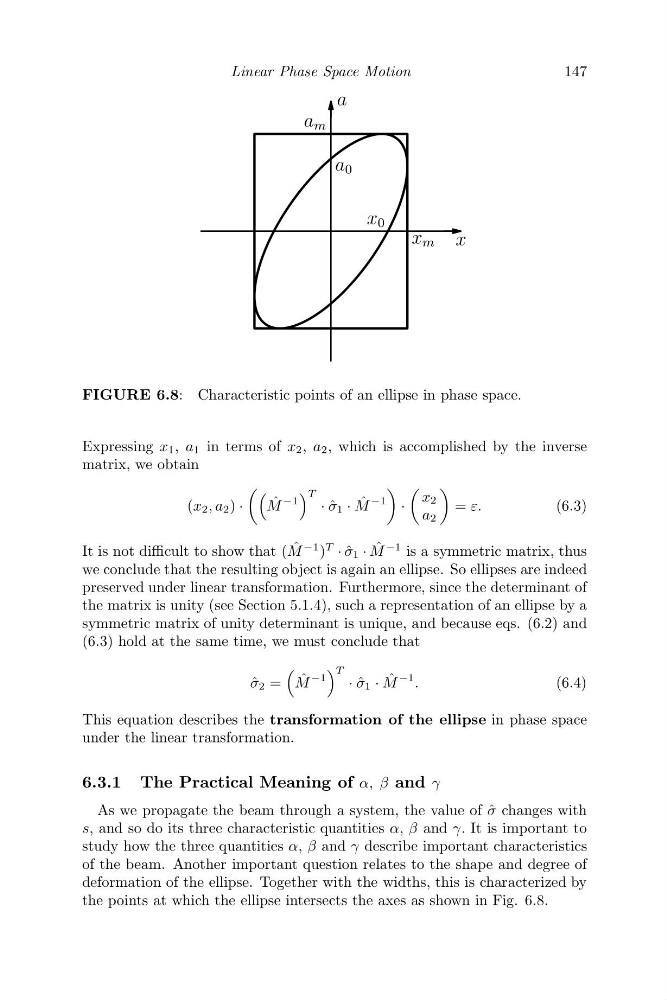
FIGURE 6.8: Characteristic points of an ellipse in phase space.
Expressing x 1 , a 1 in terms of x 2 , a 2 , which is accomplished by the inverse
matrix, we obtain
(x 2 , a 2 ) ·
ˆ
M
−1
T · ˆ
σ 1 · ˆ
M
−1
·
x 2
a 2
= ε.
(6.3)
It is not difficult to show that ( ˆ
M
−1 )
T
· ˆ
σ 1 · ˆ
M
−1 is a symmetric matrix, thus
we conclude that the resulting object is again an ellipse. So ellipses are indeed
preserved under linear transformation. Furthermore, since the determinant of
the matrix is unity (see Section 5.1.4), such a representation of an ellipse by a
symmetric matrix of unity determinant is unique, and because eqs. (6.2) and
(6.3) hold at the same time, we must conclude that
ˆ
σ 2 =
ˆ
M
−1
T · ˆ
σ 1 · ˆ
M
−1 .
(6.4)
This equation describes the transformation of the ellipse in phase space
under the linear transformation.
6.3.1 The Practical Meaning of α, β and γ
As we propagate the beam through a system, the value of ˆ
σ changes with
s, and so do its three characteristic quantities α, β and γ. It is important to
study how the three quantities α, β and γ describe important characteristics
of the beam. Another important question relates to the shape and degree of
deformation of the ellipse. Together with the widths, this is characterized by
the points at which the ellipse intersects the axes as shown in Fig. 6.8.
147
x
a
x m
a m
x 0
a 0
FIGURE 6.8: Characteristic points of an ellipse in phase space.
Expressing x 1 , a 1 in terms of x 2 , a 2 , which is accomplished by the inverse
matrix, we obtain
(x 2 , a 2 ) ·
ˆ
M
−1
T · ˆ
σ 1 · ˆ
M
−1
·
x 2
a 2
= ε.
(6.3)
It is not difficult to show that ( ˆ
M
−1 )
T
· ˆ
σ 1 · ˆ
M
−1 is a symmetric matrix, thus
we conclude that the resulting object is again an ellipse. So ellipses are indeed
preserved under linear transformation. Furthermore, since the determinant of
the matrix is unity (see Section 5.1.4), such a representation of an ellipse by a
symmetric matrix of unity determinant is unique, and because eqs. (6.2) and
(6.3) hold at the same time, we must conclude that
ˆ
σ 2 =
ˆ
M
−1
T · ˆ
σ 1 · ˆ
M
−1 .
(6.4)
This equation describes the transformation of the ellipse in phase space
under the linear transformation.
6.3.1 The Practical Meaning of α, β and γ
As we propagate the beam through a system, the value of ˆ
σ changes with
s, and so do its three characteristic quantities α, β and γ. It is important to
study how the three quantities α, β and γ describe important characteristics
of the beam. Another important question relates to the shape and degree of
deformation of the ellipse. Together with the widths, this is characterized by
the points at which the ellipse intersects the axes as shown in Fig. 6.8.