

Linear Phase Space Motion
145
x 2
a 2
x 1
a 1
M
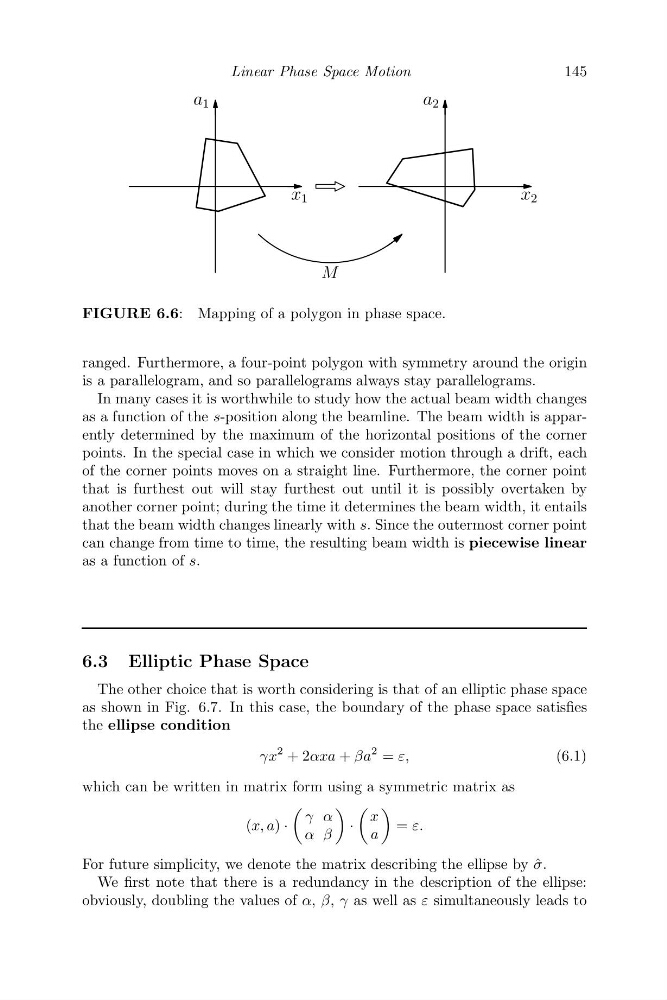
FIGURE 6.6: Mapping of a polygon in phase space.
ranged. Furthermore, a four-point polygon with symmetry around the origin
is a parallelogram, and so parallelograms always stay parallelograms.
In many cases it is worthwhile to study how the actual beam width changes
as a function of the s-position along the beamline. The beam width is apparently determined by the maximum of the horizontal positions of the corner
points. In the special case in which we consider motion through a drift, each
of the corner points moves on a straight line. Furthermore, the corner point
that is furthest out will stay furthest out until it is possibly overtaken by
another corner point; during the time it determines the beam width, it entails
that the beam width changes linearly with s. Since the outermost corner point
can change from time to time, the resulting beam width is piecewise linear
as a function of s.
6.3 Elliptic Phase Space
The other choice that is worth considering is that of an elliptic phase space
as shown in Fig. 6.7. In this case, the boundary of the phase space satisfies
the ellipse condition
γx
2 + 2αxa + βa
2 = ε,
(6.1)
which can be written in matrix form using a symmetric matrix as
(x, a) ·
γ α
α β
·
x
a
= ε.
For future simplicity, we denote the matrix describing the ellipse by ˆ
σ.
We first note that there is a redundancy in the description of the ellipse:
obviously, doubling the values of α, β, γ as well as ε simultaneously leads to
145
x 2
a 2
x 1
a 1
M
FIGURE 6.6: Mapping of a polygon in phase space.
ranged. Furthermore, a four-point polygon with symmetry around the origin
is a parallelogram, and so parallelograms always stay parallelograms.
In many cases it is worthwhile to study how the actual beam width changes
as a function of the s-position along the beamline. The beam width is apparently determined by the maximum of the horizontal positions of the corner
points. In the special case in which we consider motion through a drift, each
of the corner points moves on a straight line. Furthermore, the corner point
that is furthest out will stay furthest out until it is possibly overtaken by
another corner point; during the time it determines the beam width, it entails
that the beam width changes linearly with s. Since the outermost corner point
can change from time to time, the resulting beam width is piecewise linear
as a function of s.
6.3 Elliptic Phase Space
The other choice that is worth considering is that of an elliptic phase space
as shown in Fig. 6.7. In this case, the boundary of the phase space satisfies
the ellipse condition
γx
2 + 2αxa + βa
2 = ε,
(6.1)
which can be written in matrix form using a symmetric matrix as
(x, a) ·
γ α
α β
·
x
a
= ε.
For future simplicity, we denote the matrix describing the ellipse by ˆ
σ.
We first note that there is a redundancy in the description of the ellipse:
obviously, doubling the values of α, β, γ as well as ε simultaneously leads to