

130
An Introduction to Beam Physics
where D denotes the differential part. In the last step use has been made of
the fact that f (x) has no differential part. Hence Differential Algebras are
useful to compute derivatives directly, without requiring an analytic formula
for the derivative and without the inaccuracies of numerical techniques.
The computation of derivatives shall be illustrated in an example using the
following function:
f (x) =
1
x + 1/x
.
(5.16)
The derivative of the function is
f
(x) =
1/x
2
− 1
(x + 1/x)
2 .
Suppose we are interested in the value of the function and its derivative at
x = 2. We obtain
f (2) =
2
5
, f
(2) = −
3
25
.
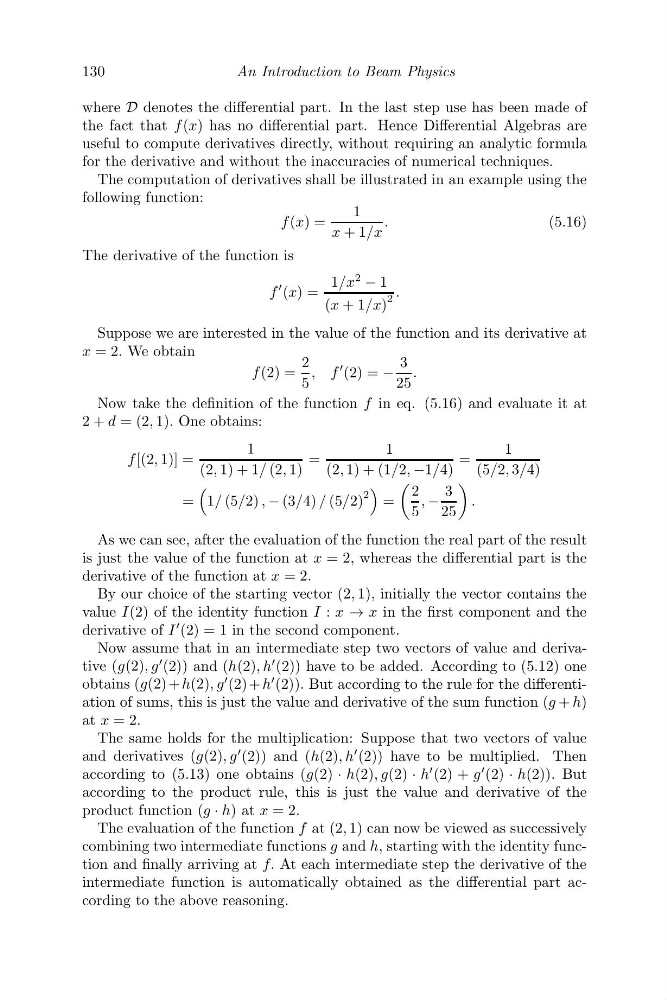
Now take the definition of the function f in eq. (5.16) and evaluate it at
2 + d = (2, 1). One obtains:
f [(2, 1)] =
1
(2, 1) + 1/ (2, 1)
=
1
(2, 1) + (1/2, −1/4)
=
1
(5/2, 3/4)
=
1/ (5/2) , − (3/4) / (5/2)
2
=
2
5
, −
3
25
.
As we can see, after the evaluation of the function the real part of the result
is just the value of the function at x = 2, whereas the differential part is the
derivative of the function at x = 2.
By our choice of the starting vector (2, 1), initially the vector contains the
value I(2) of the identity function I : x → x in the first component and the
derivative of I
(2) = 1 in the second component.
Now assume that in an intermediate step two vectors of value and derivative (g(2), g
(2)) and (h(2), h
(2)) have to be added. According to (5.12) one
obtains (g(2) + h(2), g
(2) + h
(2)). But according to the rule for the differentiation of sums, this is just the value and derivative of the sum function (g + h)
at x = 2.
The same holds for the multiplication: Suppose that two vectors of value
and derivatives (g(2), g
(2)) and (h(2), h
(2)) have to be multiplied. Then
according to (5.13) one obtains (g(2) · h(2), g(2) · h
(2) + g
(2) · h(2)). But
according to the product rule, this is just the value and derivative of the
product function (g · h) at x = 2.
The evaluation of the function f at (2, 1) can now be viewed as successively
combining two intermediate functions g and h, starting with the identity function and finally arriving at f. At each intermediate step the derivative of the
intermediate function is automatically obtained as the differential part according to the above reasoning.
An Introduction to Beam Physics
where D denotes the differential part. In the last step use has been made of
the fact that f (x) has no differential part. Hence Differential Algebras are
useful to compute derivatives directly, without requiring an analytic formula
for the derivative and without the inaccuracies of numerical techniques.
The computation of derivatives shall be illustrated in an example using the
following function:
f (x) =
1
x + 1/x
.
(5.16)
The derivative of the function is
f
(x) =
1/x
2
− 1
(x + 1/x)
2 .
Suppose we are interested in the value of the function and its derivative at
x = 2. We obtain
f (2) =
2
5
, f
(2) = −
3
25
.
Now take the definition of the function f in eq. (5.16) and evaluate it at
2 + d = (2, 1). One obtains:
f [(2, 1)] =
1
(2, 1) + 1/ (2, 1)
=
1
(2, 1) + (1/2, −1/4)
=
1
(5/2, 3/4)
=
1/ (5/2) , − (3/4) / (5/2)
2
=
2
5
, −
3
25
.
As we can see, after the evaluation of the function the real part of the result
is just the value of the function at x = 2, whereas the differential part is the
derivative of the function at x = 2.
By our choice of the starting vector (2, 1), initially the vector contains the
value I(2) of the identity function I : x → x in the first component and the
derivative of I
(2) = 1 in the second component.
Now assume that in an intermediate step two vectors of value and derivative (g(2), g
(2)) and (h(2), h
(2)) have to be added. According to (5.12) one
obtains (g(2) + h(2), g
(2) + h
(2)). But according to the rule for the differentiation of sums, this is just the value and derivative of the sum function (g + h)
at x = 2.
The same holds for the multiplication: Suppose that two vectors of value
and derivatives (g(2), g
(2)) and (h(2), h
(2)) have to be multiplied. Then
according to (5.13) one obtains (g(2) · h(2), g(2) · h
(2) + g
(2) · h(2)). But
according to the product rule, this is just the value and derivative of the
product function (g · h) at x = 2.
The evaluation of the function f at (2, 1) can now be viewed as successively
combining two intermediate functions g and h, starting with the identity function and finally arriving at f. At each intermediate step the derivative of the
intermediate function is automatically obtained as the differential part according to the above reasoning.