

128
An Introduction to Beam Physics
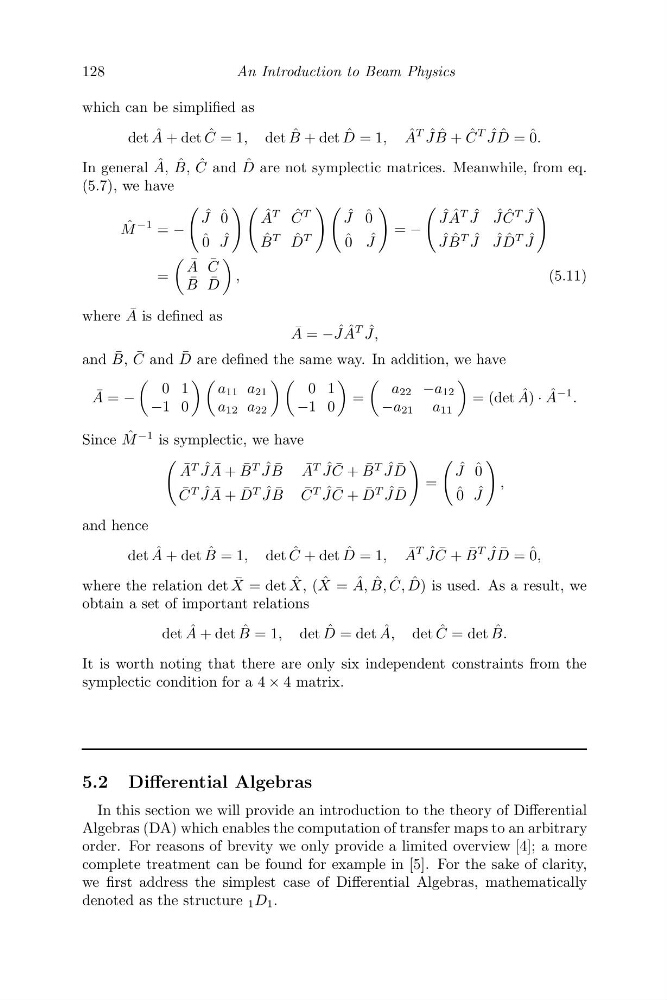
which can be simplified as
det ˆ
A + det ˆ
C = 1, det ˆ
B + det ˆ
D = 1, ˆ
A
T ˆ
J ˆ
B + ˆ
C
T ˆ
J ˆ
D = ˆ 0.
In general ˆ
A, ˆ
B, ˆ
C and ˆ
D are not symplectic matrices. Meanwhile, from eq.
(5.7), we have
ˆ
M
−1 = −
ˆ
J ˆ 0
ˆ 0 ˆ
J
ˆ
A
T ˆ
C
T
ˆ
B
T ˆ
D
T
ˆ
J ˆ 0
ˆ 0 ˆ
J
= −
ˆ
J ˆ
A
T ˆ
J ˆ
J ˆ
C
T ˆ
J
ˆ
J ˆ
B
T ˆ
J ˆ
J ˆ
D
T ˆ
J
=
¯
A ¯
C
¯
B ¯
D
,
(5.11)
where ¯
A is defined as
¯
A = − ˆ
J ˆ
A
T ˆ
J,
and ¯
B, ¯
C and ¯
D are defined the same way. In addition, we have
¯
A = −
0 1
−1 0
a 11 a 21
a 12 a 22
0 1
−1 0
=
a 22 −a 12
−a 21 a 11
= (det ˆ
A) · ˆ
A
−1 .
Since ˆ
M
−1 is symplectic, we have
¯
A
T ˆ
J ¯
A + ¯
B
T ˆ
J ¯
B
¯
A
T ˆ
J ¯
C + ¯
B
T ˆ
J ¯
D
¯
C
T ˆ
J ¯
A + ¯
D
T ˆ
J ¯
B ¯
C
T ˆ
J ¯
C + ¯
D
T ˆ
J ¯
D
=
ˆ
J ˆ 0
ˆ 0 ˆ
J
,
and hence
det ˆ
A + det ˆ
B = 1, det ˆ
C + det ˆ
D = 1, ¯
A
T ˆ
J ¯
C + ¯
B
T ˆ
J ¯
D = ˆ 0,
where the relation det ¯
X = det ˆ
X, ( ˆ
X = ˆ
A, ˆ
B, ˆ
C, ˆ
D) is used. As a result, we
obtain a set of important relations
det ˆ
A + det ˆ
B = 1, det ˆ
D = det ˆ
A, det ˆ
C = det ˆ
B.
It is worth noting that there are only six independent constraints from the
symplectic condition for a 4 × 4 matrix.
5.2 Differential Algebras
In this section we will provide an introduction to the theory of Differential
Algebras (DA) which enables the computation of transfer maps to an arbitrary
order. For reasons of brevity we only provide a limited overview [4]; a more
complete treatment can be found for example in [5]. For the sake of clarity,
we first address the simplest case of Differential Algebras, mathematically
denoted as the structure 1 D 1 .
An Introduction to Beam Physics
which can be simplified as
det ˆ
A + det ˆ
C = 1, det ˆ
B + det ˆ
D = 1, ˆ
A
T ˆ
J ˆ
B + ˆ
C
T ˆ
J ˆ
D = ˆ 0.
In general ˆ
A, ˆ
B, ˆ
C and ˆ
D are not symplectic matrices. Meanwhile, from eq.
(5.7), we have
ˆ
M
−1 = −
ˆ
J ˆ 0
ˆ 0 ˆ
J
ˆ
A
T ˆ
C
T
ˆ
B
T ˆ
D
T
ˆ
J ˆ 0
ˆ 0 ˆ
J
= −
ˆ
J ˆ
A
T ˆ
J ˆ
J ˆ
C
T ˆ
J
ˆ
J ˆ
B
T ˆ
J ˆ
J ˆ
D
T ˆ
J
=
¯
A ¯
C
¯
B ¯
D
,
(5.11)
where ¯
A is defined as
¯
A = − ˆ
J ˆ
A
T ˆ
J,
and ¯
B, ¯
C and ¯
D are defined the same way. In addition, we have
¯
A = −
0 1
−1 0
a 11 a 21
a 12 a 22
0 1
−1 0
=
a 22 −a 12
−a 21 a 11
= (det ˆ
A) · ˆ
A
−1 .
Since ˆ
M
−1 is symplectic, we have
¯
A
T ˆ
J ¯
A + ¯
B
T ˆ
J ¯
B
¯
A
T ˆ
J ¯
C + ¯
B
T ˆ
J ¯
D
¯
C
T ˆ
J ¯
A + ¯
D
T ˆ
J ¯
B ¯
C
T ˆ
J ¯
C + ¯
D
T ˆ
J ¯
D
=
ˆ
J ˆ 0
ˆ 0 ˆ
J
,
and hence
det ˆ
A + det ˆ
B = 1, det ˆ
C + det ˆ
D = 1, ¯
A
T ˆ
J ¯
C + ¯
B
T ˆ
J ¯
D = ˆ 0,
where the relation det ¯
X = det ˆ
X, ( ˆ
X = ˆ
A, ˆ
B, ˆ
C, ˆ
D) is used. As a result, we
obtain a set of important relations
det ˆ
A + det ˆ
B = 1, det ˆ
D = det ˆ
A, det ˆ
C = det ˆ
B.
It is worth noting that there are only six independent constraints from the
symplectic condition for a 4 × 4 matrix.
5.2 Differential Algebras
In this section we will provide an introduction to the theory of Differential
Algebras (DA) which enables the computation of transfer maps to an arbitrary
order. For reasons of brevity we only provide a limited overview [4]; a more
complete treatment can be found for example in [5]. For the sake of clarity,
we first address the simplest case of Differential Algebras, mathematically
denoted as the structure 1 D 1 .