

116
An Introduction to Beam Physics
write
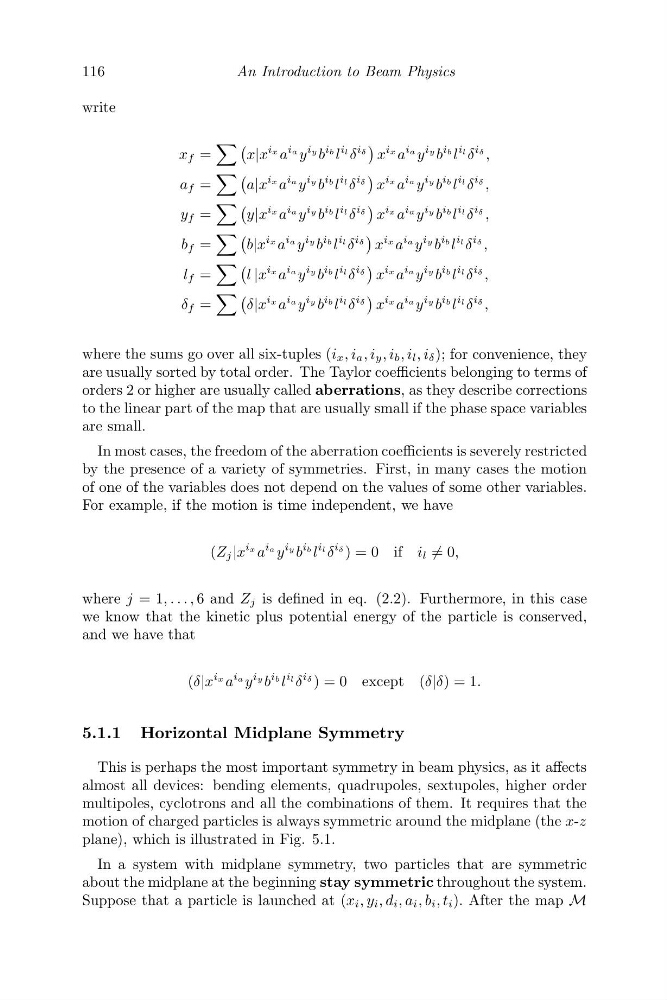
x f =
x|x
ix a
ia y
iy b
i b l
i l δ
i δ
x
ix a
ia y
iy b
i b l
i l δ
i δ ,
a f =
a|x
ix a
ia y
iy b
i b l
i l δ
i δ
x
ix a
ia y
iy b
i b l
i l δ
i δ ,
y f =
y|x
ix a
ia y
iy b
i b l
i l δ
i δ
x
ix a
ia y
iy b
i b l
i l δ
i δ ,
b f =
b|x
ix a
ia y
iy b
i b l
i l δ
i δ
x
ix a
ia y
iy b
i b l
i l δ
i δ ,
l f =
l |x
ix a
ia y
iy b
i b l
i l δ
i δ
x
ix a
ia y
iy b
i b l
i l δ
i δ ,
δ f =
δ|x
ix a
ia y
iy b
i b l
i l δ
i δ
x
ix a
ia y
iy b
i b l
i l δ
i δ ,
where the sums go over all six-tuples (i x , i a , i y , i b , i l , i δ ); for convenience, they
are usually sorted by total order. The Taylor coefficients belonging to terms of
orders 2 or higher are usually called aberrations, as they describe corrections
to the linear part of the map that are usually small if the phase space variables
are small.
In most cases, the freedom of the aberration coefficients is severely restricted
by the presence of a variety of symmetries. First, in many cases the motion
of one of the variables does not depend on the values of some other variables.
For example, if the motion is time independent, we have
(Z j |x
ix a
ia y
iy b
i b l
i l δ
i δ ) = 0 if i l = 0,
where j = 1, . . . , 6 and Z j is defined in eq. (2.2). Furthermore, in this case
we know that the kinetic plus potential energy of the particle is conserved,
and we have that
(δ|x
ix a
ia y
iy b
i b l
i l δ
i δ ) = 0 except (δ|δ) = 1.
5.1.1 Horizontal Midplane Symmetry
This is perhaps the most important symmetry in beam physics, as it affects
almost all devices: bending elements, quadrupoles, sextupoles, higher order
multipoles, cyclotrons and all the combinations of them. It requires that the
motion of charged particles is always symmetric around the midplane (the x-z
plane), which is illustrated in Fig. 5.1.
In a system with midplane symmetry, two particles that are symmetric
about the midplane at the beginning stay symmetric throughout the system.
Suppose that a particle is launched at (x i , y i , d i , a i , b i , t i ). After the map M
An Introduction to Beam Physics
write
x f =
x|x
ix a
ia y
iy b
i b l
i l δ
i δ
x
ix a
ia y
iy b
i b l
i l δ
i δ ,
a f =
a|x
ix a
ia y
iy b
i b l
i l δ
i δ
x
ix a
ia y
iy b
i b l
i l δ
i δ ,
y f =
y|x
ix a
ia y
iy b
i b l
i l δ
i δ
x
ix a
ia y
iy b
i b l
i l δ
i δ ,
b f =
b|x
ix a
ia y
iy b
i b l
i l δ
i δ
x
ix a
ia y
iy b
i b l
i l δ
i δ ,
l f =
l |x
ix a
ia y
iy b
i b l
i l δ
i δ
x
ix a
ia y
iy b
i b l
i l δ
i δ ,
δ f =
δ|x
ix a
ia y
iy b
i b l
i l δ
i δ
x
ix a
ia y
iy b
i b l
i l δ
i δ ,
where the sums go over all six-tuples (i x , i a , i y , i b , i l , i δ ); for convenience, they
are usually sorted by total order. The Taylor coefficients belonging to terms of
orders 2 or higher are usually called aberrations, as they describe corrections
to the linear part of the map that are usually small if the phase space variables
are small.
In most cases, the freedom of the aberration coefficients is severely restricted
by the presence of a variety of symmetries. First, in many cases the motion
of one of the variables does not depend on the values of some other variables.
For example, if the motion is time independent, we have
(Z j |x
ix a
ia y
iy b
i b l
i l δ
i δ ) = 0 if i l = 0,
where j = 1, . . . , 6 and Z j is defined in eq. (2.2). Furthermore, in this case
we know that the kinetic plus potential energy of the particle is conserved,
and we have that
(δ|x
ix a
ia y
iy b
i b l
i l δ
i δ ) = 0 except (δ|δ) = 1.
5.1.1 Horizontal Midplane Symmetry
This is perhaps the most important symmetry in beam physics, as it affects
almost all devices: bending elements, quadrupoles, sextupoles, higher order
multipoles, cyclotrons and all the combinations of them. It requires that the
motion of charged particles is always symmetric around the midplane (the x-z
plane), which is illustrated in Fig. 5.1.
In a system with midplane symmetry, two particles that are symmetric
about the midplane at the beginning stay symmetric throughout the system.
Suppose that a particle is launched at (x i , y i , d i , a i , b i , t i ). After the map M