

The Linearization of the Equations of Motion
85
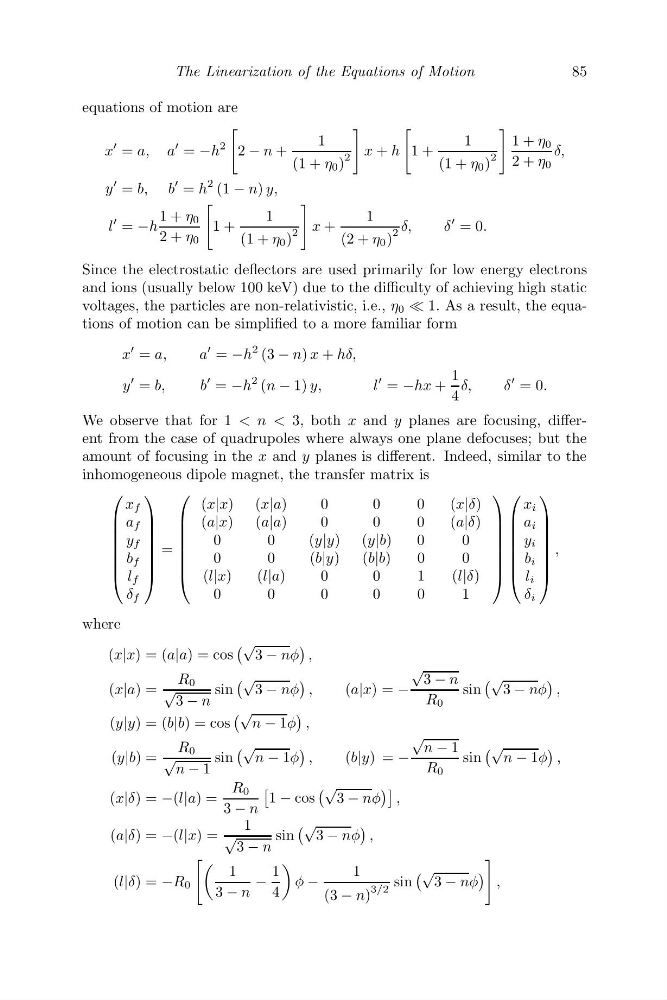
equations of motion are
x
= a, a
= −h
2
2 − n +
1
(1 + η 0 )
2
x + h
1 +
1
(1 + η 0 )
2
1 + η 0
2 + η 0
δ,
y
= b, b
= h
2 (1 − n) y,
l
= −h
1 + η 0
2 + η 0
1 +
1
(1 + η 0 )
2
x +
1
(2 + η 0 )
2 δ,
δ
= 0.
Since the electrostatic deflectors are used primarily for low energy electrons
and ions (usually below 100 keV) due to the difficulty of achieving high static
voltages, the particles are non-relativistic, i.e., η 0 1. As a result, the equations of motion can be simplified to a more familiar form
x
= a,
a
= −h
2 (3 − n) x + hδ,
y
= b,
b
= −h
2 (n − 1) y,
l
= −hx +
1
4
δ,
δ
= 0.
We observe that for 1 < n < 3, both x and y planes are focusing, different from the case of quadrupoles where always one plane defocuses; but the
amount of focusing in the x and y planes is different. Indeed, similar to the
inhomogeneous dipole magnet, the transfer matrix is
⎛
⎜
⎜
⎜
⎜
⎜
⎜
⎝
x f
a f
y f
b f
l f
δ f
⎞
⎟
⎟
⎟
⎟
⎟
⎟
⎠
=
⎛
⎜
⎜
⎜
⎜
⎜
⎜
⎝
(x|x) (x|a)
0
0
0
(x|δ)
(a|x) (a|a)
0
0
0
(a|δ)
0
0
( y|y) (y|b)
0
0
0
0
( b|y)
(b|b)
0
0
(l|x)
(l|a)
0
0
1
(l|δ)
0
0
0
0
0
1
⎞
⎟
⎟
⎟
⎟
⎟
⎟
⎠
⎛
⎜
⎜
⎜
⎜
⎜
⎜
⎝
x i
a i
y i
b i
l i
δ i
⎞
⎟
⎟
⎟
⎟
⎟
⎟
⎠
,
where
(x|x) = (a|a) = cos
√
3 − nφ
,
(x|a) =
R 0
√
3 − n
sin
√
3 − nφ
,
(a|x) = −
√
3 − n
R 0
sin
√
3 − nφ
,
(y|y) = (b|b) = cos
√
n − 1φ
,
(y|b) =
R 0
√
n − 1
sin
√
n − 1φ
,
(b|y) = −
√
n − 1
R 0
sin
√
n − 1φ
,
(x|δ) = −(l|a) =
R 0
3 − n
1 − cos
√
3 − nφ
,
(a|δ) = −(l|x) =
1
√
3 − n
sin
√
3 − nφ
,
(l|δ) = −R 0
1
3 − n
−
1
4
φ −
1
(3 − n)
3/2
sin
√
3 − nφ
,
85
equations of motion are
x
= a, a
= −h
2
2 − n +
1
(1 + η 0 )
2
x + h
1 +
1
(1 + η 0 )
2
1 + η 0
2 + η 0
δ,
y
= b, b
= h
2 (1 − n) y,
l
= −h
1 + η 0
2 + η 0
1 +
1
(1 + η 0 )
2
x +
1
(2 + η 0 )
2 δ,
δ
= 0.
Since the electrostatic deflectors are used primarily for low energy electrons
and ions (usually below 100 keV) due to the difficulty of achieving high static
voltages, the particles are non-relativistic, i.e., η 0 1. As a result, the equations of motion can be simplified to a more familiar form
x
= a,
a
= −h
2 (3 − n) x + hδ,
y
= b,
b
= −h
2 (n − 1) y,
l
= −hx +
1
4
δ,
δ
= 0.
We observe that for 1 < n < 3, both x and y planes are focusing, different from the case of quadrupoles where always one plane defocuses; but the
amount of focusing in the x and y planes is different. Indeed, similar to the
inhomogeneous dipole magnet, the transfer matrix is
⎛
⎜
⎜
⎜
⎜
⎜
⎜
⎝
x f
a f
y f
b f
l f
δ f
⎞
⎟
⎟
⎟
⎟
⎟
⎟
⎠
=
⎛
⎜
⎜
⎜
⎜
⎜
⎜
⎝
(x|x) (x|a)
0
0
0
(x|δ)
(a|x) (a|a)
0
0
0
(a|δ)
0
0
( y|y) (y|b)
0
0
0
0
( b|y)
(b|b)
0
0
(l|x)
(l|a)
0
0
1
(l|δ)
0
0
0
0
0
1
⎞
⎟
⎟
⎟
⎟
⎟
⎟
⎠
⎛
⎜
⎜
⎜
⎜
⎜
⎜
⎝
x i
a i
y i
b i
l i
δ i
⎞
⎟
⎟
⎟
⎟
⎟
⎟
⎠
,
where
(x|x) = (a|a) = cos
√
3 − nφ
,
(x|a) =
R 0
√
3 − n
sin
√
3 − nφ
,
(a|x) = −
√
3 − n
R 0
sin
√
3 − nφ
,
(y|y) = (b|b) = cos
√
n − 1φ
,
(y|b) =
R 0
√
n − 1
sin
√
n − 1φ
,
(b|y) = −
√
n − 1
R 0
sin
√
n − 1φ
,
(x|δ) = −(l|a) =
R 0
3 − n
1 − cos
√
3 − nφ
,
(a|δ) = −(l|x) =
1
√
3 − n
sin
√
3 − nφ
,
(l|δ) = −R 0
1
3 − n
−
1
4
φ −
1
(3 − n)
3/2
sin
√
3 − nφ
,