

70 Damage to concrete structures
gradients and thermal stresses. As soon as the hydration process slows, the
concrete element will start cooling down, causing thermal shrinkage. The
phenomenon of early-age thermal cracking during hydration will be further
discussed in Section 4.4 of this chapter.
It should be well considered that hardening concrete can be very vulnerable to crack formation. During hardening, stresses are quite often
the result of an imposed deformation, e.g. due to shrinkage or thermal
effects. When the imposed deformation is restrained, the resulting stresses
are proportional to the level of restrained deformation and to the stiffness
of the concrete (Young’s modulus). When the concrete tensile strength is
not sufficient to withstand the tensile stress, cracks will occur. At early
age, the Young’s modulus of concrete develops relatively much faster than
the strength (De Schutter and Taerwe 1996). As a consequence, during
hardening, relatively large stresses can occur due to restraint of imposed
deformations while the concrete still has a relatively low strength. This
fundamentally explains why hardening concrete is so sensitive to early-age
crack formation.
4.2 autogenous shrInKage
4.2.1 Mechanism
During the hydration process of cement, the reaction between cement
clinker minerals and water leads to the formation of hydration products, as also explained in Chapter 1. These chemical transformations
are accompanied by a volume reduction, as the resulting volume of the
reaction products formed is smaller than the sum of the volumes of the
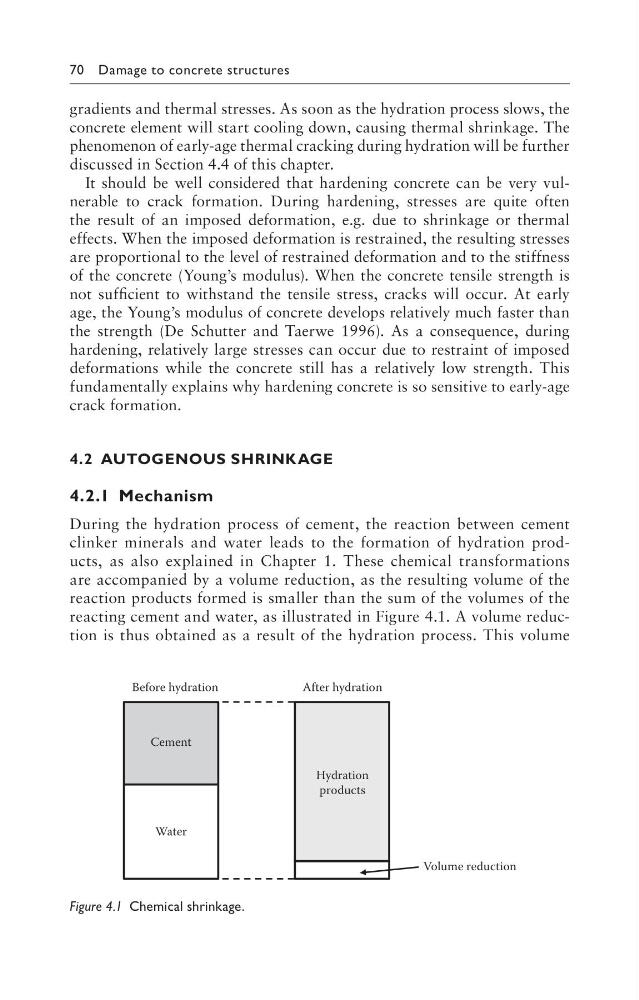
reacting cement and water, as illustrated in Figure 4.1. A volume reduction is thus obtained as a result of the hydration process. This volume
Volume reduction
After hydration
Hydration
products
Before hydration
Cement
Water
Figure 4.1 Chemical shrinkage.
gradients and thermal stresses. As soon as the hydration process slows, the
concrete element will start cooling down, causing thermal shrinkage. The
phenomenon of early-age thermal cracking during hydration will be further
discussed in Section 4.4 of this chapter.
It should be well considered that hardening concrete can be very vulnerable to crack formation. During hardening, stresses are quite often
the result of an imposed deformation, e.g. due to shrinkage or thermal
effects. When the imposed deformation is restrained, the resulting stresses
are proportional to the level of restrained deformation and to the stiffness
of the concrete (Young’s modulus). When the concrete tensile strength is
not sufficient to withstand the tensile stress, cracks will occur. At early
age, the Young’s modulus of concrete develops relatively much faster than
the strength (De Schutter and Taerwe 1996). As a consequence, during
hardening, relatively large stresses can occur due to restraint of imposed
deformations while the concrete still has a relatively low strength. This
fundamentally explains why hardening concrete is so sensitive to early-age
crack formation.
4.2 autogenous shrInKage
4.2.1 Mechanism
During the hydration process of cement, the reaction between cement
clinker minerals and water leads to the formation of hydration products, as also explained in Chapter 1. These chemical transformations
are accompanied by a volume reduction, as the resulting volume of the
reaction products formed is smaller than the sum of the volumes of the
reacting cement and water, as illustrated in Figure 4.1. A volume reduction is thus obtained as a result of the hydration process. This volume
Volume reduction
After hydration
Hydration
products
Before hydration
Cement
Water
Figure 4.1 Chemical shrinkage.