

Errors during casting 65
(a few centimetres deep into the concrete), they can also run through the
entire concrete slab depending on the boundary conditions.
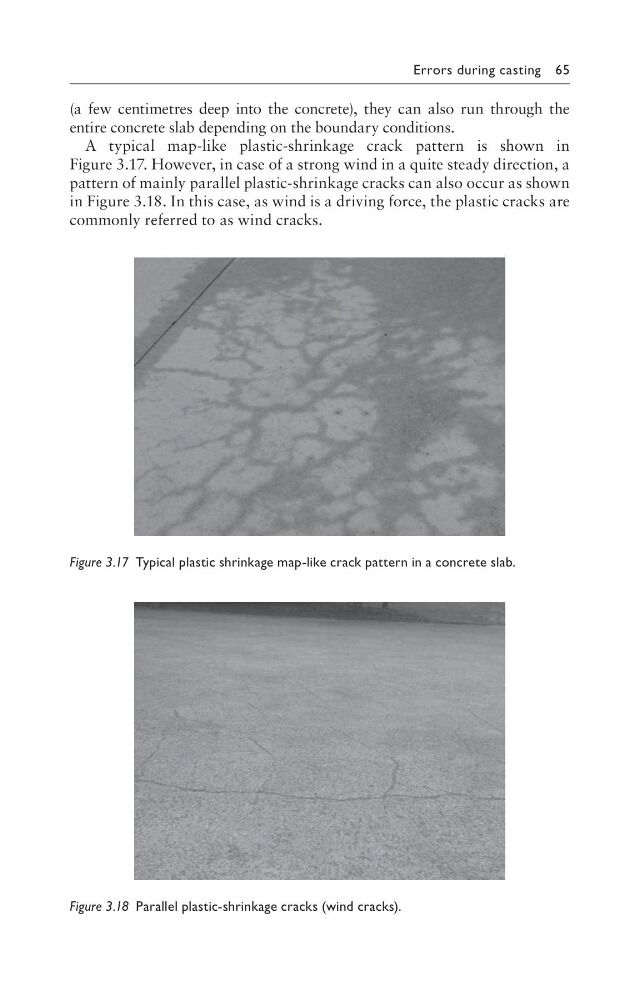
A typical map-like plastic-shrinkage crack pattern is shown in
Figure 3.17. However, in case of a strong wind in a quite steady direction, a
pattern of mainly parallel plastic-shrinkage cracks can also occur as shown
in Figure 3.18. In this case, as wind is a driving force, the plastic cracks are
commonly referred to as wind cracks.
Figure 3.17 Typical plastic shrinkage map-like crack pattern in a concrete slab.
Figure 3.18 Parallel plastic-shrinkage cracks (wind cracks).
(a few centimetres deep into the concrete), they can also run through the
entire concrete slab depending on the boundary conditions.
A typical map-like plastic-shrinkage crack pattern is shown in
Figure 3.17. However, in case of a strong wind in a quite steady direction, a
pattern of mainly parallel plastic-shrinkage cracks can also occur as shown
in Figure 3.18. In this case, as wind is a driving force, the plastic cracks are
commonly referred to as wind cracks.
Figure 3.17 Typical plastic shrinkage map-like crack pattern in a concrete slab.
Figure 3.18 Parallel plastic-shrinkage cracks (wind cracks).