

Inappropriate design 31
2.2.1 collapse of the Melle bridge, belgium, 1991
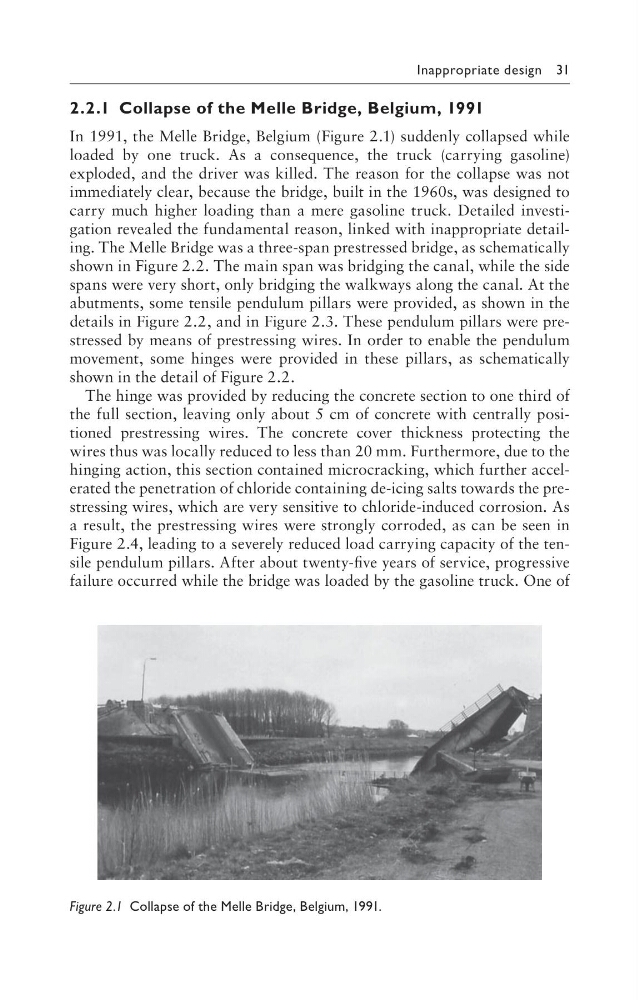
In 1991, the Melle Bridge, Belgium (Figure 2.1) suddenly collapsed while
loaded by one truck. As a consequence, the truck (carrying gasoline)
exploded, and the driver was killed. The reason for the collapse was not
immediately clear, because the bridge, built in the 1960s, was designed to
carry much higher loading than a mere gasoline truck. Detailed investigation revealed the fundamental reason, linked with inappropriate detailing. The Melle Bridge was a three-span prestressed bridge, as schematically
shown in Figure 2.2. The main span was bridging the canal, while the side
spans were very short, only bridging the walkways along the canal. At the
abutments, some tensile pendulum pillars were provided, as shown in the
details in Figure 2.2, and in Figure 2.3. These pendulum pillars were prestressed by means of prestressing wires. In order to enable the pendulum
movement, some hinges were provided in these pillars, as schematically
shown in the detail of Figure 2.2.
The hinge was provided by reducing the concrete section to one third of
the full section, leaving only about 5 cm of concrete with centrally positioned prestressing wires. The concrete cover thickness protecting the
wires thus was locally reduced to less than 20 mm. Furthermore, due to the
hinging action, this section contained microcracking, which further accelerated the penetration of chloride containing de-icing salts towards the prestressing wires, which are very sensitive to chloride-induced corrosion. As
a result, the prestressing wires were strongly corroded, as can be seen in
Figure 2.4, leading to a severely reduced load carrying capacity of the tensile pendulum pillars. After about twenty-five years of service, progressive
failure occurred while the bridge was loaded by the gasoline truck. One of
Figure 2.1 Collapse of the Melle Bridge, Belgium, 1991.
2.2.1 collapse of the Melle bridge, belgium, 1991
In 1991, the Melle Bridge, Belgium (Figure 2.1) suddenly collapsed while
loaded by one truck. As a consequence, the truck (carrying gasoline)
exploded, and the driver was killed. The reason for the collapse was not
immediately clear, because the bridge, built in the 1960s, was designed to
carry much higher loading than a mere gasoline truck. Detailed investigation revealed the fundamental reason, linked with inappropriate detailing. The Melle Bridge was a three-span prestressed bridge, as schematically
shown in Figure 2.2. The main span was bridging the canal, while the side
spans were very short, only bridging the walkways along the canal. At the
abutments, some tensile pendulum pillars were provided, as shown in the
details in Figure 2.2, and in Figure 2.3. These pendulum pillars were prestressed by means of prestressing wires. In order to enable the pendulum
movement, some hinges were provided in these pillars, as schematically
shown in the detail of Figure 2.2.
The hinge was provided by reducing the concrete section to one third of
the full section, leaving only about 5 cm of concrete with centrally positioned prestressing wires. The concrete cover thickness protecting the
wires thus was locally reduced to less than 20 mm. Furthermore, due to the
hinging action, this section contained microcracking, which further accelerated the penetration of chloride containing de-icing salts towards the prestressing wires, which are very sensitive to chloride-induced corrosion. As
a result, the prestressing wires were strongly corroded, as can be seen in
Figure 2.4, leading to a severely reduced load carrying capacity of the tensile pendulum pillars. After about twenty-five years of service, progressive
failure occurred while the bridge was loaded by the gasoline truck. One of
Figure 2.1 Collapse of the Melle Bridge, Belgium, 1991.