

16 Damage to concrete structures
To illustrate the effect of a reduced cover thickness, suppose that the end
of service life is reached when the carbonation depth reaches the steel reinforcement. According to the evolution shown in Figure 1.9, a concrete cover
thickness of 2.5 cm is required to reach a service life of one hundred years.
In case the real cover, due to inadequate positioning of formwork and reinforcement cage, is reduced to half the prescribed value, the service life is
tremendously reduced to only fifteen years (and not to fifty years, which
would be half the targeted service life!). This numerical example clearly
illustrates the importance of cover thickness. An effective quality control
system should be defined on site in order to make sure that the prescribed
cover thickness is strictly respected.
Freshly cast concrete should also be properly cured in order to make sure
that the cement hydration proceeds in a good way and that no early age
cracks occur due to loss of water. Depending on some important parameters
(such as the hardening rate of the concrete and temperature and humidity
of the environment), the curing period should be appropriately determined.
It is not the intention of this text to outline different curing methods. It will
only be explained here what the effect of improper curing could be on the
final durability of the concrete element.
A first consequence of bad curing could be a reduction of the concrete
quality because early loss of water might lead to a premature end of the
hydration process which can only partly be recovered later on by rewetting.
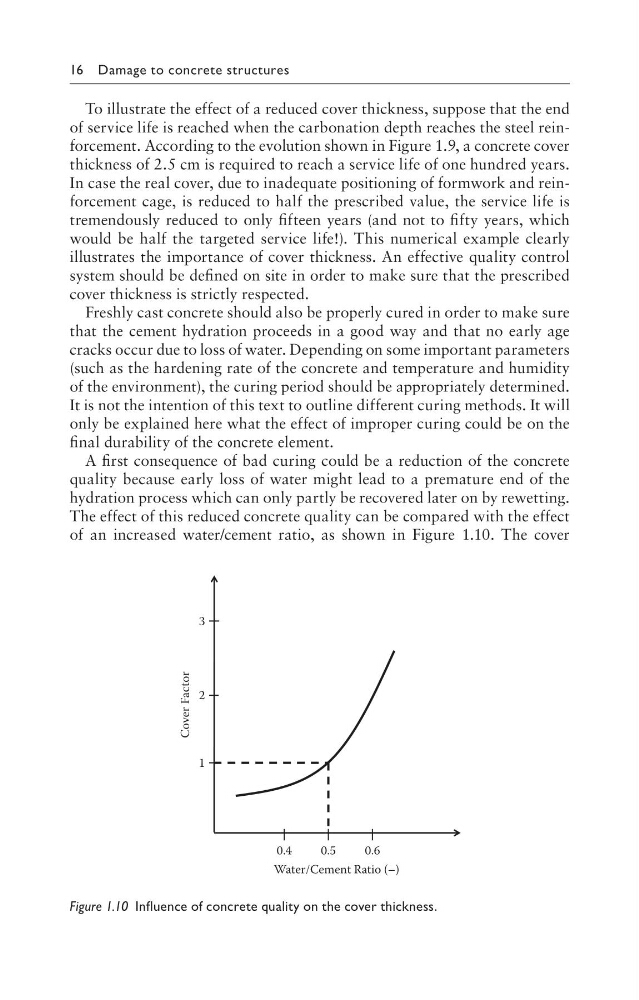
The effect of this reduced concrete quality can be compared with the effect
of an increased water/cement ratio, as shown in Figure 1.10. The cover
0.4
1
2
Cover Factor
3
0.5
0.6
Water/Cement Ratio (–)
Figure 1.10 Influence of concrete quality on the cover thickness.
To illustrate the effect of a reduced cover thickness, suppose that the end
of service life is reached when the carbonation depth reaches the steel reinforcement. According to the evolution shown in Figure 1.9, a concrete cover
thickness of 2.5 cm is required to reach a service life of one hundred years.
In case the real cover, due to inadequate positioning of formwork and reinforcement cage, is reduced to half the prescribed value, the service life is
tremendously reduced to only fifteen years (and not to fifty years, which
would be half the targeted service life!). This numerical example clearly
illustrates the importance of cover thickness. An effective quality control
system should be defined on site in order to make sure that the prescribed
cover thickness is strictly respected.
Freshly cast concrete should also be properly cured in order to make sure
that the cement hydration proceeds in a good way and that no early age
cracks occur due to loss of water. Depending on some important parameters
(such as the hardening rate of the concrete and temperature and humidity
of the environment), the curing period should be appropriately determined.
It is not the intention of this text to outline different curing methods. It will
only be explained here what the effect of improper curing could be on the
final durability of the concrete element.
A first consequence of bad curing could be a reduction of the concrete
quality because early loss of water might lead to a premature end of the
hydration process which can only partly be recovered later on by rewetting.
The effect of this reduced concrete quality can be compared with the effect
of an increased water/cement ratio, as shown in Figure 1.10. The cover
0.4
1
2
Cover Factor
3
0.5
0.6
Water/Cement Ratio (–)
Figure 1.10 Influence of concrete quality on the cover thickness.