

12 Damage to concrete structures
Figure 1.8 illustrates the major importance of the water/cement ratio for
the permeability and thus for the durability of paste, mortar, and concrete.
For a water/cement ratio higher than 0.5, a pore structure is obtained with
a higher degree of percolation. The more the pore structure percolates,
the faster aggressive substances can enter the material. Avoiding a percolating pore structure should be considered as a necessary condition in
order to obtain a durable concrete. In this respect, concrete with a water/
cement ratio larger than 0.6 can hardly be named durable. Durable concrete requires a limited water/cement ratio.
1.4.3 cement content
As such, the cement content is not a decisive parameter for the durability of concrete. It is clear that the cement content does have an influence
for instance on the amount of chlorides that can be chemically bound in
concrete or the amount of carbon dioxide that can be buffered by the portlandite. However, the influence of cement content will be less determining
than the influence of the water/cement ratio.
As the durability (and also the strength) of concrete depends on the properties of the hydrated cement matrix, the cement concentration within this
matrix surely has an influence. On the other hand, the required cement
matrix volume is dependent on the maximum particle size of the aggregates. For a larger aggregate size, the needed matrix volume to ‘glue’ the
particles is lower. As a result, the cement content per cubic meter of concrete should be studied in relation to the maximum particle size applied in
the concrete. This interrelation was well understood in the former British
Standard BS 5328:Part 1:1991, prescribing a correction of the required
cement content per cubic meter of concrete depending on the maximum
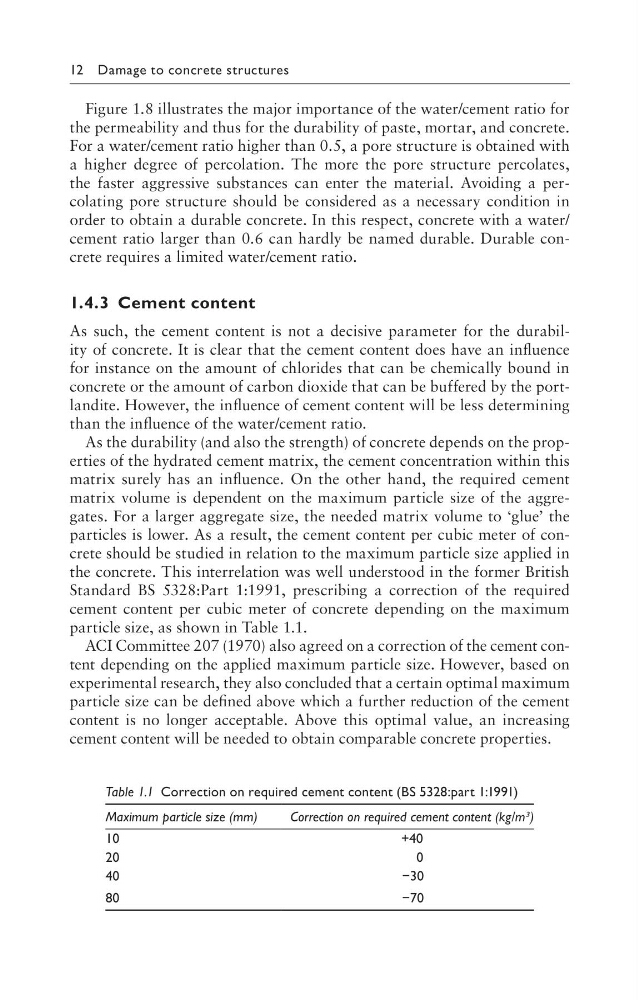
particle size, as shown in Table 1.1.
ACI Committee 207 (1970) also agreed on a correction of the cement content depending on the applied maximum particle size. However, based on
experimental research, they also concluded that a certain optimal maximum
particle size can be defined above which a further reduction of the cement
content is no longer acceptable. Above this optimal value, an increasing
cement content will be needed to obtain comparable concrete properties.
Table 1.1 Correction on required cement content (BS 5328:part 1:1991)
Maximum particle size (mm)
Correction on required cement content (kg/m³)
10
+40
20
0
40
−30
80
−70
Figure 1.8 illustrates the major importance of the water/cement ratio for
the permeability and thus for the durability of paste, mortar, and concrete.
For a water/cement ratio higher than 0.5, a pore structure is obtained with
a higher degree of percolation. The more the pore structure percolates,
the faster aggressive substances can enter the material. Avoiding a percolating pore structure should be considered as a necessary condition in
order to obtain a durable concrete. In this respect, concrete with a water/
cement ratio larger than 0.6 can hardly be named durable. Durable concrete requires a limited water/cement ratio.
1.4.3 cement content
As such, the cement content is not a decisive parameter for the durability of concrete. It is clear that the cement content does have an influence
for instance on the amount of chlorides that can be chemically bound in
concrete or the amount of carbon dioxide that can be buffered by the portlandite. However, the influence of cement content will be less determining
than the influence of the water/cement ratio.
As the durability (and also the strength) of concrete depends on the properties of the hydrated cement matrix, the cement concentration within this
matrix surely has an influence. On the other hand, the required cement
matrix volume is dependent on the maximum particle size of the aggregates. For a larger aggregate size, the needed matrix volume to ‘glue’ the
particles is lower. As a result, the cement content per cubic meter of concrete should be studied in relation to the maximum particle size applied in
the concrete. This interrelation was well understood in the former British
Standard BS 5328:Part 1:1991, prescribing a correction of the required
cement content per cubic meter of concrete depending on the maximum
particle size, as shown in Table 1.1.
ACI Committee 207 (1970) also agreed on a correction of the cement content depending on the applied maximum particle size. However, based on
experimental research, they also concluded that a certain optimal maximum
particle size can be defined above which a further reduction of the cement
content is no longer acceptable. Above this optimal value, an increasing
cement content will be needed to obtain comparable concrete properties.
Table 1.1 Correction on required cement content (BS 5328:part 1:1991)
Maximum particle size (mm)
Correction on required cement content (kg/m³)
10
+40
20
0
40
−30
80
−70