

154 Damage to concrete structures
including Na 2 SO 4 , CaSO 4 , FeSO 4 and MgSO 4 . For example, in Korla
City, Xinjiang Province, China, within the groundwater the SO 4
2− content
is about 21,000 mg/l, while the Mg 2+ content is about 3600 mg/l. In the
Baijialing Tunnel of Chengkun Railway (from Chengdu City to Kunming
City), the SO 4
2− concentration in the water present in the tunnel drainage
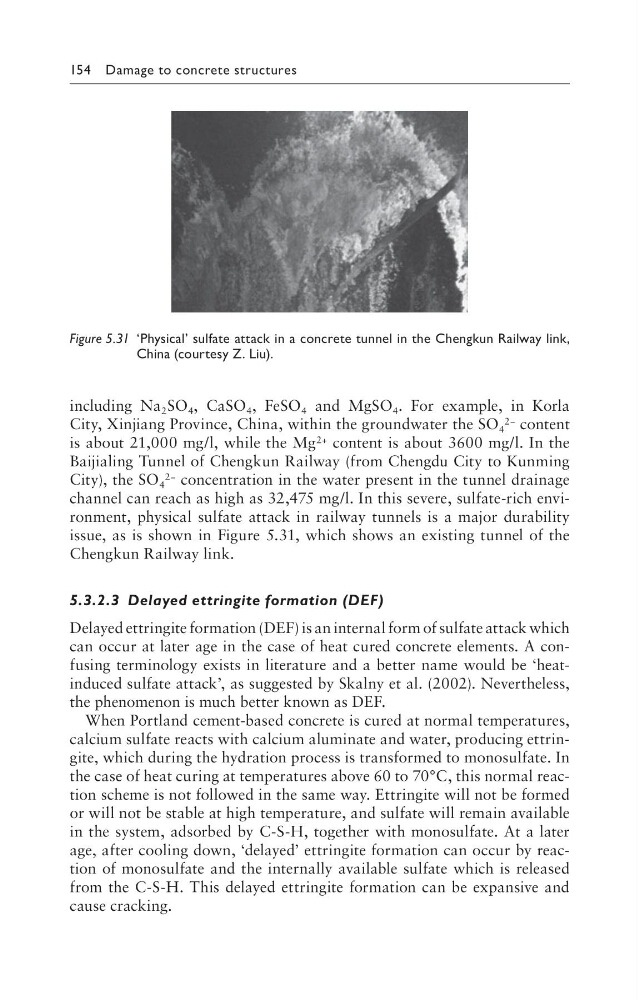
channel can reach as high as 32,475 mg/l. In this severe, sulfate-rich environment, physical sulfate attack in railway tunnels is a major durability
issue, as is shown in Figure 5.31, which shows an existing tunnel of the
Chengkun Railway link.
5.3.2.3 Delayed ettringite formation (DEF)
Delayed ettringite formation (DEF) is an internal form of sulfate attack which
can occur at later age in the case of heat cured concrete elements. A confusing terminology exists in literature and a better name would be ‘heatinduced sulfate attack’, as suggested by Skalny et al. (2002). Nevertheless,
the phenomenon is much better known as DEF.
When Portland cement-based concrete is cured at normal temperatures,
calcium sulfate reacts with calcium aluminate and water, producing ettringite, which during the hydration process is transformed to monosulfate. In
the case of heat curing at temperatures above 60 to 70°C, this normal reaction scheme is not followed in the same way. Ettringite will not be formed
or will not be stable at high temperature, and sulfate will remain available
in the system, adsorbed by C-S-H, together with monosulfate. At a later
age, after cooling down, ‘delayed’ ettringite formation can occur by reaction of monosulfate and the internally available sulfate which is released
from the C-S-H. This delayed ettringite formation can be expansive and
cause cracking.
Figure 5.31 ‘Physical’ sulfate attack in a concrete tunnel in the Chengkun Railway link,
China (courtesy Z. Liu).
including Na 2 SO 4 , CaSO 4 , FeSO 4 and MgSO 4 . For example, in Korla
City, Xinjiang Province, China, within the groundwater the SO 4
2− content
is about 21,000 mg/l, while the Mg 2+ content is about 3600 mg/l. In the
Baijialing Tunnel of Chengkun Railway (from Chengdu City to Kunming
City), the SO 4
2− concentration in the water present in the tunnel drainage
channel can reach as high as 32,475 mg/l. In this severe, sulfate-rich environment, physical sulfate attack in railway tunnels is a major durability
issue, as is shown in Figure 5.31, which shows an existing tunnel of the
Chengkun Railway link.
5.3.2.3 Delayed ettringite formation (DEF)
Delayed ettringite formation (DEF) is an internal form of sulfate attack which
can occur at later age in the case of heat cured concrete elements. A confusing terminology exists in literature and a better name would be ‘heatinduced sulfate attack’, as suggested by Skalny et al. (2002). Nevertheless,
the phenomenon is much better known as DEF.
When Portland cement-based concrete is cured at normal temperatures,
calcium sulfate reacts with calcium aluminate and water, producing ettringite, which during the hydration process is transformed to monosulfate. In
the case of heat curing at temperatures above 60 to 70°C, this normal reaction scheme is not followed in the same way. Ettringite will not be formed
or will not be stable at high temperature, and sulfate will remain available
in the system, adsorbed by C-S-H, together with monosulfate. At a later
age, after cooling down, ‘delayed’ ettringite formation can occur by reaction of monosulfate and the internally available sulfate which is released
from the C-S-H. This delayed ettringite formation can be expansive and
cause cracking.
Figure 5.31 ‘Physical’ sulfate attack in a concrete tunnel in the Chengkun Railway link,
China (courtesy Z. Liu).