

148 Damage to concrete structures
Thaumasite and ettringite have similar structures replacing Al(OH) 6
3−
ions with Si(OH) 6
2− ions and (3SO 4
2− + 2H 2 O) with (2CO 3
2− + 2SO 4
2− )
(Skalny et al. 2002). Nevertheless, in the case of direct thaumasite formation, the concrete loses strength due to decomposition of C-S-H and the
consequent softening of the matrix rather than due to expansive cracking.
TSA can proceed much faster when exposed to a magnesium sulfate solution, as in this case the C-S-H is decomposing faster.
Apart from the direct route to form thaumasite as explained in the previous paragraph, an indirect route through ettringite, called the woodfordite
route, is also possible (Irassar 2009). However, according to Kohler et al.,
the woodfordite route is not followed, while the direct route is extremely
slow, if not unlikely (Kohler et al. 2006). According to Kohler et al., thaumasite is rather formed through nucleation on the ettringite surface when
the C-S-H is decomposed.
The appearance of thaumasite sulfate attack in real structures seems to
be a point of discussion. However, in the 1990s, an increasing number of
TSA cases were reported in the United Kingdom (Skalny et al. 2002). In a
recent study, Bellmann et al. (2012) reported TSA to be the main damage
cause in a series of 20 investigated structures, while ettringite only damaged one structure in this series.
The risk of TSA is said to increase when self-compacting concrete contains limestone filler, although this statement is also under debate. Bassuoni
et al. (2009) reported some inferior performance of limestone filler-based
self-compacting concrete ascribed to TSA upon exposure to sodium sulfate
and cold temperatures. They stated that ‘such a performance risk should
Original Cement Paste
Pore Solution
Liquid
R eaction Zone
AFm
AFt
SO 4
2–
SO 4
2–
Mg
2+
C-S-H
Ca(OH) 2
Ca
2+
Mg
2+
Mg(OH) 2
OH
–
3MgO.2SiO 2 .2H 2 O
SiO 2 .aq
CaSO 4 .2H 2 O
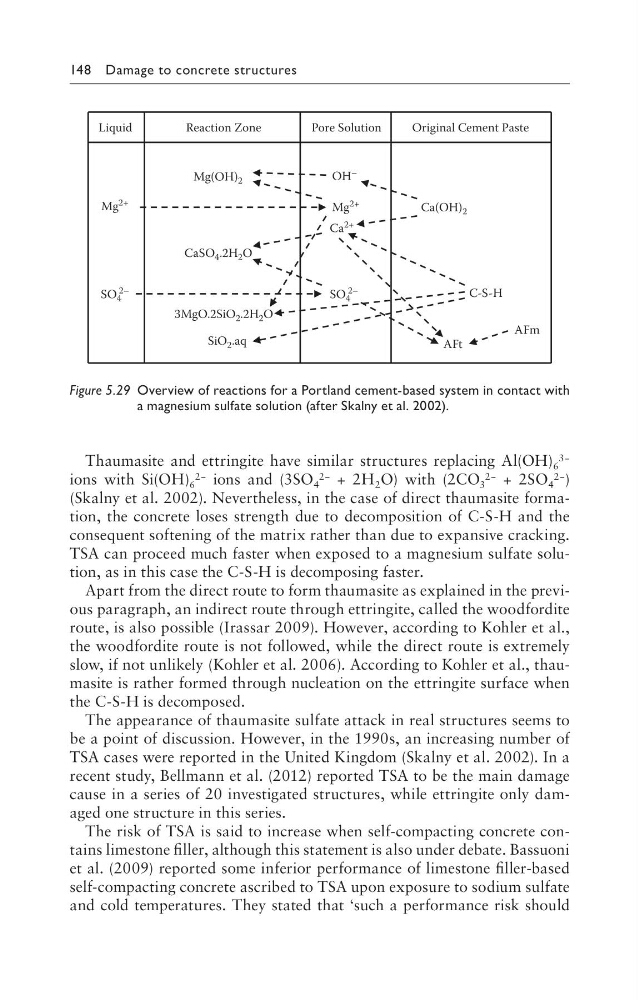
Figure 5.29 Overview of reactions for a Portland cement-based system in contact with
a magnesium sulfate solution (after Skalny et al. 2002).
Thaumasite and ettringite have similar structures replacing Al(OH) 6
3−
ions with Si(OH) 6
2− ions and (3SO 4
2− + 2H 2 O) with (2CO 3
2− + 2SO 4
2− )
(Skalny et al. 2002). Nevertheless, in the case of direct thaumasite formation, the concrete loses strength due to decomposition of C-S-H and the
consequent softening of the matrix rather than due to expansive cracking.
TSA can proceed much faster when exposed to a magnesium sulfate solution, as in this case the C-S-H is decomposing faster.
Apart from the direct route to form thaumasite as explained in the previous paragraph, an indirect route through ettringite, called the woodfordite
route, is also possible (Irassar 2009). However, according to Kohler et al.,
the woodfordite route is not followed, while the direct route is extremely
slow, if not unlikely (Kohler et al. 2006). According to Kohler et al., thaumasite is rather formed through nucleation on the ettringite surface when
the C-S-H is decomposed.
The appearance of thaumasite sulfate attack in real structures seems to
be a point of discussion. However, in the 1990s, an increasing number of
TSA cases were reported in the United Kingdom (Skalny et al. 2002). In a
recent study, Bellmann et al. (2012) reported TSA to be the main damage
cause in a series of 20 investigated structures, while ettringite only damaged one structure in this series.
The risk of TSA is said to increase when self-compacting concrete contains limestone filler, although this statement is also under debate. Bassuoni
et al. (2009) reported some inferior performance of limestone filler-based
self-compacting concrete ascribed to TSA upon exposure to sodium sulfate
and cold temperatures. They stated that ‘such a performance risk should
Original Cement Paste
Pore Solution
Liquid
R eaction Zone
AFm
AFt
SO 4
2–
SO 4
2–
Mg
2+
C-S-H
Ca(OH) 2
Ca
2+
Mg
2+
Mg(OH) 2
OH
–
3MgO.2SiO 2 .2H 2 O
SiO 2 .aq
CaSO 4 .2H 2 O
Figure 5.29 Overview of reactions for a Portland cement-based system in contact with
a magnesium sulfate solution (after Skalny et al. 2002).