

146 Damage to concrete structures
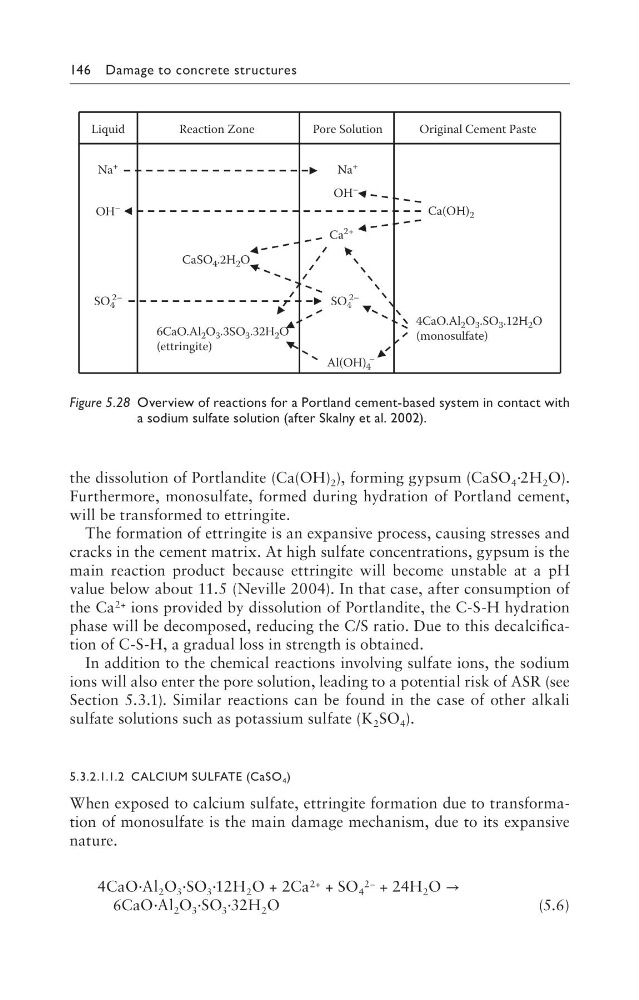
the dissolution of Portlandite (Ca(OH) 2 ), forming gypsum (CaSO 4 ∙2H 2 O).
Furthermore, monosulfate, formed during hydration of Portland cement,
will be transformed to ettringite.
The formation of ettringite is an expansive process, causing stresses and
cracks in the cement matrix. At high sulfate concentrations, gypsum is the
main reaction product because ettringite will become unstable at a pH
value below about 11.5 (Neville 2004). In that case, after consumption of
the Ca 2+ ions provided by dissolution of Portlandite, the C-S-H hydration
phase will be decomposed, reducing the C/S ratio. Due to this decalcification of C-S-H, a gradual loss in strength is obtained.
In addition to the chemical reactions involving sulfate ions, the sodium
ions will also enter the pore solution, leading to a potential risk of ASR (see
Section 5.3.1). Similar reactions can be found in the case of other alkali
sulfate solutions such as potassium sulfate (K 2 SO 4 ).
5.3.2.1.1.2 CALCIUM SULFATE (CaSO 4 )
When exposed to calcium sulfate, ettringite formation due to transformation of monosulfate is the main damage mechanism, due to its expansive
nature.
4CaO∙Al 2 O 3 ∙SO 3 ∙12H 2 O + 2Ca 2+ + SO 4
2− + 24H 2 O →
6CaO∙Al 2 O 3 ∙SO 3 ∙32H 2 O
(5.6)
4CaO.Al 2 O 3 .SO 3 .12H 2 O
(monosulfate)
Al(OH) 4
–
Ca 2+
6CaO.Al 2 O 3 .3SO 3 .32H 2 O
(ettringite)
Ca(OH) 2
CaSO 4 .2H 2 O
Original Cement Paste
Pore Solution
Liquid
Na
+
OH
–
SO 4
2–
SO 4
2–
Na
+
OH
–
Reaction Zone
Figure 5.28 Overview of reactions for a Portland cement-based system in contact with
a sodium sulfate solution (after Skalny et al. 2002).
the dissolution of Portlandite (Ca(OH) 2 ), forming gypsum (CaSO 4 ∙2H 2 O).
Furthermore, monosulfate, formed during hydration of Portland cement,
will be transformed to ettringite.
The formation of ettringite is an expansive process, causing stresses and
cracks in the cement matrix. At high sulfate concentrations, gypsum is the
main reaction product because ettringite will become unstable at a pH
value below about 11.5 (Neville 2004). In that case, after consumption of
the Ca 2+ ions provided by dissolution of Portlandite, the C-S-H hydration
phase will be decomposed, reducing the C/S ratio. Due to this decalcification of C-S-H, a gradual loss in strength is obtained.
In addition to the chemical reactions involving sulfate ions, the sodium
ions will also enter the pore solution, leading to a potential risk of ASR (see
Section 5.3.1). Similar reactions can be found in the case of other alkali
sulfate solutions such as potassium sulfate (K 2 SO 4 ).
5.3.2.1.1.2 CALCIUM SULFATE (CaSO 4 )
When exposed to calcium sulfate, ettringite formation due to transformation of monosulfate is the main damage mechanism, due to its expansive
nature.
4CaO∙Al 2 O 3 ∙SO 3 ∙12H 2 O + 2Ca 2+ + SO 4
2− + 24H 2 O →
6CaO∙Al 2 O 3 ∙SO 3 ∙32H 2 O
(5.6)
4CaO.Al 2 O 3 .SO 3 .12H 2 O
(monosulfate)
Al(OH) 4
–
Ca 2+
6CaO.Al 2 O 3 .3SO 3 .32H 2 O
(ettringite)
Ca(OH) 2
CaSO 4 .2H 2 O
Original Cement Paste
Pore Solution
Liquid
Na
+
OH
–
SO 4
2–
SO 4
2–
Na
+
OH
–
Reaction Zone
Figure 5.28 Overview of reactions for a Portland cement-based system in contact with
a sodium sulfate solution (after Skalny et al. 2002).