

140 Damage to concrete structures
The moisture content depends on the environmental conditions and on
the dimensions of the element. Larger elements typically maintain a higher
internal relative humidity, even in the case of a dryer environment, while
more slender elements will more rapidly show a dryer internal relative
humidity in a drying environment.
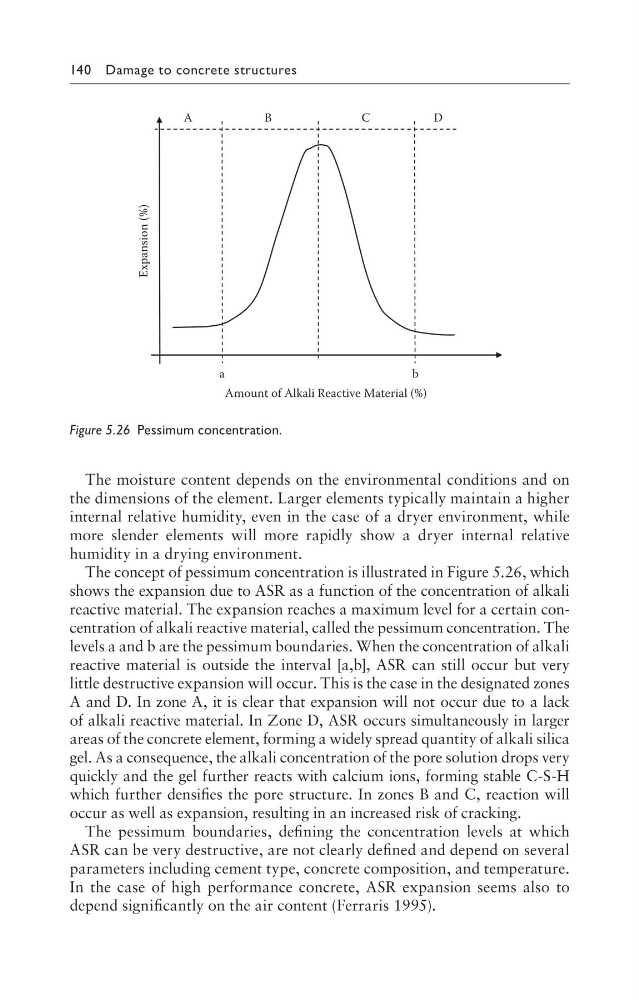
The concept of pessimum concentration is illustrated in Figure 5.26, which
shows the expansion due to ASR as a function of the concentration of alkali
reactive material. The expansion reaches a maximum level for a certain concentration of alkali reactive material, called the pessimum concentration. The
levels a and b are the pessimum boundaries. When the concentration of alkali
reactive material is outside the interval [a,b], ASR can still occur but very
little destructive expansion will occur. This is the case in the designated zones
A and D. In zone A, it is clear that expansion will not occur due to a lack
of alkali reactive material. In Zone D, ASR occurs simultaneously in larger
areas of the concrete element, forming a widely spread quantity of alkali silica
gel. As a consequence, the alkali concentration of the pore solution drops very
quickly and the gel further reacts with calcium ions, forming stable C-S-H
which further densifies the pore structure. In zones B and C, reaction will
occur as well as expansion, resulting in an increased risk of cracking.
The pessimum boundaries, defining the concentration levels at which
ASR can be very destructive, are not clearly defined and depend on several
parameters including cement type, concrete composition, and temperature.
In the case of high performance concrete, ASR expansion seems also to
depend significantly on the air content (Ferraris 1995).
Amount of Alkali Reactive Material (%)
Expansion (%)
b
a
A
B
C
D
Figure 5.26 Pessimum concentration.
The moisture content depends on the environmental conditions and on
the dimensions of the element. Larger elements typically maintain a higher
internal relative humidity, even in the case of a dryer environment, while
more slender elements will more rapidly show a dryer internal relative
humidity in a drying environment.
The concept of pessimum concentration is illustrated in Figure 5.26, which
shows the expansion due to ASR as a function of the concentration of alkali
reactive material. The expansion reaches a maximum level for a certain concentration of alkali reactive material, called the pessimum concentration. The
levels a and b are the pessimum boundaries. When the concentration of alkali
reactive material is outside the interval [a,b], ASR can still occur but very
little destructive expansion will occur. This is the case in the designated zones
A and D. In zone A, it is clear that expansion will not occur due to a lack
of alkali reactive material. In Zone D, ASR occurs simultaneously in larger
areas of the concrete element, forming a widely spread quantity of alkali silica
gel. As a consequence, the alkali concentration of the pore solution drops very
quickly and the gel further reacts with calcium ions, forming stable C-S-H
which further densifies the pore structure. In zones B and C, reaction will
occur as well as expansion, resulting in an increased risk of cracking.
The pessimum boundaries, defining the concentration levels at which
ASR can be very destructive, are not clearly defined and depend on several
parameters including cement type, concrete composition, and temperature.
In the case of high performance concrete, ASR expansion seems also to
depend significantly on the air content (Ferraris 1995).
Amount of Alkali Reactive Material (%)
Expansion (%)
b
a
A
B
C
D
Figure 5.26 Pessimum concentration.