

Actions during service 135
The chemical reaction between the alkali pore solution in the concrete
and the amorphous silica in the aggregates is commonly schematized by
following equations (Swamy 1992, Soutsos 2010):
4SiO 2 + 2NaOH → Na 2 Si 4 O 9 + H 2 O
(5.1)
SiO 2 + 2NaOH → Na 2 Si 3 + H 2 O
(5.2)
The alkali-silica gel which is produced is hydrophilic, resulting in water
absorption and expansion. The given chemical equations, however, are
simplified, because the real chemical composition of alkali-silica gel is
Na
+
H 3 SiO 4
–
K
+
K
+
OH
–
H 2 O
E
D
C
B
A
Na
+
Na
+
Ca
2+
OH
–
OH
–
H 2 O
Ca
2+
H 2 O
Ca 2+
N a
+
OH
–
K
+
Initial boundary of opal particle
Unreacted Opal
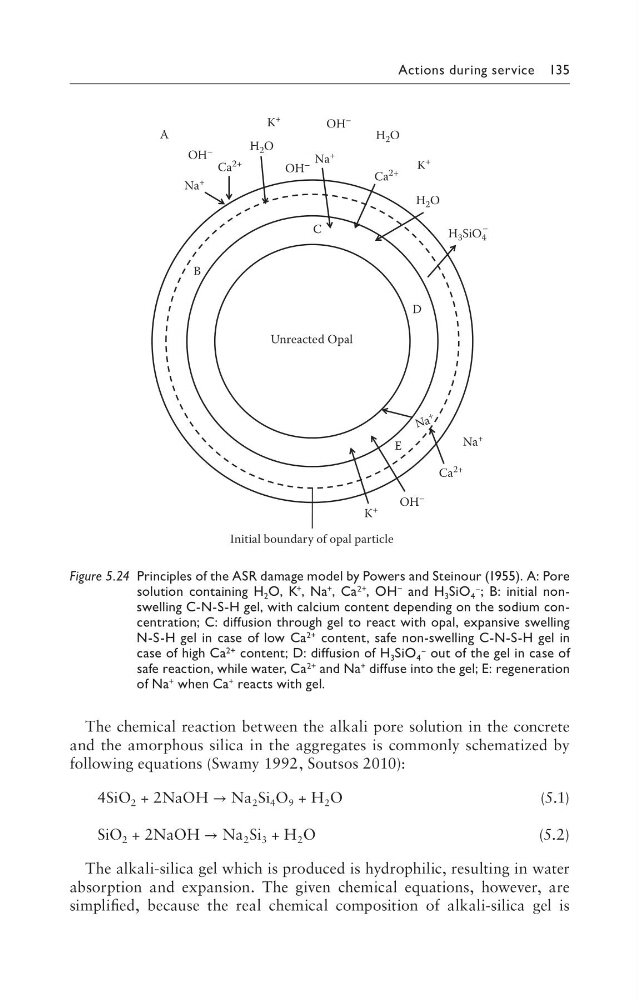
Figure 5.24 Principles of the ASR damage model by Powers and Steinour (1955). A: Pore
solution containing H 2 O, K + , Na + , Ca 2+ , OH − and H 3 SiO 4
− ; B: initial nonswelling C-N-S-H gel, with calcium content depending on the sodium concentration; C: diffusion through gel to react with opal, expansive swelling
N-S-H gel in case of low Ca 2+ content, safe non-swelling C-N-S-H gel in
case of high Ca 2+ content; D: diffusion of H 3 SiO 4
− out of the gel in case of
safe reaction, while water, Ca 2+ and Na + diffuse into the gel; E: regeneration
of Na + when Ca + reacts with gel.
The chemical reaction between the alkali pore solution in the concrete
and the amorphous silica in the aggregates is commonly schematized by
following equations (Swamy 1992, Soutsos 2010):
4SiO 2 + 2NaOH → Na 2 Si 4 O 9 + H 2 O
(5.1)
SiO 2 + 2NaOH → Na 2 Si 3 + H 2 O
(5.2)
The alkali-silica gel which is produced is hydrophilic, resulting in water
absorption and expansion. The given chemical equations, however, are
simplified, because the real chemical composition of alkali-silica gel is
Na
+
H 3 SiO 4
–
K
+
K
+
OH
–
H 2 O
E
D
C
B
A
Na
+
Na
+
Ca
2+
OH
–
OH
–
H 2 O
Ca
2+
H 2 O
Ca 2+
N a
+
OH
–
K
+
Initial boundary of opal particle
Unreacted Opal
Figure 5.24 Principles of the ASR damage model by Powers and Steinour (1955). A: Pore
solution containing H 2 O, K + , Na + , Ca 2+ , OH − and H 3 SiO 4
− ; B: initial nonswelling C-N-S-H gel, with calcium content depending on the sodium concentration; C: diffusion through gel to react with opal, expansive swelling
N-S-H gel in case of low Ca 2+ content, safe non-swelling C-N-S-H gel in
case of high Ca 2+ content; D: diffusion of H 3 SiO 4
− out of the gel in case of
safe reaction, while water, Ca 2+ and Na + diffuse into the gel; E: regeneration
of Na + when Ca + reacts with gel.