

130 Damage to concrete structures
• At higher temperatures, the mechanical properties of the concrete
will be reduced, as explained before. This also holds for the Young’s
modulus. As the stiffness is reduced, the restrained stresses will also
be reduced. However, it is also clear that at the same time, the concrete strength is reduced.
A detailed study of the load-bearing capacity of structures or structural
elements under fire conditions is out of the scope of this textbook. Secondorder effects might also be induced, e.g. reducing the buckling load of columns under fire conditions. Reference is made to relevant standards and
models in order to check the fire resistance of concrete structures.
5.2.6 crystallisation and discolouring
due to moisture movement
Moisture movements in concrete elements due to inadequate water tightness of coatings or roofing can lead to leaching. Calcium ions are dissolved
in the moving water and transported toward the concrete surface. After
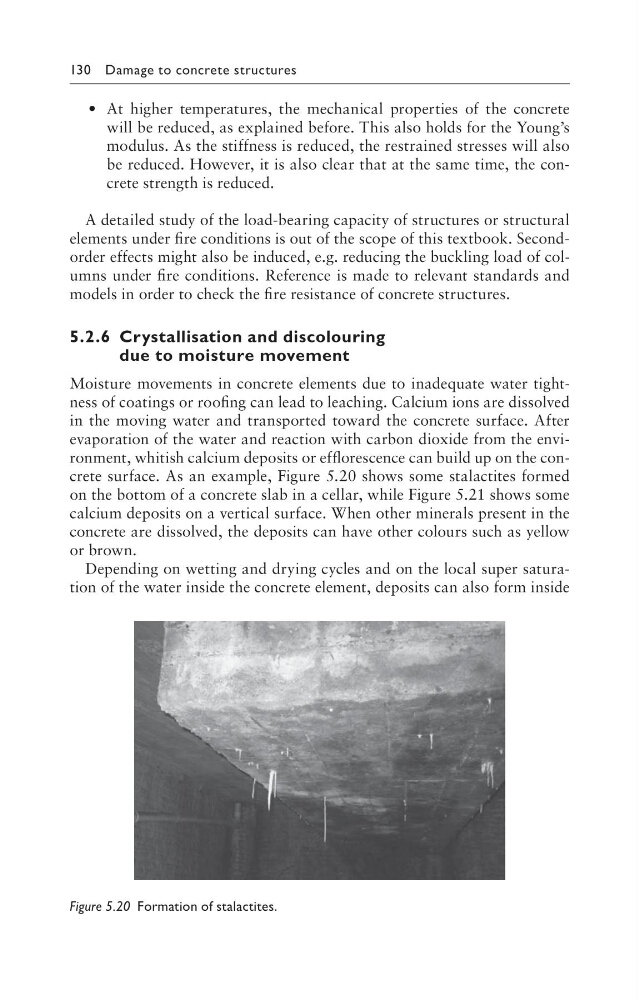
evaporation of the water and reaction with carbon dioxide from the environment, whitish calcium deposits or efflorescence can build up on the concrete surface. As an example, Figure 5.20 shows some stalactites formed
on the bottom of a concrete slab in a cellar, while Figure 5.21 shows some
calcium deposits on a vertical surface. When other minerals present in the
concrete are dissolved, the deposits can have other colours such as yellow
or brown.
Depending on wetting and drying cycles and on the local super saturation of the water inside the concrete element, deposits can also form inside
Figure 5.20 Formation of stalactites.
• At higher temperatures, the mechanical properties of the concrete
will be reduced, as explained before. This also holds for the Young’s
modulus. As the stiffness is reduced, the restrained stresses will also
be reduced. However, it is also clear that at the same time, the concrete strength is reduced.
A detailed study of the load-bearing capacity of structures or structural
elements under fire conditions is out of the scope of this textbook. Secondorder effects might also be induced, e.g. reducing the buckling load of columns under fire conditions. Reference is made to relevant standards and
models in order to check the fire resistance of concrete structures.
5.2.6 crystallisation and discolouring
due to moisture movement
Moisture movements in concrete elements due to inadequate water tightness of coatings or roofing can lead to leaching. Calcium ions are dissolved
in the moving water and transported toward the concrete surface. After
evaporation of the water and reaction with carbon dioxide from the environment, whitish calcium deposits or efflorescence can build up on the concrete surface. As an example, Figure 5.20 shows some stalactites formed
on the bottom of a concrete slab in a cellar, while Figure 5.21 shows some
calcium deposits on a vertical surface. When other minerals present in the
concrete are dissolved, the deposits can have other colours such as yellow
or brown.
Depending on wetting and drying cycles and on the local super saturation of the water inside the concrete element, deposits can also form inside
Figure 5.20 Formation of stalactites.