

Actions during service 121
this temperature range, the concrete tends to become more brittle (Rostasy
and Wiederman 1980).
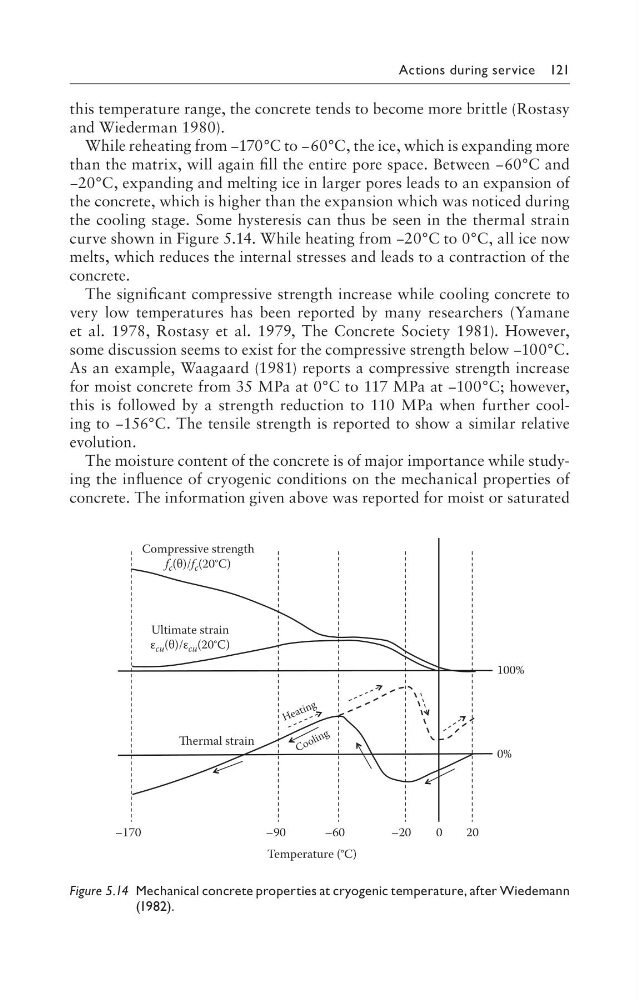
While reheating from −170°C to −60°C, the ice, which is expanding more
than the matrix, will again fill the entire pore space. Between −60°C and
−20°C, expanding and melting ice in larger pores leads to an expansion of
the concrete, which is higher than the expansion which was noticed during
the cooling stage. Some hysteresis can thus be seen in the thermal strain
curve shown in Figure 5.14. While heating from −20°C to 0°C, all ice now
melts, which reduces the internal stresses and leads to a contraction of the
concrete.
The significant compressive strength increase while cooling concrete to
very low temperatures has been reported by many researchers (Yamane
et al. 1978, Rostasy et al. 1979, The Concrete Society 1981). However,
some discussion seems to exist for the compressive strength below −100°C.
As an example, Waagaard (1981) reports a compressive strength increase
for moist concrete from 35 MPa at 0°C to 117 MPa at −100°C; however,
this is followed by a strength reduction to 110 MPa when further cooling to −156°C. The tensile strength is reported to show a similar relative
evolution.
The moisture content of the concrete is of major importance while studying the influence of cryogenic conditions on the mechanical properties of
concrete. The information given above was reported for moist or saturated
Temperature (°C)
20
0%
100%
–20
C o o li n g
H e a ti n g
–60
–90
–170
ermal strain
Ultimate strain
ε cu (θ)/ε cu (20°C)
Compressive strength
f c (θ)/f c (20°C)
0
Figure 5.14 Mechanical concrete properties at cryogenic temperature, after Wiedemann
(1982).
this temperature range, the concrete tends to become more brittle (Rostasy
and Wiederman 1980).
While reheating from −170°C to −60°C, the ice, which is expanding more
than the matrix, will again fill the entire pore space. Between −60°C and
−20°C, expanding and melting ice in larger pores leads to an expansion of
the concrete, which is higher than the expansion which was noticed during
the cooling stage. Some hysteresis can thus be seen in the thermal strain
curve shown in Figure 5.14. While heating from −20°C to 0°C, all ice now
melts, which reduces the internal stresses and leads to a contraction of the
concrete.
The significant compressive strength increase while cooling concrete to
very low temperatures has been reported by many researchers (Yamane
et al. 1978, Rostasy et al. 1979, The Concrete Society 1981). However,
some discussion seems to exist for the compressive strength below −100°C.
As an example, Waagaard (1981) reports a compressive strength increase
for moist concrete from 35 MPa at 0°C to 117 MPa at −100°C; however,
this is followed by a strength reduction to 110 MPa when further cooling to −156°C. The tensile strength is reported to show a similar relative
evolution.
The moisture content of the concrete is of major importance while studying the influence of cryogenic conditions on the mechanical properties of
concrete. The information given above was reported for moist or saturated
Temperature (°C)
20
0%
100%
–20
C o o li n g
H e a ti n g
–60
–90
–170
ermal strain
Ultimate strain
ε cu (θ)/ε cu (20°C)
Compressive strength
f c (θ)/f c (20°C)
0
Figure 5.14 Mechanical concrete properties at cryogenic temperature, after Wiedemann
(1982).