

110 Damage to concrete structures
In order to explain the damage caused by frost in combination with deicing salts, reference is often made to the same theories as valid for classical frost damage: hydraulic pressure, crystallisation pressure, and osmotic
pressure. Nevertheless, the role of the de-icing salts could be better understood by considering the salt concentration gradient theory, or by the ‘gluespall’ theory. This latter now seems to be the most widely accepted theory
to explain the specific damage mechanism related to frost in combination
with de-icing salts, also referred to as salt scaling. Other theories exist,
e.g. the thermal shock theory, and the precipitation and growth of salt.
However, these phenomena are not believed to contribute significantly to
salt frost scaling (Valenza and Scherer 2007b).
5.2.2.1.1 Salt concentration gradient
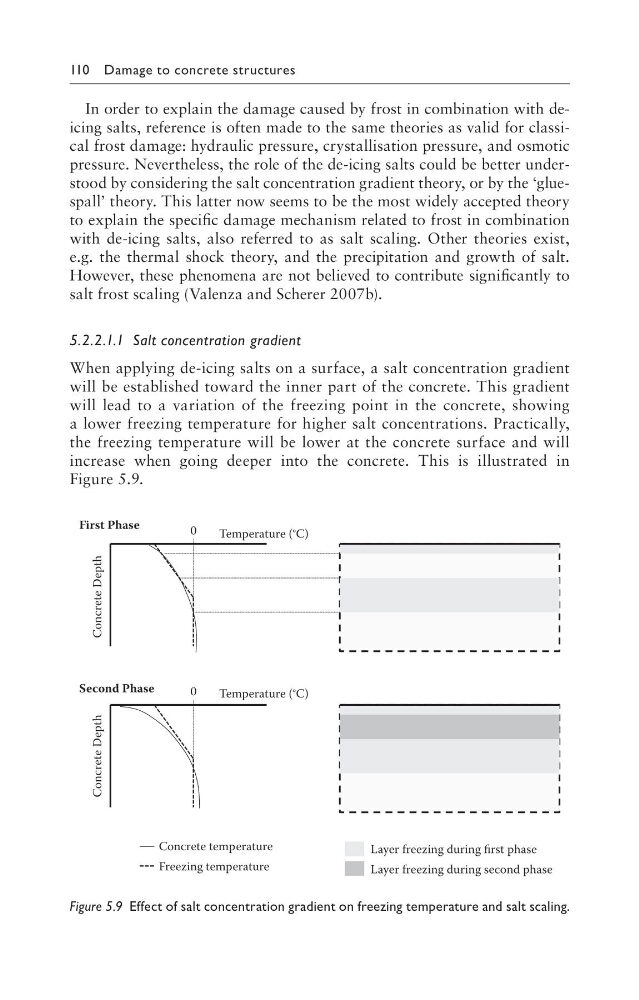
When applying de-icing salts on a surface, a salt concentration gradient
will be established toward the inner part of the concrete. This gradient
will lead to a variation of the freezing point in the concrete, showing
a lower freezing temperature for higher salt concentrations. Practically,
the freezing temperature will be lower at the concrete surface and will
increase when going deeper into the concrete. This is illustrated in
Figure 5.9.
Layer freezing during first phase
Layer freezing during second phase
Concrete temperature
Temperature (°C)
Temperature (°C)
0
0
Second Phase
First Phase
Concrete Depth
Concrete Depth
Freezing temperature
Figure 5.9 Effect of salt concentration gradient on freezing temperature and salt scaling.
In order to explain the damage caused by frost in combination with deicing salts, reference is often made to the same theories as valid for classical frost damage: hydraulic pressure, crystallisation pressure, and osmotic
pressure. Nevertheless, the role of the de-icing salts could be better understood by considering the salt concentration gradient theory, or by the ‘gluespall’ theory. This latter now seems to be the most widely accepted theory
to explain the specific damage mechanism related to frost in combination
with de-icing salts, also referred to as salt scaling. Other theories exist,
e.g. the thermal shock theory, and the precipitation and growth of salt.
However, these phenomena are not believed to contribute significantly to
salt frost scaling (Valenza and Scherer 2007b).
5.2.2.1.1 Salt concentration gradient
When applying de-icing salts on a surface, a salt concentration gradient
will be established toward the inner part of the concrete. This gradient
will lead to a variation of the freezing point in the concrete, showing
a lower freezing temperature for higher salt concentrations. Practically,
the freezing temperature will be lower at the concrete surface and will
increase when going deeper into the concrete. This is illustrated in
Figure 5.9.
Layer freezing during first phase
Layer freezing during second phase
Concrete temperature
Temperature (°C)
Temperature (°C)
0
0
Second Phase
First Phase
Concrete Depth
Concrete Depth
Freezing temperature
Figure 5.9 Effect of salt concentration gradient on freezing temperature and salt scaling.