

106 Damage to concrete structures
When insufficient space is left for further ice formation, internal pressures
will be initiated, causing expansion and possibly cracking.
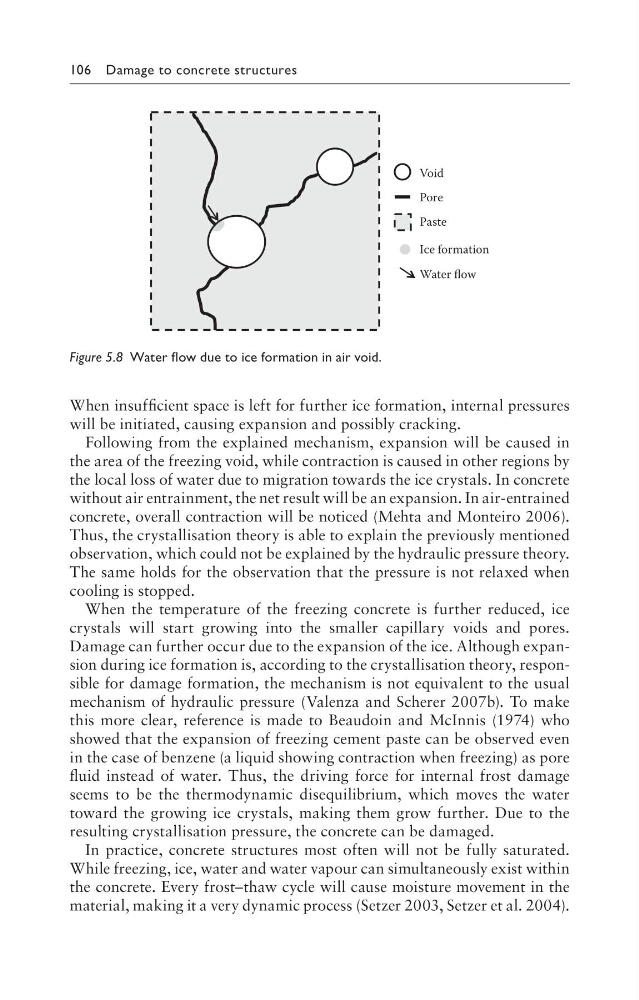
Following from the explained mechanism, expansion will be caused in
the area of the freezing void, while contraction is caused in other regions by
the local loss of water due to migration towards the ice crystals. In concrete
without air entrainment, the net result will be an expansion. In air-entrained
concrete, overall contraction will be noticed (Mehta and Monteiro 2006).
Thus, the crystallisation theory is able to explain the previously mentioned
observation, which could not be explained by the hydraulic pressure theory.
The same holds for the observation that the pressure is not relaxed when
cooling is stopped.
When the temperature of the freezing concrete is further reduced, ice
crystals will start growing into the smaller capillary voids and pores.
Damage can further occur due to the expansion of the ice. Although expansion during ice formation is, according to the crystallisation theory, responsible for damage formation, the mechanism is not equivalent to the usual
mechanism of hydraulic pressure (Valenza and Scherer 2007b). To make
this more clear, reference is made to Beaudoin and McInnis (1974) who
showed that the expansion of freezing cement paste can be observed even
in the case of benzene (a liquid showing contraction when freezing) as pore
fluid instead of water. Thus, the driving force for internal frost damage
seems to be the thermodynamic disequilibrium, which moves the water
toward the growing ice crystals, making them grow further. Due to the
resulting crystallisation pressure, the concrete can be damaged.
In practice, concrete structures most often will not be fully saturated.
While freezing, ice, water and water vapour can simultaneously exist within
the concrete. Every frost–thaw cycle will cause moisture movement in the
material, making it a very dynamic process (Setzer 2003, Setzer et al. 2004).
Void
Pore
Paste
Ice formation
Water flow
Figure 5.8 Water flow due to ice formation in air void.
When insufficient space is left for further ice formation, internal pressures
will be initiated, causing expansion and possibly cracking.
Following from the explained mechanism, expansion will be caused in
the area of the freezing void, while contraction is caused in other regions by
the local loss of water due to migration towards the ice crystals. In concrete
without air entrainment, the net result will be an expansion. In air-entrained
concrete, overall contraction will be noticed (Mehta and Monteiro 2006).
Thus, the crystallisation theory is able to explain the previously mentioned
observation, which could not be explained by the hydraulic pressure theory.
The same holds for the observation that the pressure is not relaxed when
cooling is stopped.
When the temperature of the freezing concrete is further reduced, ice
crystals will start growing into the smaller capillary voids and pores.
Damage can further occur due to the expansion of the ice. Although expansion during ice formation is, according to the crystallisation theory, responsible for damage formation, the mechanism is not equivalent to the usual
mechanism of hydraulic pressure (Valenza and Scherer 2007b). To make
this more clear, reference is made to Beaudoin and McInnis (1974) who
showed that the expansion of freezing cement paste can be observed even
in the case of benzene (a liquid showing contraction when freezing) as pore
fluid instead of water. Thus, the driving force for internal frost damage
seems to be the thermodynamic disequilibrium, which moves the water
toward the growing ice crystals, making them grow further. Due to the
resulting crystallisation pressure, the concrete can be damaged.
In practice, concrete structures most often will not be fully saturated.
While freezing, ice, water and water vapour can simultaneously exist within
the concrete. Every frost–thaw cycle will cause moisture movement in the
material, making it a very dynamic process (Setzer 2003, Setzer et al. 2004).
Void
Pore
Paste
Ice formation
Water flow
Figure 5.8 Water flow due to ice formation in air void.