

94 Damage to concrete structures
were performed, implementing all relevant material properties (thermal
and mechanical), and considering relevant boundary conditions (also thermal and mechanical).
Casting the massive quay wall in different horizontal layers seemed inadvisable because some kind of thermal shock was occurring between the
newly cast layer (temperature of the fresh concrete) and the previous layer
(higher temperature due to heat of hydration). This thermal shock was
causing possibly severe damage in the contact zone between the successive
layers, as illustrated in Figure 4.15.
Cooling of the fresh concrete, e.g. by cooling of the aggregates or the
mixing water, was shown to be a very effective measure in order to avoid
thermal cracking at the surface of the quay wall. However, when casting in
layers, the damage in the contact zone between layers could not be avoided
by cooling the fresh concrete.
An optimal approach seemed to be the casting of the quay wall in one
operation, from bottom to top, combined with cooling of the fresh concrete. In this way, the internal damage can also be avoided. However, some
logistic problems have to be solved concerning cooling and mixing of the
concrete in considerable quantities during a short time period.
7
9.5
4.5
9
7
12
1
3
14
7.5
17
9
8
4.5
8.5
5
3
1
2.5
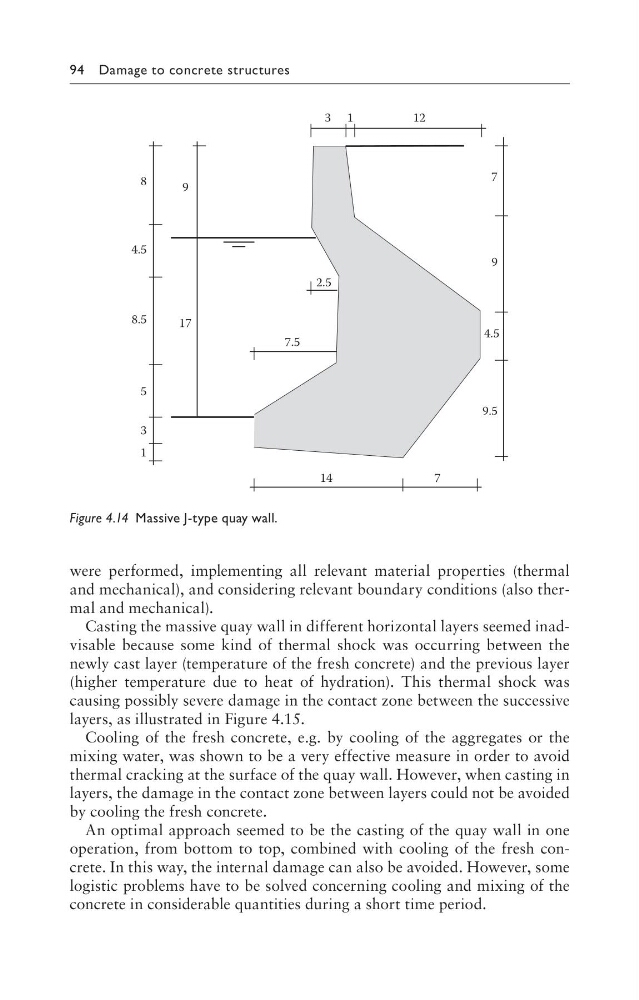
Figure 4.14 Massive J-type quay wall.
were performed, implementing all relevant material properties (thermal
and mechanical), and considering relevant boundary conditions (also thermal and mechanical).
Casting the massive quay wall in different horizontal layers seemed inadvisable because some kind of thermal shock was occurring between the
newly cast layer (temperature of the fresh concrete) and the previous layer
(higher temperature due to heat of hydration). This thermal shock was
causing possibly severe damage in the contact zone between the successive
layers, as illustrated in Figure 4.15.
Cooling of the fresh concrete, e.g. by cooling of the aggregates or the
mixing water, was shown to be a very effective measure in order to avoid
thermal cracking at the surface of the quay wall. However, when casting in
layers, the damage in the contact zone between layers could not be avoided
by cooling the fresh concrete.
An optimal approach seemed to be the casting of the quay wall in one
operation, from bottom to top, combined with cooling of the fresh concrete. In this way, the internal damage can also be avoided. However, some
logistic problems have to be solved concerning cooling and mixing of the
concrete in considerable quantities during a short time period.
7
9.5
4.5
9
7
12
1
3
14
7.5
17
9
8
4.5
8.5
5
3
1
2.5
Figure 4.14 Massive J-type quay wall.