

90 Damage to concrete structures
In other words, a residual strain and residual stresses (so-called eïgenstresses) are obtained in the two halves of the element.
This case is more representative for massive hardening concrete elements,
where a time and location dependent Young’s modulus indeed occurs. The
example nicely illustrates the occurrence of eigenstresses which remain in
the hardened concrete element. However, hardening concrete is much more
complicated, because the material is not behaving in a purely elastic way.
As a result, a very complex stress distribution is obtained in hardening
concrete elements, which can only be accurately estimated by means of
advanced numerical techniques (De Schutter 1996, De Schutter 2002).
4.4.2 Influencing parameters
4.4.2.1 Parameters related to the concrete composition
As the heat of hydration is the main driving force for early-age thermal
cracking, the cement type is of major importance. Ordinary Portland
cement typically produces more heat of hydration than blended cements
such as blast furnace slag cement. Finer cements generally show higher
heat production rates than coarser cements. Puzzolan or mineral additions
can help reduce the heat of hydration. The effect of the additions on the
hydration reaction of the cement should be carefully considered, especially
in the case of high powder contents such as in self-compacting concrete
(De Schutter et al. 2008).
A higher cement content will lead to an increased heat production. This
is the reason why high strength concrete elements might show some risk
(a)
E 2
2
1
E 1
(c)
ε b
ε 2
ε 1
ε
E´ 2
E´ 1
2
1
(b)
E 2
2
t
t ´
1
E 1
σ 1
σ 1b
σ 2b
σ 2
∆θ 2
∆θ 1
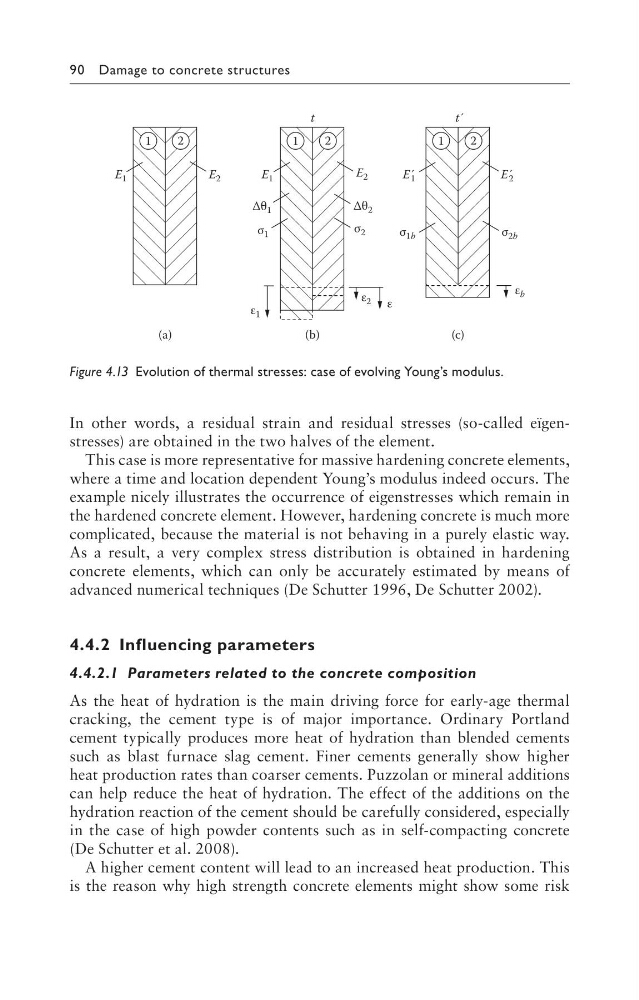
Figure 4.13 Evolution of thermal stresses: case of evolving Young’s modulus.
In other words, a residual strain and residual stresses (so-called eïgenstresses) are obtained in the two halves of the element.
This case is more representative for massive hardening concrete elements,
where a time and location dependent Young’s modulus indeed occurs. The
example nicely illustrates the occurrence of eigenstresses which remain in
the hardened concrete element. However, hardening concrete is much more
complicated, because the material is not behaving in a purely elastic way.
As a result, a very complex stress distribution is obtained in hardening
concrete elements, which can only be accurately estimated by means of
advanced numerical techniques (De Schutter 1996, De Schutter 2002).
4.4.2 Influencing parameters
4.4.2.1 Parameters related to the concrete composition
As the heat of hydration is the main driving force for early-age thermal
cracking, the cement type is of major importance. Ordinary Portland
cement typically produces more heat of hydration than blended cements
such as blast furnace slag cement. Finer cements generally show higher
heat production rates than coarser cements. Puzzolan or mineral additions
can help reduce the heat of hydration. The effect of the additions on the
hydration reaction of the cement should be carefully considered, especially
in the case of high powder contents such as in self-compacting concrete
(De Schutter et al. 2008).
A higher cement content will lead to an increased heat production. This
is the reason why high strength concrete elements might show some risk
(a)
E 2
2
1
E 1
(c)
ε b
ε 2
ε 1
ε
E´ 2
E´ 1
2
1
(b)
E 2
2
t
t ´
1
E 1
σ 1
σ 1b
σ 2b
σ 2
∆θ 2
∆θ 1
Figure 4.13 Evolution of thermal stresses: case of evolving Young’s modulus.