

Actions during hardening 81
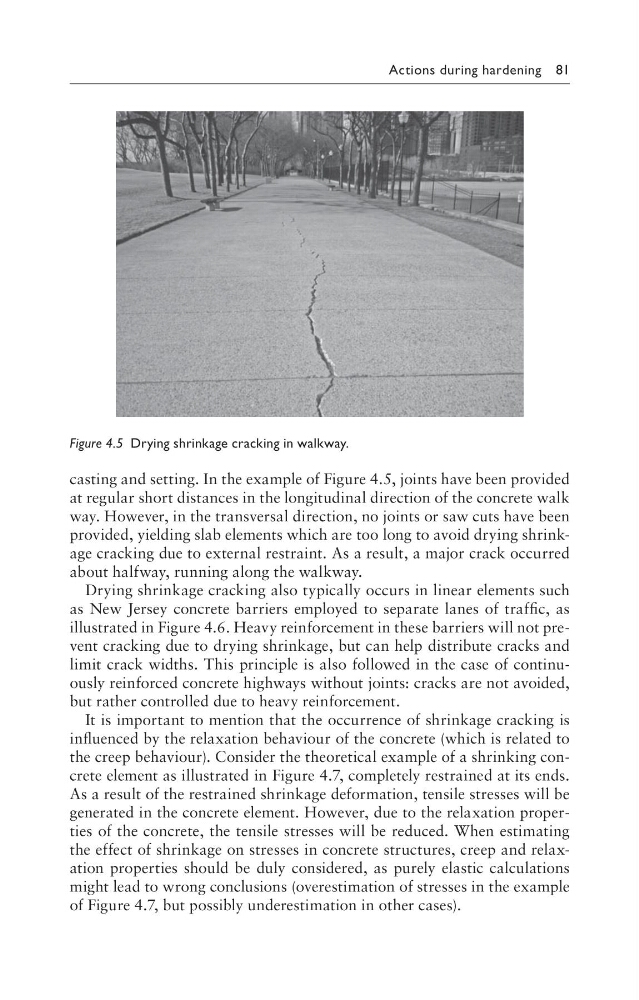
casting and setting. In the example of Figure 4.5, joints have been provided
at regular short distances in the longitudinal direction of the concrete walk
way. However, in the transversal direction, no joints or saw cuts have been
provided, yielding slab elements which are too long to avoid drying shrinkage cracking due to external restraint. As a result, a major crack occurred
about halfway, running along the walkway.
Drying shrinkage cracking also typically occurs in linear elements such
as New Jersey concrete barriers employed to separate lanes of traffic, as
illustrated in Figure 4.6. Heavy reinforcement in these barriers will not prevent cracking due to drying shrinkage, but can help distribute cracks and
limit crack widths. This principle is also followed in the case of continuously reinforced concrete highways without joints: cracks are not avoided,
but rather controlled due to heavy reinforcement.
It is important to mention that the occurrence of shrinkage cracking is
influenced by the relaxation behaviour of the concrete (which is related to
the creep behaviour). Consider the theoretical example of a shrinking concrete element as illustrated in Figure 4.7, completely restrained at its ends.
As a result of the restrained shrinkage deformation, tensile stresses will be
generated in the concrete element. However, due to the relaxation properties of the concrete, the tensile stresses will be reduced. When estimating
the effect of shrinkage on stresses in concrete structures, creep and relaxation properties should be duly considered, as purely elastic calculations
might lead to wrong conclusions (overestimation of stresses in the example
of Figure 4.7, but possibly underestimation in other cases).
Figure 4.5 Drying shrinkage cracking in walkway.
casting and setting. In the example of Figure 4.5, joints have been provided
at regular short distances in the longitudinal direction of the concrete walk
way. However, in the transversal direction, no joints or saw cuts have been
provided, yielding slab elements which are too long to avoid drying shrinkage cracking due to external restraint. As a result, a major crack occurred
about halfway, running along the walkway.
Drying shrinkage cracking also typically occurs in linear elements such
as New Jersey concrete barriers employed to separate lanes of traffic, as
illustrated in Figure 4.6. Heavy reinforcement in these barriers will not prevent cracking due to drying shrinkage, but can help distribute cracks and
limit crack widths. This principle is also followed in the case of continuously reinforced concrete highways without joints: cracks are not avoided,
but rather controlled due to heavy reinforcement.
It is important to mention that the occurrence of shrinkage cracking is
influenced by the relaxation behaviour of the concrete (which is related to
the creep behaviour). Consider the theoretical example of a shrinking concrete element as illustrated in Figure 4.7, completely restrained at its ends.
As a result of the restrained shrinkage deformation, tensile stresses will be
generated in the concrete element. However, due to the relaxation properties of the concrete, the tensile stresses will be reduced. When estimating
the effect of shrinkage on stresses in concrete structures, creep and relaxation properties should be duly considered, as purely elastic calculations
might lead to wrong conclusions (overestimation of stresses in the example
of Figure 4.7, but possibly underestimation in other cases).
Figure 4.5 Drying shrinkage cracking in walkway.