

682
R. H. de Ruiz and L. E. R. C. Rielli
8 Discussion
This paper seeks to encourage the efficient and effective adoption of BSS in São
Paulo, Brazil. Two international cases will serve as guidelines for the development
of an expansion plan for BSS in the city. The Berlin experience can be considered
a success case in the adoption of BSS, even though there is still place for growth.
Shanghai, on the other hand, suffered from a series of excesses on the part of the
service providers part, which ended up troubling the population. Some characteristics
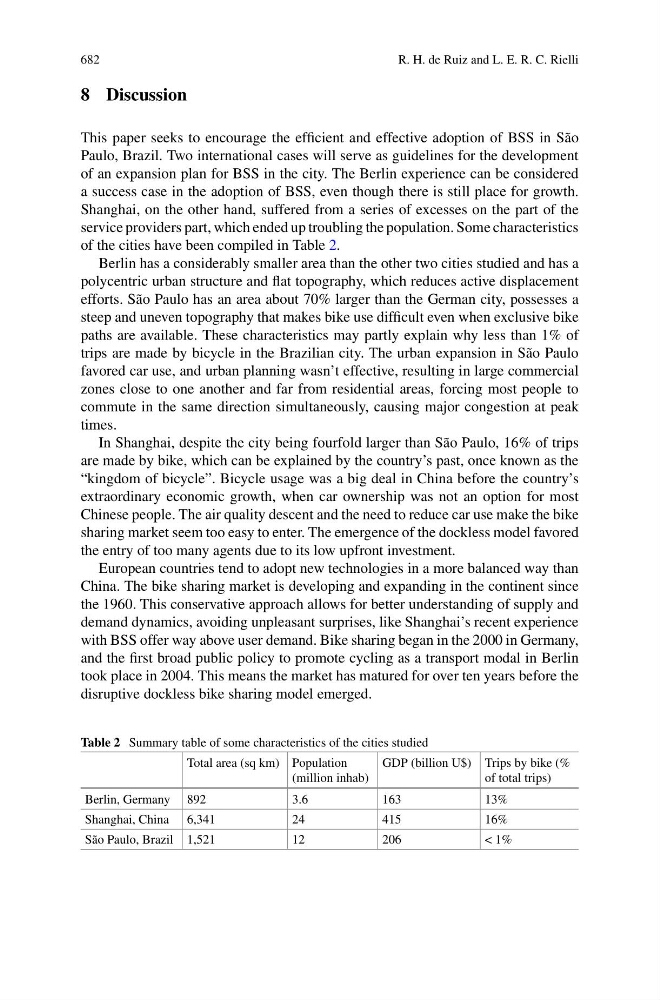
of the cities have been compiled in Table 2.
Berlin has a considerably smaller area than the other two cities studied and has a
polycentric urban structure and flat topography, which reduces active displacement
efforts. São Paulo has an area about 70% larger than the German city, possesses a
steep and uneven topography that makes bike use difficult even when exclusive bike
paths are available. These characteristics may partly explain why less than 1% of
trips are made by bicycle in the Brazilian city. The urban expansion in São Paulo
favored car use, and urban planning wasn’t effective, resulting in large commercial
zones close to one another and far from residential areas, forcing most people to
commute in the same direction simultaneously, causing major congestion at peak
times.
In Shanghai, despite the city being fourfold larger than São Paulo, 16% of trips
are made by bike, which can be explained by the country’s past, once known as the
“kingdom of bicycle”. Bicycle usage was a big deal in China before the country’s
extraordinary economic growth, when car ownership was not an option for most
Chinese people. The air quality descent and the need to reduce car use make the bike
sharing market seem too easy to enter. The emergence of the dockless model favored
the entry of too many agents due to its low upfront investment.
European countries tend to adopt new technologies in a more balanced way than
China. The bike sharing market is developing and expanding in the continent since
the 1960. This conservative approach allows for better understanding of supply and
demand dynamics, avoiding unpleasant surprises, like Shanghai’s recent experience
with BSS offer way above user demand. Bike sharing began in the 2000 in Germany,
and the first broad public policy to promote cycling as a transport modal in Berlin
took place in 2004. This means the market has matured for over ten years before the
disruptive dockless bike sharing model emerged.
Table 2 Summary table of some characteristics of the cities studied
Total area (sq km) Population
(million inhab)
GDP (billion U$) Trips by bike (%
of total trips)
Berlin, Germany 892
3.6
163
13%
Shanghai, China 6,341
24
415
16%
São Paulo, Brazil 1,521
12
206
< 1%