

668
I. S. Rampasso et al.
Table 2 (continued)
Reference
Category
(Marinho et al. 2014)
Sustainable practices in HEI
Table 3 Percentage of
articles per category
Category
Percentage of articles
Evaluation models and/or
comparisons
40
Sustainable practices in HEIs
20
Broad debates about sustainability
insertion in Brazilian HEIs
20
Students’ behavior
10
Overview about sustainability
insertion in Brazilian HEIs
10
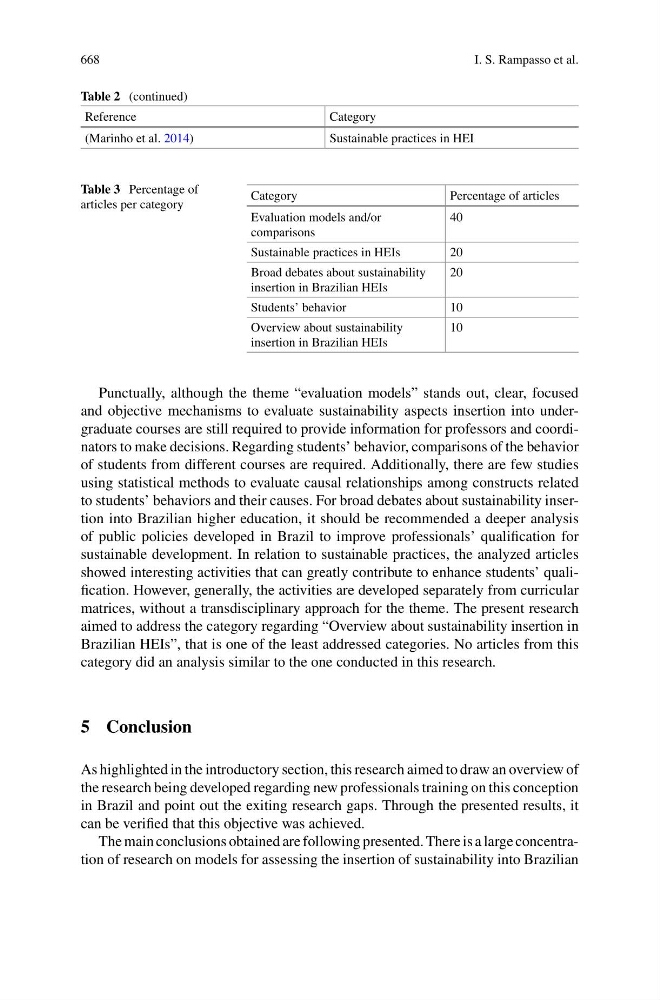
Punctually, although the theme “evaluation models” stands out, clear, focused
and objective mechanisms to evaluate sustainability aspects insertion into undergraduate courses are still required to provide information for professors and coordinators to make decisions. Regarding students’ behavior, comparisons of the behavior
of students from different courses are required. Additionally, there are few studies
using statistical methods to evaluate causal relationships among constructs related
to students’ behaviors and their causes. For broad debates about sustainability insertion into Brazilian higher education, it should be recommended a deeper analysis
of public policies developed in Brazil to improve professionals’ qualification for
sustainable development. In relation to sustainable practices, the analyzed articles
showed interesting activities that can greatly contribute to enhance students’ qualification. However, generally, the activities are developed separately from curricular
matrices, without a transdisciplinary approach for the theme. The present research
aimed to address the category regarding “Overview about sustainability insertion in
Brazilian HEIs”, that is one of the least addressed categories. No articles from this
category did an analysis similar to the one conducted in this research.
5 Conclusion
As highlighted in the introductory section, this research aimed to draw an overview of
the research being developed regarding new professionals training on this conception
in Brazil and point out the exiting research gaps. Through the presented results, it
can be verified that this objective was achieved.
The main conclusions obtained are following presented. There is a large concentration of research on models for assessing the insertion of sustainability into Brazilian