

54
P. B. Carvalho et al.
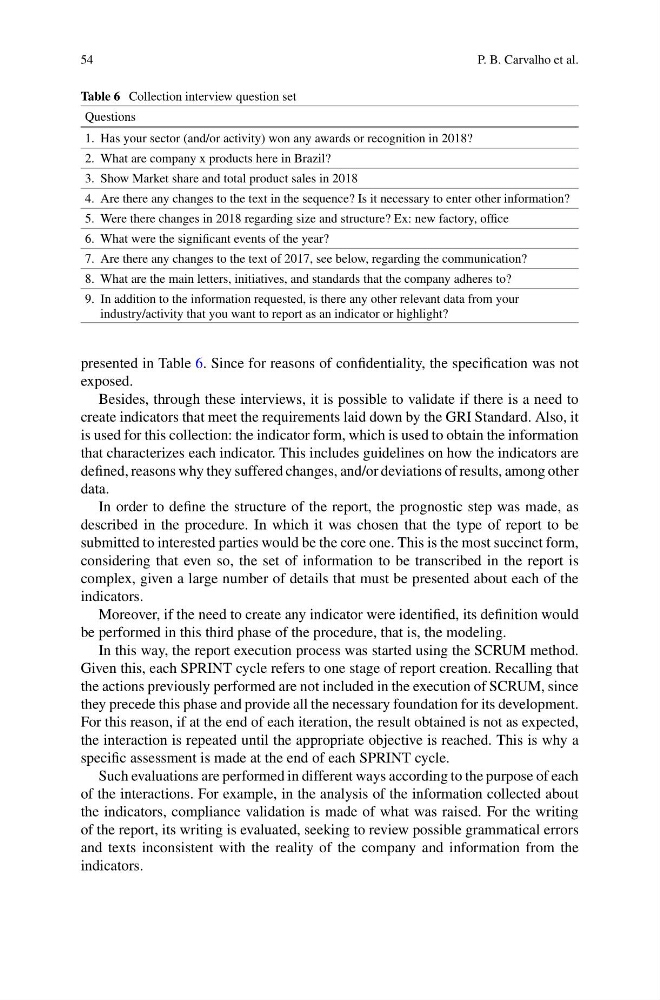
Table 6 Collection interview question set
Questions
1. Has your sector (and/or activity) won any awards or recognition in 2018?
2. What are company x products here in Brazil?
3. Show Market share and total product sales in 2018
4. Are there any changes to the text in the sequence? Is it necessary to enter other information?
5. Were there changes in 2018 regarding size and structure? Ex: new factory, office
6. What were the significant events of the year?
7. Are there any changes to the text of 2017, see below, regarding the communication?
8. What are the main letters, initiatives, and standards that the company adheres to?
9. In addition to the information requested, is there any other relevant data from your
industry/activity that you want to report as an indicator or highlight?
presented in Table 6. Since for reasons of confidentiality, the specification was not
exposed.
Besides, through these interviews, it is possible to validate if there is a need to
create indicators that meet the requirements laid down by the GRI Standard. Also, it
is used for this collection: the indicator form, which is used to obtain the information
that characterizes each indicator. This includes guidelines on how the indicators are
defined, reasons why they suffered changes, and/or deviations of results, among other
data.
In order to define the structure of the report, the prognostic step was made, as
described in the procedure. In which it was chosen that the type of report to be
submitted to interested parties would be the core one. This is the most succinct form,
considering that even so, the set of information to be transcribed in the report is
complex, given a large number of details that must be presented about each of the
indicators.
Moreover, if the need to create any indicator were identified, its definition would
be performed in this third phase of the procedure, that is, the modeling.
In this way, the report execution process was started using the SCRUM method.
Given this, each SPRINT cycle refers to one stage of report creation. Recalling that
the actions previously performed are not included in the execution of SCRUM, since
they precede this phase and provide all the necessary foundation for its development.
For this reason, if at the end of each iteration, the result obtained is not as expected,
the interaction is repeated until the appropriate objective is reached. This is why a
specific assessment is made at the end of each SPRINT cycle.
Such evaluations are performed in different ways according to the purpose of each
of the interactions. For example, in the analysis of the information collected about
the indicators, compliance validation is made of what was raised. For the writing
of the report, its writing is evaluated, seeking to review possible grammatical errors
and texts inconsistent with the reality of the company and information from the
indicators.
P. B. Carvalho et al.
Table 6 Collection interview question set
Questions
1. Has your sector (and/or activity) won any awards or recognition in 2018?
2. What are company x products here in Brazil?
3. Show Market share and total product sales in 2018
4. Are there any changes to the text in the sequence? Is it necessary to enter other information?
5. Were there changes in 2018 regarding size and structure? Ex: new factory, office
6. What were the significant events of the year?
7. Are there any changes to the text of 2017, see below, regarding the communication?
8. What are the main letters, initiatives, and standards that the company adheres to?
9. In addition to the information requested, is there any other relevant data from your
industry/activity that you want to report as an indicator or highlight?
presented in Table 6. Since for reasons of confidentiality, the specification was not
exposed.
Besides, through these interviews, it is possible to validate if there is a need to
create indicators that meet the requirements laid down by the GRI Standard. Also, it
is used for this collection: the indicator form, which is used to obtain the information
that characterizes each indicator. This includes guidelines on how the indicators are
defined, reasons why they suffered changes, and/or deviations of results, among other
data.
In order to define the structure of the report, the prognostic step was made, as
described in the procedure. In which it was chosen that the type of report to be
submitted to interested parties would be the core one. This is the most succinct form,
considering that even so, the set of information to be transcribed in the report is
complex, given a large number of details that must be presented about each of the
indicators.
Moreover, if the need to create any indicator were identified, its definition would
be performed in this third phase of the procedure, that is, the modeling.
In this way, the report execution process was started using the SCRUM method.
Given this, each SPRINT cycle refers to one stage of report creation. Recalling that
the actions previously performed are not included in the execution of SCRUM, since
they precede this phase and provide all the necessary foundation for its development.
For this reason, if at the end of each iteration, the result obtained is not as expected,
the interaction is repeated until the appropriate objective is reached. This is why a
specific assessment is made at the end of each SPRINT cycle.
Such evaluations are performed in different ways according to the purpose of each
of the interactions. For example, in the analysis of the information collected about
the indicators, compliance validation is made of what was raised. For the writing
of the report, its writing is evaluated, seeking to review possible grammatical errors
and texts inconsistent with the reality of the company and information from the
indicators.