

Environmental Bioethics, Sustainable Development and Social …
559
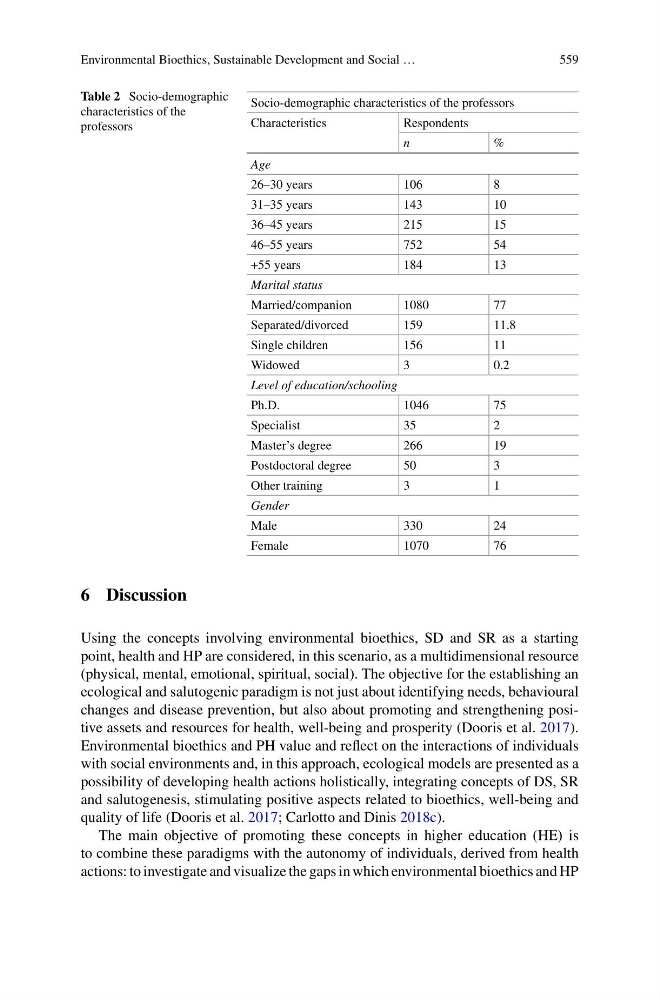
Table 2 Socio-demographic
characteristics of the
professors
Socio-demographic characteristics of the professors
Characteristics
Respondents
n
%
Age
26–30 years
106
8
31–35 years
143
10
36–45 years
215
15
46–55 years
752
54
+55 years
184
13
Marital status
Married/companion
1080
77
Separated/divorced
159
11.8
Single children
156
11
Widowed
3
0.2
Level of education/schooling
Ph.D.
1046
75
Specialist
35
2
Master’s degree
266
19
Postdoctoral degree
50
3
Other training
3
1
Gender
Male
330
24
Female
1070
76
6 Discussion
Using the concepts involving environmental bioethics, SD and SR as a starting
point, health and HP are considered, in this scenario, as a multidimensional resource
(physical, mental, emotional, spiritual, social). The objective for the establishing an
ecological and salutogenic paradigm is not just about identifying needs, behavioural
changes and disease prevention, but also about promoting and strengthening positive assets and resources for health, well-being and prosperity (Dooris et al. 2017).
Environmental bioethics and PH value and reflect on the interactions of individuals
with social environments and, in this approach, ecological models are presented as a
possibility of developing health actions holistically, integrating concepts of DS, SR
and salutogenesis, stimulating positive aspects related to bioethics, well-being and
quality of life (Dooris et al. 2017; Carlotto and Dinis 2018c).
The main objective of promoting these concepts in higher education (HE) is
to combine these paradigms with the autonomy of individuals, derived from health
actions: to investigate and visualize the gaps in which environmental bioethics and HP
559
Table 2 Socio-demographic
characteristics of the
professors
Socio-demographic characteristics of the professors
Characteristics
Respondents
n
%
Age
26–30 years
106
8
31–35 years
143
10
36–45 years
215
15
46–55 years
752
54
+55 years
184
13
Marital status
Married/companion
1080
77
Separated/divorced
159
11.8
Single children
156
11
Widowed
3
0.2
Level of education/schooling
Ph.D.
1046
75
Specialist
35
2
Master’s degree
266
19
Postdoctoral degree
50
3
Other training
3
1
Gender
Male
330
24
Female
1070
76
6 Discussion
Using the concepts involving environmental bioethics, SD and SR as a starting
point, health and HP are considered, in this scenario, as a multidimensional resource
(physical, mental, emotional, spiritual, social). The objective for the establishing an
ecological and salutogenic paradigm is not just about identifying needs, behavioural
changes and disease prevention, but also about promoting and strengthening positive assets and resources for health, well-being and prosperity (Dooris et al. 2017).
Environmental bioethics and PH value and reflect on the interactions of individuals
with social environments and, in this approach, ecological models are presented as a
possibility of developing health actions holistically, integrating concepts of DS, SR
and salutogenesis, stimulating positive aspects related to bioethics, well-being and
quality of life (Dooris et al. 2017; Carlotto and Dinis 2018c).
The main objective of promoting these concepts in higher education (HE) is
to combine these paradigms with the autonomy of individuals, derived from health
actions: to investigate and visualize the gaps in which environmental bioethics and HP