

546
R. C. Soares et al.
the part of students (Dellos 2015). Gamification applied in education provides challenging, pleasurable and engaging classes motivating students to achieve the established goals (Martins and Gouveia 2019), making teaching creative, as the pedagogical contents are worked through a different methodology, in combination with means
of technology information, such as the Kahoot app (Cheng 2018). Also according to
UNESCO guidelines (2014), the use of playful methods, such as educational games
on mobile devices, develop cooperative, affective and motivational relationships,
allowing a greater understanding of the content. The use of a pedagogical practice
through digital technologies enhances new ways of looking and interacting with the
world and the environment (Pereira et al. 2020).
3 Analysis of Results
The game was realised with the participation of 33 students. However, the final
sample totalled n = 15 students, due to the difficulty of internet access presented
during the study. Despite the technological limitations imposed, the students worked
in partnership, making their devices available to other participants so that everyone
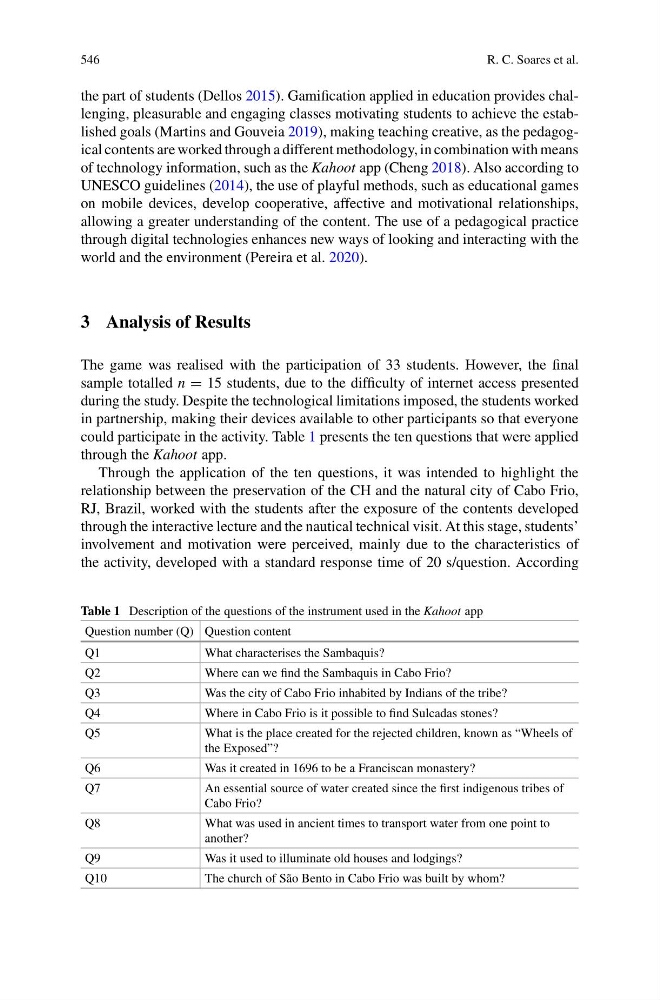
could participate in the activity. Table 1 presents the ten questions that were applied
through the Kahoot app.
Through the application of the ten questions, it was intended to highlight the
relationship between the preservation of the CH and the natural city of Cabo Frio,
RJ, Brazil, worked with the students after the exposure of the contents developed
through the interactive lecture and the nautical technical visit. At this stage, students’
involvement and motivation were perceived, mainly due to the characteristics of
the activity, developed with a standard response time of 20 s/question. According
Table 1 Description of the questions of the instrument used in the Kahoot app
Question number (Q) Question content
Q1
What characterises the Sambaquis?
Q2
Where can we find the Sambaquis in Cabo Frio?
Q3
Was the city of Cabo Frio inhabited by Indians of the tribe?
Q4
Where in Cabo Frio is it possible to find Sulcadas stones?
Q5
What is the place created for the rejected children, known as “Wheels of
the Exposed”?
Q6
Was it created in 1696 to be a Franciscan monastery?
Q7
An essential source of water created since the first indigenous tribes of
Cabo Frio?
Q8
What was used in ancient times to transport water from one point to
another?
Q9
Was it used to illuminate old houses and lodgings?
Q10
The church of São Bento in Cabo Frio was built by whom?
R. C. Soares et al.
the part of students (Dellos 2015). Gamification applied in education provides challenging, pleasurable and engaging classes motivating students to achieve the established goals (Martins and Gouveia 2019), making teaching creative, as the pedagogical contents are worked through a different methodology, in combination with means
of technology information, such as the Kahoot app (Cheng 2018). Also according to
UNESCO guidelines (2014), the use of playful methods, such as educational games
on mobile devices, develop cooperative, affective and motivational relationships,
allowing a greater understanding of the content. The use of a pedagogical practice
through digital technologies enhances new ways of looking and interacting with the
world and the environment (Pereira et al. 2020).
3 Analysis of Results
The game was realised with the participation of 33 students. However, the final
sample totalled n = 15 students, due to the difficulty of internet access presented
during the study. Despite the technological limitations imposed, the students worked
in partnership, making their devices available to other participants so that everyone
could participate in the activity. Table 1 presents the ten questions that were applied
through the Kahoot app.
Through the application of the ten questions, it was intended to highlight the
relationship between the preservation of the CH and the natural city of Cabo Frio,
RJ, Brazil, worked with the students after the exposure of the contents developed
through the interactive lecture and the nautical technical visit. At this stage, students’
involvement and motivation were perceived, mainly due to the characteristics of
the activity, developed with a standard response time of 20 s/question. According
Table 1 Description of the questions of the instrument used in the Kahoot app
Question number (Q) Question content
Q1
What characterises the Sambaquis?
Q2
Where can we find the Sambaquis in Cabo Frio?
Q3
Was the city of Cabo Frio inhabited by Indians of the tribe?
Q4
Where in Cabo Frio is it possible to find Sulcadas stones?
Q5
What is the place created for the rejected children, known as “Wheels of
the Exposed”?
Q6
Was it created in 1696 to be a Franciscan monastery?
Q7
An essential source of water created since the first indigenous tribes of
Cabo Frio?
Q8
What was used in ancient times to transport water from one point to
another?
Q9
Was it used to illuminate old houses and lodgings?
Q10
The church of São Bento in Cabo Frio was built by whom?