

518
A. C. W. Z. Jayme et al.
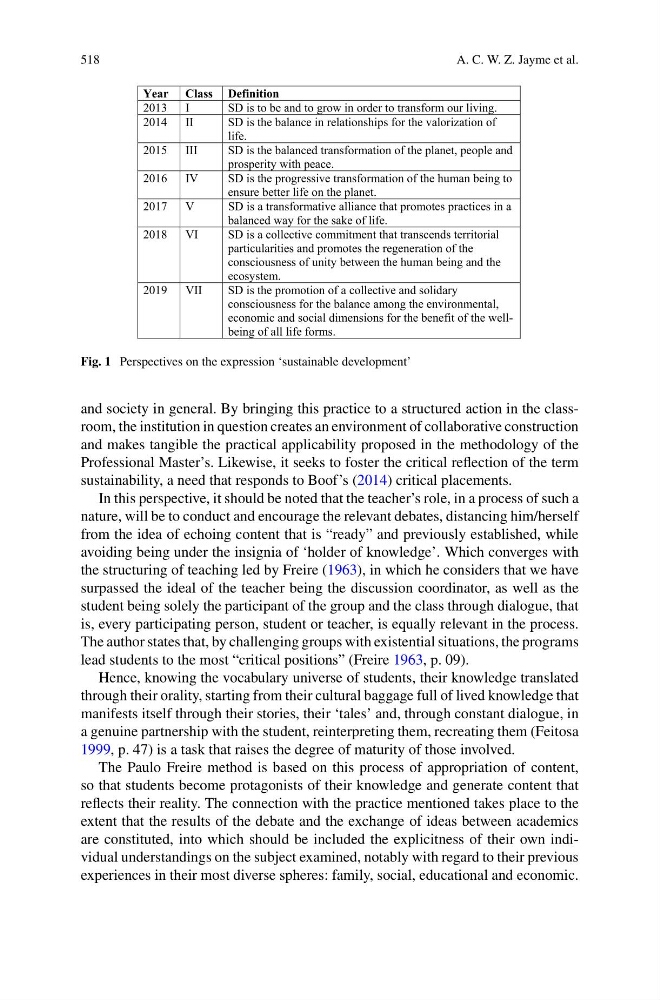
Year Class Definition
2013
I
SD is to be and to grow in order to transform our living.
2014
II
SD is the balance in relationships for the valorization of
life.
2015
III
SD is the balanced transformation of the planet, people and
prosperity with peace.
2016
IV
SD is the progressive transformation of the human being to
ensure better life on the planet.
2017
V
SD is a transformative alliance that promotes practices in a
balanced way for the sake of life.
2018
VI
SD is a collective commitment that transcends territorial
particularities and promotes the regeneration of the
consciousness of unity between the human being and the
ecosystem.
2019
VII
SD is the promotion of a collective and solidary
consciousness for the balance among the environmental,
economic and social dimensions for the benefit of the wellbeing of all life forms.
Fig. 1 Perspectives on the expression ‘sustainable development’
and society in general. By bringing this practice to a structured action in the classroom, the institution in question creates an environment of collaborative construction
and makes tangible the practical applicability proposed in the methodology of the
Professional Master’s. Likewise, it seeks to foster the critical reflection of the term
sustainability, a need that responds to Boof’s (2014) critical placements.
In this perspective, it should be noted that the teacher’s role, in a process of such a
nature, will be to conduct and encourage the relevant debates, distancing him/herself
from the idea of echoing content that is “ready” and previously established, while
avoiding being under the insignia of ‘holder of knowledge’. Which converges with
the structuring of teaching led by Freire (1963), in which he considers that we have
surpassed the ideal of the teacher being the discussion coordinator, as well as the
student being solely the participant of the group and the class through dialogue, that
is, every participating person, student or teacher, is equally relevant in the process.
The author states that, by challenging groups with existential situations, the programs
lead students to the most “critical positions” (Freire 1963, p. 09).
Hence, knowing the vocabulary universe of students, their knowledge translated
through their orality, starting from their cultural baggage full of lived knowledge that
manifests itself through their stories, their ‘tales’ and, through constant dialogue, in
a genuine partnership with the student, reinterpreting them, recreating them (Feitosa
1999, p. 47) is a task that raises the degree of maturity of those involved.
The Paulo Freire method is based on this process of appropriation of content,
so that students become protagonists of their knowledge and generate content that
reflects their reality. The connection with the practice mentioned takes place to the
extent that the results of the debate and the exchange of ideas between academics
are constituted, into which should be included the explicitness of their own individual understandings on the subject examined, notably with regard to their previous
experiences in their most diverse spheres: family, social, educational and economic.
A. C. W. Z. Jayme et al.
Year Class Definition
2013
I
SD is to be and to grow in order to transform our living.
2014
II
SD is the balance in relationships for the valorization of
life.
2015
III
SD is the balanced transformation of the planet, people and
prosperity with peace.
2016
IV
SD is the progressive transformation of the human being to
ensure better life on the planet.
2017
V
SD is a transformative alliance that promotes practices in a
balanced way for the sake of life.
2018
VI
SD is a collective commitment that transcends territorial
particularities and promotes the regeneration of the
consciousness of unity between the human being and the
ecosystem.
2019
VII
SD is the promotion of a collective and solidary
consciousness for the balance among the environmental,
economic and social dimensions for the benefit of the wellbeing of all life forms.
Fig. 1 Perspectives on the expression ‘sustainable development’
and society in general. By bringing this practice to a structured action in the classroom, the institution in question creates an environment of collaborative construction
and makes tangible the practical applicability proposed in the methodology of the
Professional Master’s. Likewise, it seeks to foster the critical reflection of the term
sustainability, a need that responds to Boof’s (2014) critical placements.
In this perspective, it should be noted that the teacher’s role, in a process of such a
nature, will be to conduct and encourage the relevant debates, distancing him/herself
from the idea of echoing content that is “ready” and previously established, while
avoiding being under the insignia of ‘holder of knowledge’. Which converges with
the structuring of teaching led by Freire (1963), in which he considers that we have
surpassed the ideal of the teacher being the discussion coordinator, as well as the
student being solely the participant of the group and the class through dialogue, that
is, every participating person, student or teacher, is equally relevant in the process.
The author states that, by challenging groups with existential situations, the programs
lead students to the most “critical positions” (Freire 1963, p. 09).
Hence, knowing the vocabulary universe of students, their knowledge translated
through their orality, starting from their cultural baggage full of lived knowledge that
manifests itself through their stories, their ‘tales’ and, through constant dialogue, in
a genuine partnership with the student, reinterpreting them, recreating them (Feitosa
1999, p. 47) is a task that raises the degree of maturity of those involved.
The Paulo Freire method is based on this process of appropriation of content,
so that students become protagonists of their knowledge and generate content that
reflects their reality. The connection with the practice mentioned takes place to the
extent that the results of the debate and the exchange of ideas between academics
are constituted, into which should be included the explicitness of their own individual understandings on the subject examined, notably with regard to their previous
experiences in their most diverse spheres: family, social, educational and economic.