

The Social License to Operate as a Tool to Promote Sustainability …
409
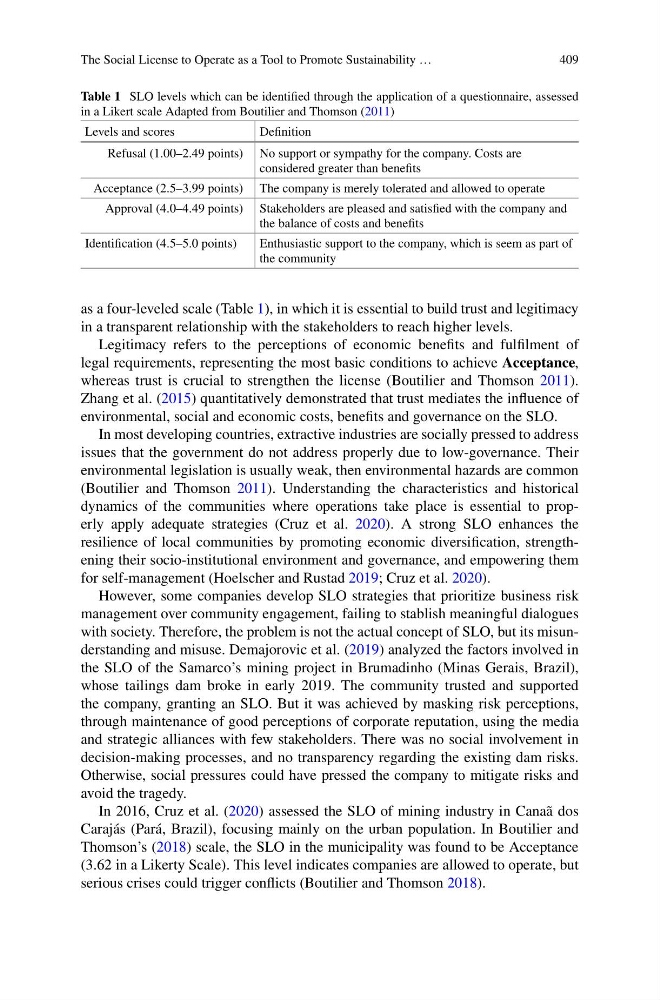
Table 1 SLO levels which can be identified through the application of a questionnaire, assessed
in a Likert scale Adapted from Boutilier and Thomson (2011)
Levels and scores
Definition
Refusal (1.00–2.49 points) No support or sympathy for the company. Costs are
considered greater than benefits
Acceptance (2.5–3.99 points) The company is merely tolerated and allowed to operate
Approval (4.0–4.49 points) Stakeholders are pleased and satisfied with the company and
the balance of costs and benefits
Identification (4.5–5.0 points)
Enthusiastic support to the company, which is seem as part of
the community
as a four-leveled scale (Table 1), in which it is essential to build trust and legitimacy
in a transparent relationship with the stakeholders to reach higher levels.
Legitimacy refers to the perceptions of economic benefits and fulfilment of
legal requirements, representing the most basic conditions to achieve Acceptance,
whereas trust is crucial to strengthen the license (Boutilier and Thomson 2011).
Zhang et al. (2015) quantitatively demonstrated that trust mediates the influence of
environmental, social and economic costs, benefits and governance on the SLO.
In most developing countries, extractive industries are socially pressed to address
issues that the government do not address properly due to low-governance. Their
environmental legislation is usually weak, then environmental hazards are common
(Boutilier and Thomson 2011). Understanding the characteristics and historical
dynamics of the communities where operations take place is essential to properly apply adequate strategies (Cruz et al. 2020). A strong SLO enhances the
resilience of local communities by promoting economic diversification, strengthening their socio-institutional environment and governance, and empowering them
for self-management (Hoelscher and Rustad 2019; Cruz et al. 2020).
However, some companies develop SLO strategies that prioritize business risk
management over community engagement, failing to stablish meaningful dialogues
with society. Therefore, the problem is not the actual concept of SLO, but its misunderstanding and misuse. Demajorovic et al. (2019) analyzed the factors involved in
the SLO of the Samarco’s mining project in Brumadinho (Minas Gerais, Brazil),
whose tailings dam broke in early 2019. The community trusted and supported
the company, granting an SLO. But it was achieved by masking risk perceptions,
through maintenance of good perceptions of corporate reputation, using the media
and strategic alliances with few stakeholders. There was no social involvement in
decision-making processes, and no transparency regarding the existing dam risks.
Otherwise, social pressures could have pressed the company to mitigate risks and
avoid the tragedy.
In 2016, Cruz et al. (2020) assessed the SLO of mining industry in Canaã dos
Carajás (Pará, Brazil), focusing mainly on the urban population. In Boutilier and
Thomson’s (2018) scale, the SLO in the municipality was found to be Acceptance
(3.62 in a Likerty Scale). This level indicates companies are allowed to operate, but
serious crises could trigger conflicts (Boutilier and Thomson 2018).
409
Table 1 SLO levels which can be identified through the application of a questionnaire, assessed
in a Likert scale Adapted from Boutilier and Thomson (2011)
Levels and scores
Definition
Refusal (1.00–2.49 points) No support or sympathy for the company. Costs are
considered greater than benefits
Acceptance (2.5–3.99 points) The company is merely tolerated and allowed to operate
Approval (4.0–4.49 points) Stakeholders are pleased and satisfied with the company and
the balance of costs and benefits
Identification (4.5–5.0 points)
Enthusiastic support to the company, which is seem as part of
the community
as a four-leveled scale (Table 1), in which it is essential to build trust and legitimacy
in a transparent relationship with the stakeholders to reach higher levels.
Legitimacy refers to the perceptions of economic benefits and fulfilment of
legal requirements, representing the most basic conditions to achieve Acceptance,
whereas trust is crucial to strengthen the license (Boutilier and Thomson 2011).
Zhang et al. (2015) quantitatively demonstrated that trust mediates the influence of
environmental, social and economic costs, benefits and governance on the SLO.
In most developing countries, extractive industries are socially pressed to address
issues that the government do not address properly due to low-governance. Their
environmental legislation is usually weak, then environmental hazards are common
(Boutilier and Thomson 2011). Understanding the characteristics and historical
dynamics of the communities where operations take place is essential to properly apply adequate strategies (Cruz et al. 2020). A strong SLO enhances the
resilience of local communities by promoting economic diversification, strengthening their socio-institutional environment and governance, and empowering them
for self-management (Hoelscher and Rustad 2019; Cruz et al. 2020).
However, some companies develop SLO strategies that prioritize business risk
management over community engagement, failing to stablish meaningful dialogues
with society. Therefore, the problem is not the actual concept of SLO, but its misunderstanding and misuse. Demajorovic et al. (2019) analyzed the factors involved in
the SLO of the Samarco’s mining project in Brumadinho (Minas Gerais, Brazil),
whose tailings dam broke in early 2019. The community trusted and supported
the company, granting an SLO. But it was achieved by masking risk perceptions,
through maintenance of good perceptions of corporate reputation, using the media
and strategic alliances with few stakeholders. There was no social involvement in
decision-making processes, and no transparency regarding the existing dam risks.
Otherwise, social pressures could have pressed the company to mitigate risks and
avoid the tragedy.
In 2016, Cruz et al. (2020) assessed the SLO of mining industry in Canaã dos
Carajás (Pará, Brazil), focusing mainly on the urban population. In Boutilier and
Thomson’s (2018) scale, the SLO in the municipality was found to be Acceptance
(3.62 in a Likerty Scale). This level indicates companies are allowed to operate, but
serious crises could trigger conflicts (Boutilier and Thomson 2018).