

“Beira Trilhos”: The Implementation of the Right to Housing …
403
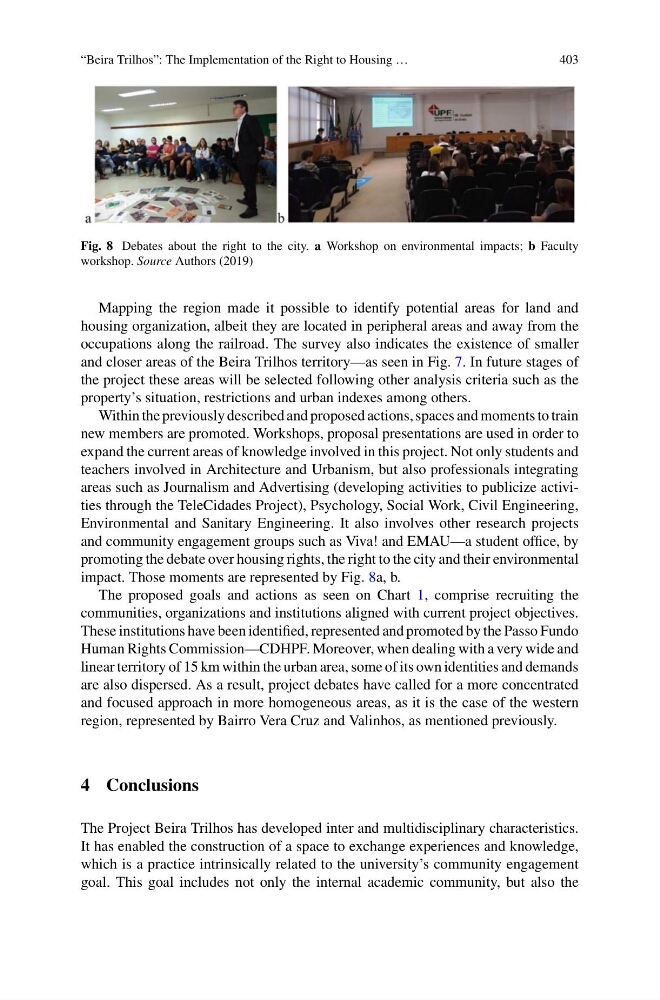
Fig. 8 Debates about the right to the city. a Workshop on environmental impacts; b Faculty
workshop. Source Authors (2019)
Mapping the region made it possible to identify potential areas for land and
housing organization, albeit they are located in peripheral areas and away from the
occupations along the railroad. The survey also indicates the existence of smaller
and closer areas of the Beira Trilhos territory—as seen in Fig. 7. In future stages of
the project these areas will be selected following other analysis criteria such as the
property’s situation, restrictions and urban indexes among others.
Within the previously described and proposed actions, spaces and moments to train
new members are promoted. Workshops, proposal presentations are used in order to
expand the current areas of knowledge involved in this project. Not only students and
teachers involved in Architecture and Urbanism, but also professionals integrating
areas such as Journalism and Advertising (developing activities to publicize activities through the TeleCidades Project), Psychology, Social Work, Civil Engineering,
Environmental and Sanitary Engineering. It also involves other research projects
and community engagement groups such as Viva! and EMAU—a student office, by
promoting the debate over housing rights, the right to the city and their environmental
impact. Those moments are represented by Fig. 8a, b.
The proposed goals and actions as seen on Chart 1, comprise recruiting the
communities, organizations and institutions aligned with current project objectives.
These institutions have been identified, represented and promoted by the Passo Fundo
Human Rights Commission—CDHPF. Moreover, when dealing with a very wide and
linear territory of 15 km within the urban area, some of its own identities and demands
are also dispersed. As a result, project debates have called for a more concentrated
and focused approach in more homogeneous areas, as it is the case of the western
region, represented by Bairro Vera Cruz and Valinhos, as mentioned previously.
4 Conclusions
The Project Beira Trilhos has developed inter and multidisciplinary characteristics.
It has enabled the construction of a space to exchange experiences and knowledge,
which is a practice intrinsically related to the university’s community engagement
goal. This goal includes not only the internal academic community, but also the
403
Fig. 8 Debates about the right to the city. a Workshop on environmental impacts; b Faculty
workshop. Source Authors (2019)
Mapping the region made it possible to identify potential areas for land and
housing organization, albeit they are located in peripheral areas and away from the
occupations along the railroad. The survey also indicates the existence of smaller
and closer areas of the Beira Trilhos territory—as seen in Fig. 7. In future stages of
the project these areas will be selected following other analysis criteria such as the
property’s situation, restrictions and urban indexes among others.
Within the previously described and proposed actions, spaces and moments to train
new members are promoted. Workshops, proposal presentations are used in order to
expand the current areas of knowledge involved in this project. Not only students and
teachers involved in Architecture and Urbanism, but also professionals integrating
areas such as Journalism and Advertising (developing activities to publicize activities through the TeleCidades Project), Psychology, Social Work, Civil Engineering,
Environmental and Sanitary Engineering. It also involves other research projects
and community engagement groups such as Viva! and EMAU—a student office, by
promoting the debate over housing rights, the right to the city and their environmental
impact. Those moments are represented by Fig. 8a, b.
The proposed goals and actions as seen on Chart 1, comprise recruiting the
communities, organizations and institutions aligned with current project objectives.
These institutions have been identified, represented and promoted by the Passo Fundo
Human Rights Commission—CDHPF. Moreover, when dealing with a very wide and
linear territory of 15 km within the urban area, some of its own identities and demands
are also dispersed. As a result, project debates have called for a more concentrated
and focused approach in more homogeneous areas, as it is the case of the western
region, represented by Bairro Vera Cruz and Valinhos, as mentioned previously.
4 Conclusions
The Project Beira Trilhos has developed inter and multidisciplinary characteristics.
It has enabled the construction of a space to exchange experiences and knowledge,
which is a practice intrinsically related to the university’s community engagement
goal. This goal includes not only the internal academic community, but also the