

Sustainability in Logistic Systems: An Analysis of Articles Published …
323
presented above, companies present relevant challenges in adapting their operations
to sustainability standards (El-Berishy et al. 2013).
From the works of Tan et al. (2019), Wang (2019), Sadeghi and Haapala (2019),
Govindan et al. (2019), it is possible to observe that, in general, the debates about
the insertion of sustainability in the logistics systems are growing and considering an
increasing number of sectors, which justifies the need for more events and research
in the area.
3 Methodology
To achieve the objective presented in the introductory section, a systematic literature
review was carried out following the guidelines proposed by Xavier et al. (2017).
According to these authors, a systematic literature review should follow the following
steps: (a) formulation of the research question; (b) location of studies; (c) selection
and evaluation of studies; (d) analysis and synthesis; (e) reporting and using research
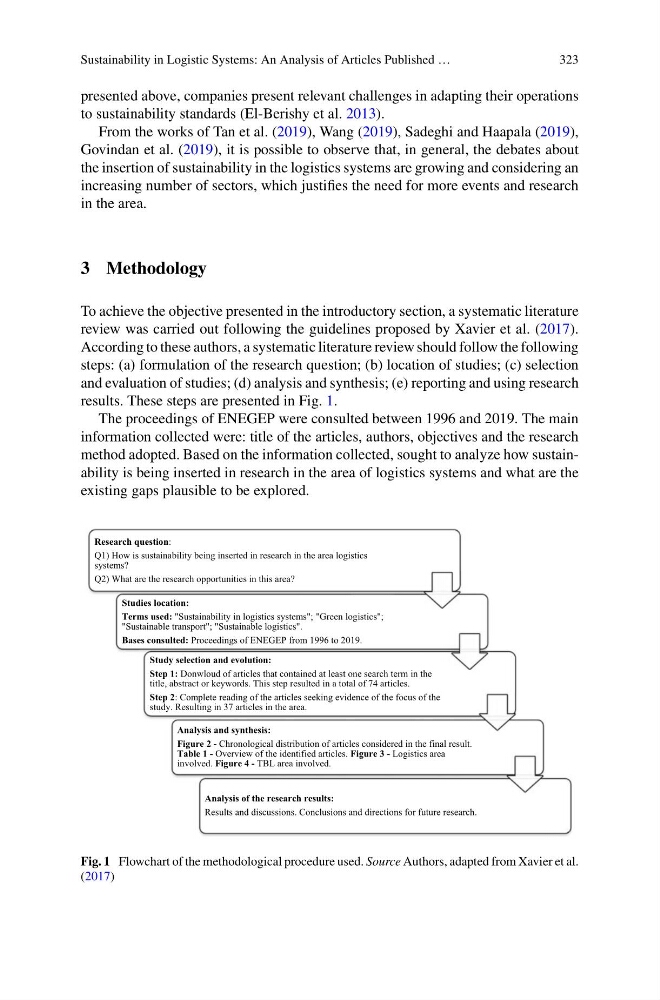
results. These steps are presented in Fig. 1.
The proceedings of ENEGEP were consulted between 1996 and 2019. The main
information collected were: title of the articles, authors, objectives and the research
method adopted. Based on the information collected, sought to analyze how sustainability is being inserted in research in the area of logistics systems and what are the
existing gaps plausible to be explored.
Research question:
Q1) How is sustainability being inserted in research in the area logistics
systems?
Q2) What are the research opportunities in this area?
Studies location:
Terms used: "Sustainability in logistics systems"; "Green logistics";
"Sustainable transport"; "Sustainable logistics".
Bases consulted: Proceedings of ENEGEP from 1996 to 2019.
Study selection and evolution:
Step 1: Donwloud of articles that contained at least one search term in the
title, abstract or keywords. This step resulted in a total of 74 articles.
Step 2: Complete reading of the articles seeking evidence of the focus of the
study. Resulting in 37 articles in the area.
Analysis and synthesis:
Figure 2 - Chronological distribution of articles considered in the final result.
Table 1 - Overview of the identified articles. Figure 3 - Logistics area
involved. Figure 4 - TBL area involved.
Analysis of the research results:
Results and discussions. Conclusions and directions for future research.
Fig. 1 Flowchart of the methodological procedure used. Source Authors, adapted from Xavier et al.
(2017)
323
presented above, companies present relevant challenges in adapting their operations
to sustainability standards (El-Berishy et al. 2013).
From the works of Tan et al. (2019), Wang (2019), Sadeghi and Haapala (2019),
Govindan et al. (2019), it is possible to observe that, in general, the debates about
the insertion of sustainability in the logistics systems are growing and considering an
increasing number of sectors, which justifies the need for more events and research
in the area.
3 Methodology
To achieve the objective presented in the introductory section, a systematic literature
review was carried out following the guidelines proposed by Xavier et al. (2017).
According to these authors, a systematic literature review should follow the following
steps: (a) formulation of the research question; (b) location of studies; (c) selection
and evaluation of studies; (d) analysis and synthesis; (e) reporting and using research
results. These steps are presented in Fig. 1.
The proceedings of ENEGEP were consulted between 1996 and 2019. The main
information collected were: title of the articles, authors, objectives and the research
method adopted. Based on the information collected, sought to analyze how sustainability is being inserted in research in the area of logistics systems and what are the
existing gaps plausible to be explored.
Research question:
Q1) How is sustainability being inserted in research in the area logistics
systems?
Q2) What are the research opportunities in this area?
Studies location:
Terms used: "Sustainability in logistics systems"; "Green logistics";
"Sustainable transport"; "Sustainable logistics".
Bases consulted: Proceedings of ENEGEP from 1996 to 2019.
Study selection and evolution:
Step 1: Donwloud of articles that contained at least one search term in the
title, abstract or keywords. This step resulted in a total of 74 articles.
Step 2: Complete reading of the articles seeking evidence of the focus of the
study. Resulting in 37 articles in the area.
Analysis and synthesis:
Figure 2 - Chronological distribution of articles considered in the final result.
Table 1 - Overview of the identified articles. Figure 3 - Logistics area
involved. Figure 4 - TBL area involved.
Analysis of the research results:
Results and discussions. Conclusions and directions for future research.
Fig. 1 Flowchart of the methodological procedure used. Source Authors, adapted from Xavier et al.
(2017)