

290
M. L. M. Bernartt et al.
analyze its composition by a specialized company. Two reports were made, with two
samples, the first is all tailings except plastics, and the second is only for the plastics.
All parameters in the two reports were within the permitted limits. Thus, the sample
was approved, and the material is fit to be used for co-processing.
To introduce co-process in ARLeV, it is necessary to separate the tailings since
initially it may present an organic part and sometimes hazardous waste. The work for
the association would increase. It would be necessary that the same employees who
perform the screening, also separate the tailings, taking out the organic and dangerous
parts. Another option is at the end of the conveyor another member will be responsible
only for the separation of the material that can be used for co-processing, letting the
rest of the materials that cannot be co-processed continue on the conveyor until the
tailings big bag, as it is the current case. It is also necessary to instruct them correctly,
explaining what co-processing is, which materials are allowed and not allowed. No
new equipment is required.
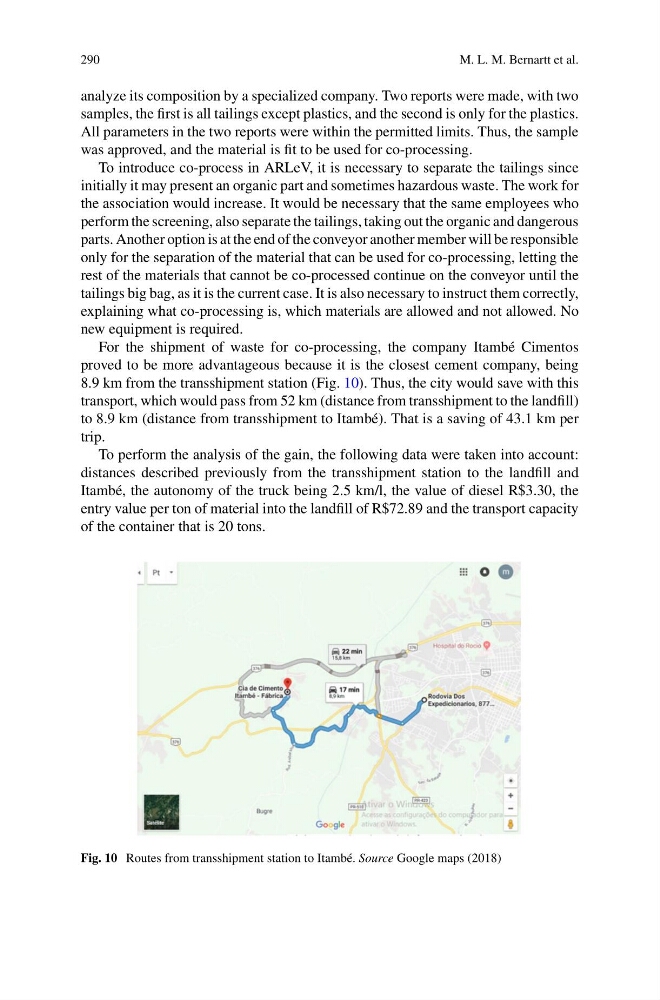
For the shipment of waste for co-processing, the company Itambé Cimentos
proved to be more advantageous because it is the closest cement company, being
8.9 km from the transshipment station (Fig. 10). Thus, the city would save with this
transport, which would pass from 52 km (distance from transshipment to the landfill)
to 8.9 km (distance from transshipment to Itambé). That is a saving of 43.1 km per
trip.
To perform the analysis of the gain, the following data were taken into account:
distances described previously from the transshipment station to the landfill and
Itambé, the autonomy of the truck being 2.5 km/l, the value of diesel R$3.30, the
entry value per ton of material into the landfill of R$72.89 and the transport capacity
of the container that is 20 tons.
Fig. 10 Routes from transshipment station to Itambé. Source Google maps (2018)
M. L. M. Bernartt et al.
analyze its composition by a specialized company. Two reports were made, with two
samples, the first is all tailings except plastics, and the second is only for the plastics.
All parameters in the two reports were within the permitted limits. Thus, the sample
was approved, and the material is fit to be used for co-processing.
To introduce co-process in ARLeV, it is necessary to separate the tailings since
initially it may present an organic part and sometimes hazardous waste. The work for
the association would increase. It would be necessary that the same employees who
perform the screening, also separate the tailings, taking out the organic and dangerous
parts. Another option is at the end of the conveyor another member will be responsible
only for the separation of the material that can be used for co-processing, letting the
rest of the materials that cannot be co-processed continue on the conveyor until the
tailings big bag, as it is the current case. It is also necessary to instruct them correctly,
explaining what co-processing is, which materials are allowed and not allowed. No
new equipment is required.
For the shipment of waste for co-processing, the company Itambé Cimentos
proved to be more advantageous because it is the closest cement company, being
8.9 km from the transshipment station (Fig. 10). Thus, the city would save with this
transport, which would pass from 52 km (distance from transshipment to the landfill)
to 8.9 km (distance from transshipment to Itambé). That is a saving of 43.1 km per
trip.
To perform the analysis of the gain, the following data were taken into account:
distances described previously from the transshipment station to the landfill and
Itambé, the autonomy of the truck being 2.5 km/l, the value of diesel R$3.30, the
entry value per ton of material into the landfill of R$72.89 and the transport capacity
of the container that is 20 tons.
Fig. 10 Routes from transshipment station to Itambé. Source Google maps (2018)