

282
M. L. M. Bernartt et al.
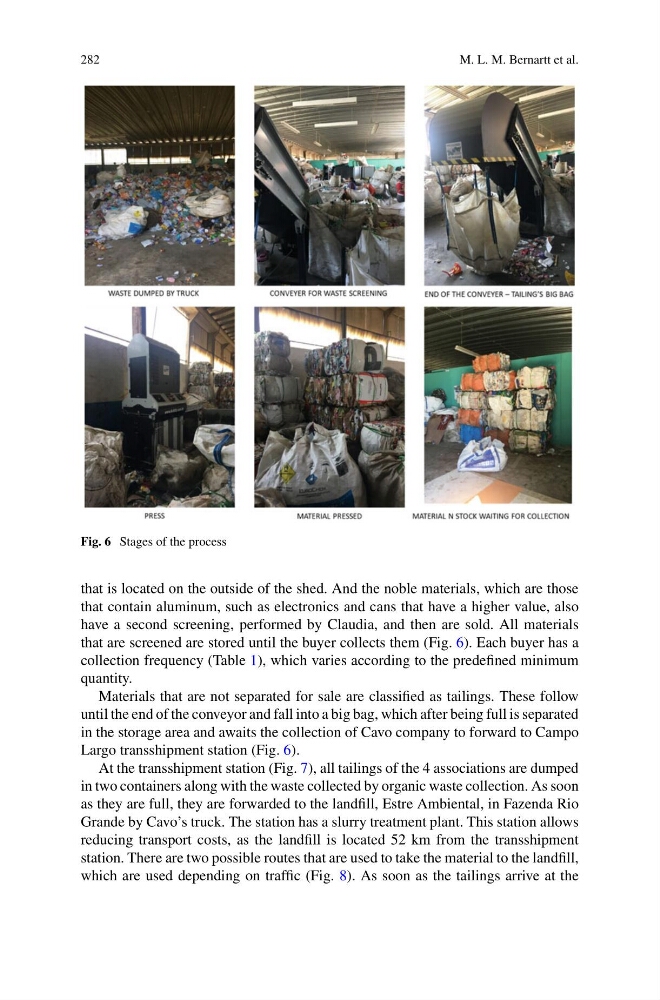
Fig. 6 Stages of the process
that is located on the outside of the shed. And the noble materials, which are those
that contain aluminum, such as electronics and cans that have a higher value, also
have a second screening, performed by Claudia, and then are sold. All materials
that are screened are stored until the buyer collects them (Fig. 6). Each buyer has a
collection frequency (Table 1), which varies according to the predefined minimum
quantity.
Materials that are not separated for sale are classified as tailings. These follow
until the end of the conveyor and fall into a big bag, which after being full is separated
in the storage area and awaits the collection of Cavo company to forward to Campo
Largo transshipment station (Fig. 6).
At the transshipment station (Fig. 7), all tailings of the 4 associations are dumped
in two containers along with the waste collected by organic waste collection. As soon
as they are full, they are forwarded to the landfill, Estre Ambiental, in Fazenda Rio
Grande by Cavo’s truck. The station has a slurry treatment plant. This station allows
reducing transport costs, as the landfill is located 52 km from the transshipment
station. There are two possible routes that are used to take the material to the landfill,
which are used depending on traffic (Fig. 8). As soon as the tailings arrive at the
M. L. M. Bernartt et al.
Fig. 6 Stages of the process
that is located on the outside of the shed. And the noble materials, which are those
that contain aluminum, such as electronics and cans that have a higher value, also
have a second screening, performed by Claudia, and then are sold. All materials
that are screened are stored until the buyer collects them (Fig. 6). Each buyer has a
collection frequency (Table 1), which varies according to the predefined minimum
quantity.
Materials that are not separated for sale are classified as tailings. These follow
until the end of the conveyor and fall into a big bag, which after being full is separated
in the storage area and awaits the collection of Cavo company to forward to Campo
Largo transshipment station (Fig. 6).
At the transshipment station (Fig. 7), all tailings of the 4 associations are dumped
in two containers along with the waste collected by organic waste collection. As soon
as they are full, they are forwarded to the landfill, Estre Ambiental, in Fazenda Rio
Grande by Cavo’s truck. The station has a slurry treatment plant. This station allows
reducing transport costs, as the landfill is located 52 km from the transshipment
station. There are two possible routes that are used to take the material to the landfill,
which are used depending on traffic (Fig. 8). As soon as the tailings arrive at the